
 3302 Westgrove Drive Arlington, TX 76001


Some propane grills can be converted to natural gas. It only works if the manufacturer sells a conversion kit for your exact model, and only if a licensed gas professional installs it. A real conversion swaps every burner orifice and the regulator. Weber does not allow conversions on any of its grills. Most built-in brands do.
We get this question constantly from homeowners in Frisco, Prosper, McKinney, and Allen. New construction here almost always includes a natural gas stub-out on the patio. You look at that capped line, then at the propane tank you’ve been hauling to the hardware store twice a summer, and the math seems obvious.
It usually is. But the conversion is not a fitting swap, and the shortcut versions of this job are the ones that scare us.
Can you actually convert a propane grill to natural gas?
Only if your grill’s manufacturer builds a conversion kit for your specific model number. There is no universal answer by brand, and there is no safe universal kit.
Blaze, Lynx, DCS, Fire Magic, Coyote, Alfresco, Summerset, and Bull all sell model-specific LP-to-NG conversion kits. Weber does not. According to Weber’s own support guidance, the company does not offer conversion kits for its gas grills, and converting one voids the warranty and can create an unsafe grill. If you own a Genesis or a Spirit and you want natural gas, Weber’s answer is to buy the natural gas version of that grill.
Check your model number first. On most built-ins the rating plate is on the underside of the control panel or inside the cart door. That plate tells you what fuel the grill was built and certified for.
What’s physically different between a propane grill and a natural gas grill?
Two things: orifice size and regulated pressure. Everything else on the grill is usually identical.
An orifice is the small brass fitting where gas enters each burner’s venturi tube. The hole drilled through it meters the fuel. Propane carries far more energy per unit of volume than natural gas, so a propane orifice has a much smaller hole. Run natural gas through a propane orifice and the burner starves. Run propane through a natural gas orifice and you get a fireball.
The pressure side matters just as much. According to the Blaze Professional grill manual, a Blaze grill on natural gas requires a regulator set for 4 inches of water column, while the same grill on liquid propane requires a regulator set for 11 inches of water column. Different fuel, different regulator. You cannot reuse the old one.
The energy difference is why. The U.S. Energy Information Administration puts natural gas at roughly 1,036 Btu per cubic foot and propane at 91,452 Btu per gallon. Per cubic foot of vapor, propane is in a completely different range. The grill has to be re-metered to compensate.
| Component | Liquid propane setup | Natural gas setup |
|---|---|---|
| Burner orifices | Small drilled hole | Noticeably larger hole |
| Regulator setting (Blaze Pro) | 11 in. water column | 4 in. water column |
| Fuel source | 20 lb tank or bulk LP tank | Hard-piped house line |
| Supply hose | Rubber LP hose with QCC fitting | 1/2 in. or 3/4 in. gas line, often with a quick-disconnect |
| Rear and side burners | Own orifice, own size | Own orifice, own size |
What does a correct propane-to-natural-gas conversion involve?
Five steps, and a licensed gas professional should do all of them. Blaze states plainly in its documentation that gas conversions must be performed by a qualified technician.
- Confirm the grill is listed as convertible. Find the model number on the rating plate and check the manufacturer’s parts list for a kit built for that model.
- Get the manufacturer’s kit. It contains an orifice for every burner on the grill, including the rear rotisserie burner and any side or sear burner, plus the correct natural gas regulator.
- Have a licensed plumber run and pressure-test the gas line. The patio stub-out on a new build is usually capped and not sized for a 90,000 Btu grill. Line sizing is a code question, not a preference.
- Swap every orifice and the regulator. Miss one burner and that burner runs wrong for the life of the grill.
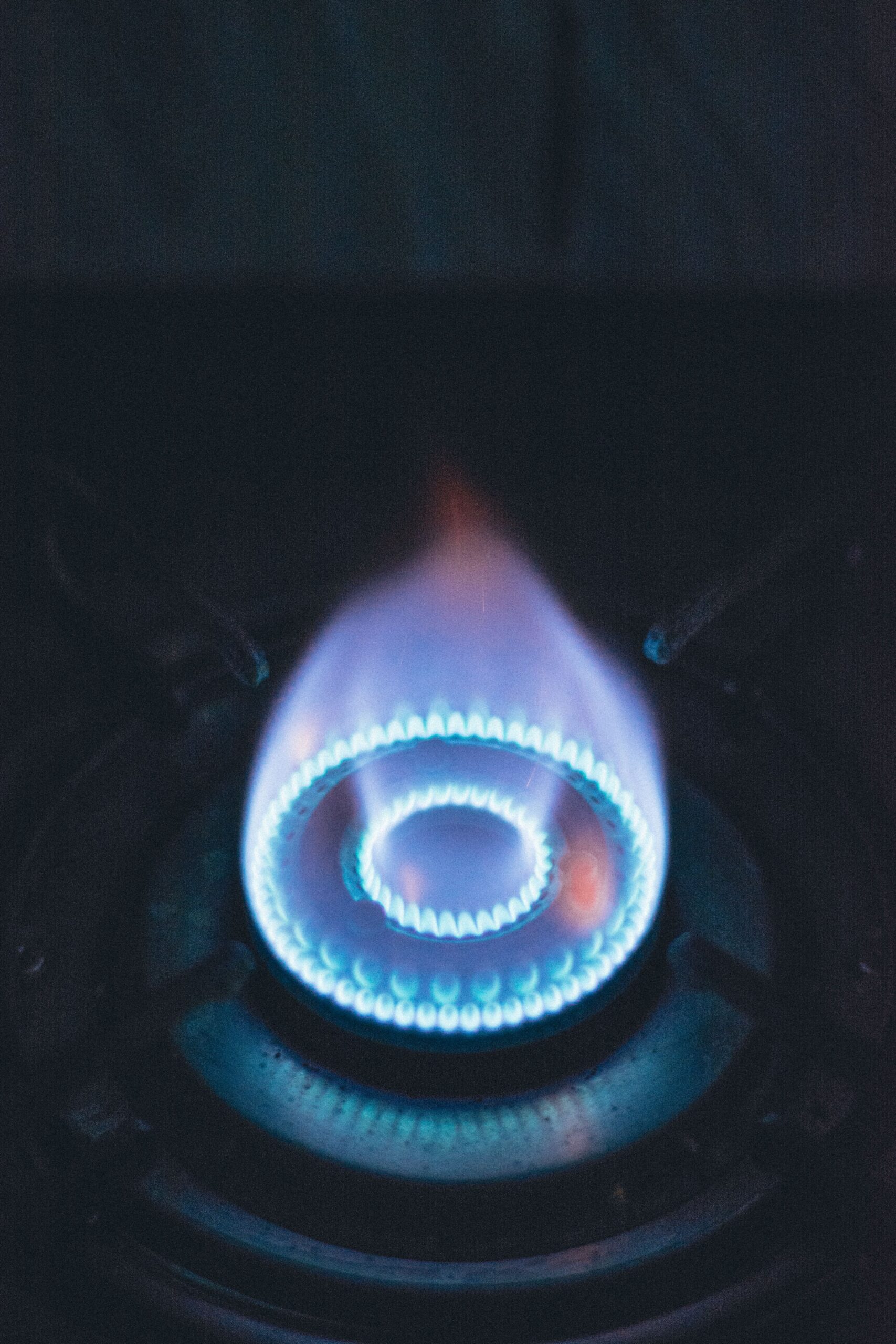
- Leak-test and check the flame. Soapy water on every joint, then light each burner. A correctly converted burner shows a steady blue flame with a small inner cone. Yellow, lazy, or lifting flames mean something is off.
That last step is not a formality. Flame color is the fastest read on whether a conversion was done right. If you’re not sure what you’re looking at, our guide on what a yellow burner flame is telling you walks through it.
What goes wrong when a grill is converted the wrong way?
The failures we see in the field are almost always one of three things: the wrong orifice size, a reused propane regulator, or a partial conversion where the side burner got skipped.
An undersized orifice on natural gas gives you a grill that never gets past 400 degrees, no matter how long you preheat. Homeowners usually blame the burners and replace them. The burners were fine. If your grill is struggling to hold heat, our breakdown of why a grill won’t get hot on one side covers the other common causes.
The opposite mistake is worse. Too much fuel for the orifice means incomplete combustion, sooty yellow flames, carbon building fast on the flame tamers and the inside of the lid, and food that picks up a bitter taste. Heavy soot is also a sign you’re producing more carbon monoxide than that burner should.
Then there’s the third-party kit problem. The listings you find online promise to fit “most” grills. A bag of generic orifices is not a conversion kit. Orifice sizing is model-specific because burner Btu ratings are model-specific.
Is natural gas actually worth switching to?
For a built-in grill in an outdoor kitchen, usually yes. For a portable cart grill, usually no.
Natural gas means you never run out mid-cook, and per Btu it’s typically cheaper than tank propane in North Texas. The tradeoff is that the grill is now tethered to the house. You also pay for the conversion kit and the plumber.
Here’s the part nobody wants to hear: if your grill is more than eight or nine years old, or the firebox is already showing rust-through, spending several hundred dollars on a conversion and a gas line is money going into a grill that’s near the end. We wrote a whole piece on whether to repair or replace a built-in grill that covers how to judge the firebox.
And if you smell gas at any point during or after a conversion, stop. Shut the supply valve and read our guide on finding a propane or gas leak safely before you light anything.
What we see in DFW outdoor kitchens
Most of the conversion problems that land on our schedule aren’t dramatic. They’re grills that have quietly run wrong for two or three seasons. Sooty lids, flame tamers caked black, one burner that’s always been weaker than the rest. The owner assumed that’s just how the grill cooks.
A deep clean often exposes it. When we pull the grates and diffusers and see uneven carbon patterns burner to burner, that’s a fuel delivery story, not a cleaning story. Our grill restoration and deep cleaning service starts at $239, and we check burner flames and orifice condition as part of it. If something’s wrong on the gas side, our gas grill repair team handles the grill-side components.
To be straight with you: we don’t run gas lines. That’s a licensed plumber’s work. We handle the grill.
Frequently asked questions
Can I use a universal propane-to-natural-gas conversion kit I found online?
No. Orifice hole size is calculated from each burner’s Btu rating, and those ratings differ by model. A generic kit either starves the burner or overfeeds it. Manufacturers build kits per model for that reason. Using a third-party kit also voids most warranties and can leave you uninsured if something goes wrong.
Does converting my grill void the warranty?
It depends on the brand. Using the manufacturer’s own kit, installed by a qualified technician, usually keeps the warranty intact. Weber is the clear exception. Weber does not sell conversion kits and states that converting a grill voids its warranty. Check your specific brand’s policy in writing before you buy parts.
How do I know if my grill is natural gas convertible?
Find the rating plate, usually under the control panel or inside the cart door, and note the full model number. Then search the manufacturer’s parts catalog or call their support line with that number. If a kit exists for your model, they’ll tell you the part number. If none exists, the grill isn’t convertible.
Do I need a plumber to run the gas line to my patio?
Yes. Gas line sizing and installation are regulated work in Texas, and a grill can pull 60,000 to 100,000 Btu. Undersized line causes low pressure and weak flames even with a perfect conversion. Many DFW new builds have a capped stub-out already, but it still needs to be verified, sized, and pressure-tested.
Will my grill get less hot on natural gas?
It shouldn’t. A properly converted grill hits the same temperatures on natural gas as it did on propane, because the larger orifice delivers the same Btu at lower pressure. If your grill runs cooler after a conversion, that points to an undersized orifice, an undersized gas line, or a regulator that wasn’t changed.
Can I convert a natural gas grill back to propane?
Often yes, and it’s the same process in reverse. Brands like Blaze sell NG-to-LP kits with smaller orifices and an 11 inch water column propane regulator. The same rules apply: manufacturer kit only, qualified installer, every burner converted, and a full leak test before the first cook.
How often should a converted grill be cleaned?
The same as any gas grill, so once or twice a year for a professional deep clean depending on use. There’s one extra reason to stay on schedule after a conversion, though. Carbon buildup patterns are the earliest visible sign that a burner is running rich, and a clean firebox makes that easy to spot.
Get your grill checked by people who work on them daily
If your grill has been converted and something feels off, or you’re deciding whether a conversion makes sense at all, we can look at it. We service Frisco, Plano, and the rest of the Metroplex. Full coverage is on our service areas page, and current rates are on the pricing page.
Book an appointment online or call (817) 791-4606 for a free estimate.
Texas Grill Clean is the grill cleaning, repair, and restoration division of 1st Choice Residential. Veteran-owned, locally owned, licensed and insured, serving Dallas–Fort Worth since 2009. 3302 Westgrove Drive, Arlington, TX 76001 · (817) 791-4606 · jeff@texasgrillclean.com