
 3302 Westgrove Drive Arlington, TX 76001


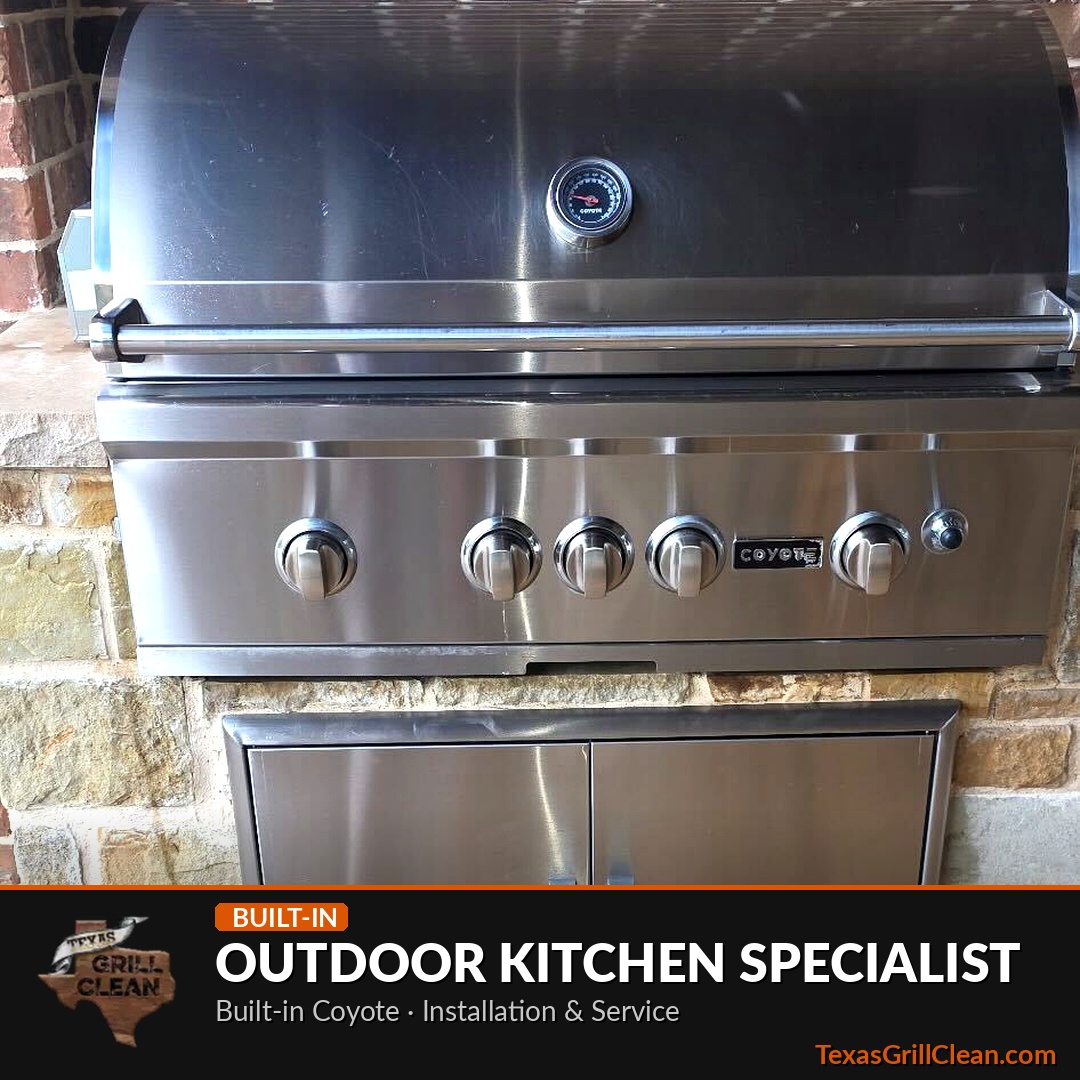
Repair a built-in grill when the firebox is solid and the failure is a wear part: burners, igniters, flame tamers, valves, or grates. Replace the grill head when the firebox has rusted through, cracked at the welds, or the model is old enough that parts are gone. The firebox is the deciding factor, not the age.
Built-in grills in Grapevine, Colleyville, and Southlake outdoor kitchens fail in a specific order. Knowing that order saves people thousands of dollars.
What actually breaks first on a built-in grill?
Burners and igniters go first. The firebox goes last. On almost every built-in we open up, the failures stack in the same order: electrode and igniter module, then flame tamers or briquette trays, then burners, then valves and the manifold, and finally the firebox shell.
Everything on that list except the last item is a bolt-in part. A tech can pull a burner, clear a venturi, swap an orifice, or replace an electrode without touching the masonry. Once the firebox floor rusts through, you’re past repair.
Our crews get the same call all over North Texas. A five-year-old grill won’t light and heats unevenly, so the owner assumes it’s finished. Usually it’s a clogged burner port and a dead electrode.
How do I tell if the firebox is done?
Press a screwdriver against the firebox floor and the lower back wall. If it flexes, flakes, or punches through, the firebox is done. Surface rust is cosmetic. Perforation is structural.
Grade of stainless matters more than brand name here. According to AmazingRibs.com, 304 stainless contains roughly 18% chromium and 8% nickel, while 430 contains chromium and no nickel. That nickel holds the passive layer together through wet-dry cycles, so a 430 firebox rusts years earlier than a 304 firebox in the same backyard. If a refrigerator magnet grabs the wall hard, you’re probably looking at 430.
Does the warranty still cover it if I bought the house with the grill already in it?
Usually not. Most premium grill warranties cover only the original purchaser and don’t transfer with the home. This catches a lot of people who bought a Grapevine or Colleyville house with the outdoor kitchen already built.
According to the Lynx limited warranty, coverage “applies only to the original purchaser and may not be transferred.” That same document gives a limited lifetime warranty on the stainless grill body, ProSear burner, and rotisserie infrared burner; 12 years on tubular stainless main burners; five years on grates, manifolds, and gas valves; and two years on everything else. It excludes surface corrosion and discoloration, and it doesn’t cover a service call to diagnose the problem.
Blaze structures it differently. Per Blaze Grills, stainless components including burners, housing, heat zone separators, control valves, and flame tamers carry a lifetime warranty, while ignition and electrical parts get one year. Blaze requires registration within 30 days of purchase.
Read your own paperwork before you buy anything. A part you were about to pay for may be free.
Repair or replace: how do the two compare?
Repair wins when the problem is a consumable part. Replacement wins when the shell, the fit, or the parts supply has failed.
| Situation | What it usually means | Repair or replace |
|---|---|---|
| Won’t light, sparks fine | Clogged burner ports, bad orifice, gas supply issue | Repair |
| Sparks weak or dead | Electrode, igniter module, or battery | Repair |
| Hot on one side, cold on the other | Blocked venturi, spider web in the burner tube, warped flame tamer | Repair |
| Rust holes in the firebox floor | Shell failure, grease draining into the island | Replace |
| Cracked welds at the firebox corners | Metal fatigue, thin-gauge construction | Replace |
| Discontinued brand, no parts available | Nothing to repair with | Replace |
| 15+ years old, failing everywhere at once | End of service life | Replace |
Most of that table lands in the repair column, which matches what we find in the field.
How do I measure a built-in grill island for a replacement head?
Measure the cutout opening, not the old grill. As BBQGuys notes in its cutout guide, built-in grills aren’t standardized between brands, and even 30-inch and 36-inch models from the same manufacturer can need different cutouts, ventilation, and clearance to combustibles.
- Shut the gas off at the valve, then pull the old grill head out of the island.
- Measure the cutout width, left edge to right edge of the opening.
- Measure the cutout depth, front edge to back edge.
- Measure the cutout height, bottom ledge to top of the opening.
- Note whether the island is masonry or wood framed. A combustible island needs an insulated jacket matched to that specific grill.
- Check the gas line size and shutoff location. A bigger grill may need a bigger supply line.
- Compare all of it to the manufacturer’s published cutout spec for the model you want.
Get this wrong and you’re paying a mason to cut stone. That’s usually what pushes replacement past the cost of repair.
Does letting a grill stay dirty actually shorten its life?
Yes, and it raises fire risk at the same time. Baked grease traps moisture against the firebox floor, which is exactly where rust-through starts. It also plugs burner ports and venturi tubes, causing the uneven heating people mistake for a dying grill.
According to the National Fire Protection Association, U.S. fire departments responded to an annual average of 12,141 home fires involving grills between 2020 and 2024, and failure to clean the grill was the leading contributing factor, at about 20% of those fires.
A grill cleaned once or twice a year rarely loses its firebox early. One that never gets cleaned often does in under a decade. Our professional grill cleaning and grill restoration and deep cleaning both include an inspection of the burners, valves, and firebox, so you know where you stand before buying a new grill. Deep cleans start at $239. Current rates are on our pricing page.
What if it’s failing in more than one place at once?
Add up the parts. If the repair approaches half the cost of a comparable new grill head and the firebox is already thin, replace it.
One dead burner on a Blaze, Bull, Coyote, Summerset, or Napoleon built-in is a straightforward fix. Three dead burners plus a leaking manifold plus a firebox you can flex with your thumb is finished. When the problem is mechanical, our gas grill repair service covers burners, igniters, valves, and gas lines. When it cleans up but looks rough, stainless steel restoration is the better spend.
Frequently asked questions
How long should a built-in grill last?
A 304 stainless built-in cleaned once or twice a year commonly runs 15 to 20 years, with burners and igniters replaced along the way. A thinner 430 unit that never gets serviced can lose its firebox in seven to ten years in North Texas humidity. Cleaning frequency and stainless grade matter more than the price tag.
Can I replace just the burners in a built-in grill?
Yes, on most brands. Burners are bolt-in parts and among the most commonly replaced items on any gas grill. The job also means checking the venturi tubes, orifices, and air shutter settings, since a new burner on a clogged venturi fails the same way the old one did.
Will a new grill head fit my existing outdoor kitchen island?
Only if the cutout dimensions match. Built-in cutouts are not standardized across brands, and depth and height requirements differ even within one manufacturer’s lineup. Measure the opening itself, then compare it to the published cutout spec for the model you want before ordering.
Does grill warranty coverage transfer when I sell my house?
Generally no. Lynx states plainly that its warranty applies only to the original purchaser and may not be transferred. Other premium brands are structured the same way. If you bought a home with the outdoor kitchen already installed, assume you’re out of warranty and budget accordingly.
Is surface rust on a built-in grill a reason to replace it?
No. Surface rust and discoloration are cosmetic and are specifically excluded from most manufacturer warranties for that reason. What matters is whether the metal is perforated. Rust you can polish off is maintenance. Rust you can push a screwdriver through is replacement.
Why does my built-in grill heat unevenly on one side?
Almost always a blocked burner. Grease and carbon plug the burner ports, and spiders build webs inside the venturi tubes, starving that burner of gas and air. Warped flame tamers scatter what heat is left. In the large majority of cases this is a repair, not a replacement.
Do you service built-in grills across DFW?
Yes. Texas Grill Clean services built-in islands and cart grills across the Metroplex, including Grapevine, Colleyville, Southlake, Keller, Plano, Frisco, Dallas, Fort Worth, and Arlington. The full coverage map is on our service areas page.
Find out what you have before you buy a new grill
Most people who call us convinced their built-in is dead need a deep clean and two parts. A few have a firebox that’s genuinely gone. We’ll open it up, show you the metal, and tell you which one you have. Related reading: how to clean gas grill burners and the spider problem in DFW gas grills.
Book an appointment online or call (817) 791-4606. Deep cleaning starts at $239, estimates are free, and we’re licensed and insured. More answers on our FAQ page.
Texas Grill Clean is the grill cleaning, repair, and restoration division of 1st Choice Residential. Veteran-owned, locally owned rather than a franchise, and serving Dallas–Fort Worth since 2009. 3302 Westgrove Drive, Arlington, TX 76001 · (817) 791-4606 · jeff@texasgrillclean.com