
 3302 Westgrove Drive Arlington, TX 76001


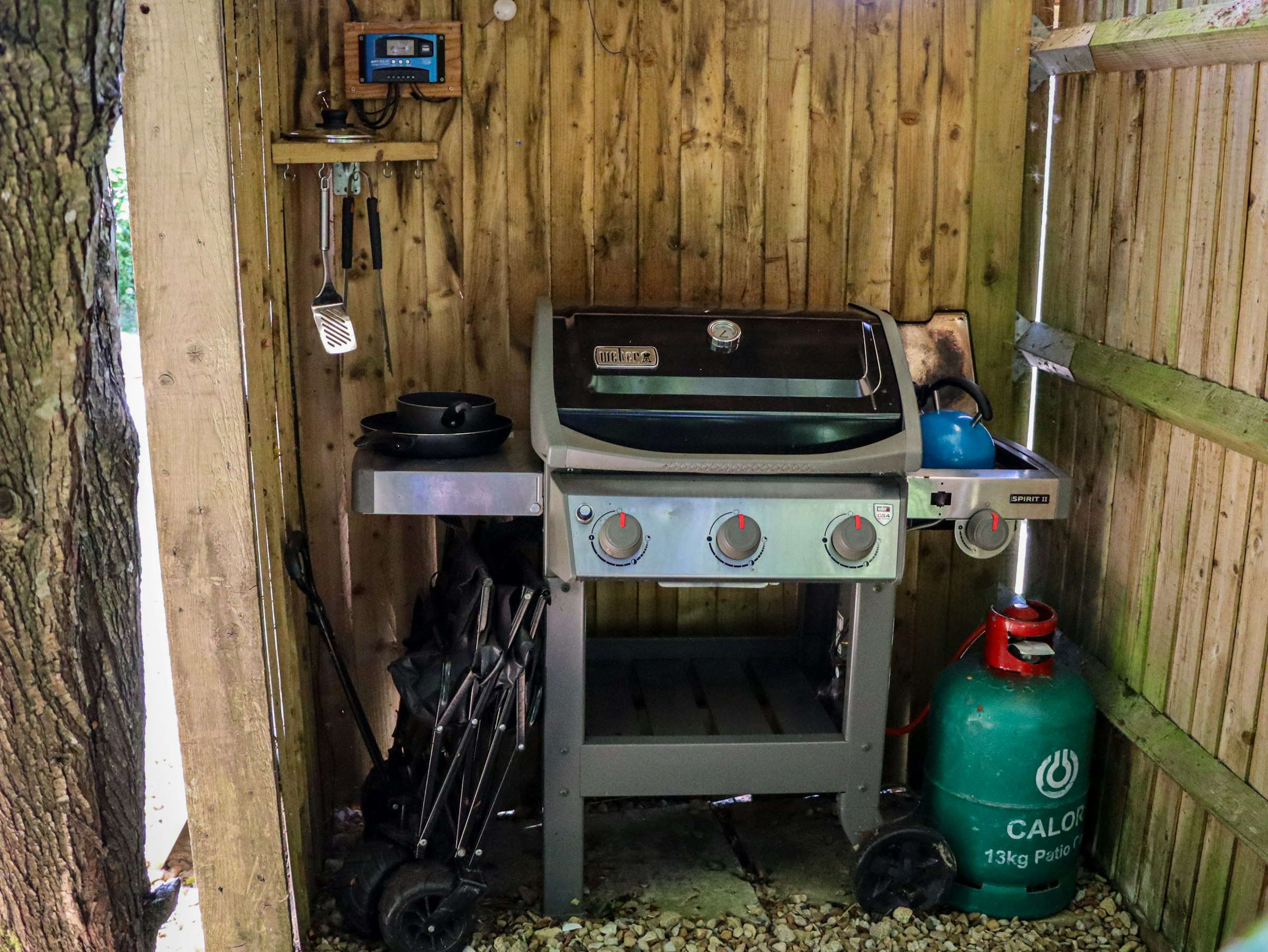
If your grill smells like propane, shut the tank valve off before you do anything else. A gas odor at a grill almost always traces to one of four places: the tank valve connection, the regulator and hose, the manifold behind the control panel, or a burner valve. A soapy water test finds it in about five minutes. Never use a lighter or a flame to hunt for a leak.
We see this call every summer across Fort Worth, Arlington, and the rest of the Metroplex. Homeowner lifts the lid, catches a whiff of rotten eggs, and isn’t sure whether it’s a real problem or just the grill being a grill. There’s a straightforward way to tell.
What does a propane leak actually smell like?
Propane leaks smell like rotten eggs or rotten cabbage, because that odor is added on purpose. Propane itself has no smell. According to NIOSH, ethyl mercaptan is the sulfur compound added to propane and n-butane specifically to give it a distinct odor, and it’s described as smelling like a rotten egg or rotten cabbage.
That’s a different smell from the other odors your grill produces. Burning grease smells sharp and acrid. A rodent nest in the cabinet smells musty. Old carbon flaking off the flame tamers smells like a campfire that went out. Mercaptan smells like something spoiled.
Where do grill gas leaks usually come from?
The tank coupling and the hose account for most leaks a homeowner will find, and the manifold accounts for most of the ones they won’t. Location tells you a lot before you ever pick up a brush.
| Where you smell it | What it usually means | What it takes to fix |
|---|---|---|
| At the tank, strongest with burners off | Loose or cross-threaded QCC-1 coupling, or a cracked rubber seal in the connector | Re-thread by hand; replace the connector if the seal is dry or split |
| Along the hose run | Heat-hardened hose, cracking, or a squirrel or rodent chew | Replace the hose and regulator as one assembly |
| Under the control panel | Leaking manifold fitting, orifice, or valve stem | Professional repair, not a homeowner job |
| For one or two seconds at startup only | Normal purge of gas sitting in the line ahead of ignition | Nothing |
| Inside the cabinet, but nothing bubbles | Old grease and carbon heating up, or a nest | Deep clean |
Leaks aren’t a small share of the problem. According to the U.S. Fire Administration’s Topical Fire Report on grill fires, leaks or breaks of containers or pipes account for 23 percent of all grill fires on residential properties, and propane is the power source in 69 percent of them.
How do I check my grill for a gas leak?
Mix one part liquid dish detergent with one part water, brush it on every connection with the tank valve open and the burners off, and watch for growing bubbles. That ratio comes straight from the U.S. Consumer Product Safety Commission gas grill fact sheet, which advises checking for leaks whenever you reconnect the cylinder or whenever you smell gas.
- Turn every knob off. Main burners, side burner, rotisserie burner, sear burner. All of them.
- Mix the solution. Equal parts liquid dish detergent and water. A cheap paint brush works better than a spray bottle because you can see the film.
- Open the tank valve slowly, all the way. Burners stay off. You want the system pressurized and nothing burning.
- Brush every connection. The tank valve outlet, the coupling nut, both hose crimps, the regulator body, and the point where the hose passes into the cabinet.
- Watch for 30 seconds. Bubbles that grow or keep forming mean gas is escaping. A few bubbles from brushing don’t count. Growing ones do.
- If it bubbles, close the tank valve, tighten the connection by hand, and retest. Snug, not gorilla-tight. Overtightening crushes the seal and makes it worse.
- If it still bubbles, stop. Close the valve, disconnect the cylinder, stand it upright away from the grill and the house, and don’t light the grill until it’s repaired.
- Rinse the soap off so it doesn’t dry into the fittings.
One more thing worth knowing from that same CPSC sheet: if your flame ever goes out mid-cook, turn the gas off at the tank, open the lid, and wait five to ten minutes before relighting. Propane is heavier than air and pools under the grates.
What if I smell gas but the soap test comes up clean?
A clean soap test on the outside connections points the problem inward, to the manifold behind the control panel. That’s the brass or aluminum rail the burner valves thread into. A weeping valve stem or a loose orifice leaks into the cabinet, where you can smell it but can’t reach it.
This is where the DIY line is. Manifold and valve work means disassembling the control panel and re-testing under pressure. On a built-in Blaze, Lynx, DCS, or Coyote head, it also means working around a firebox that’s set in stone or stucco. That’s a gas grill repair call, not a Saturday project.
Can a propane leak have no smell at all?
Yes, and this is the part most homeowners have never heard. NIOSH documents a phenomenon called odor fade, where mercaptan is absorbed or oxidized out of the gas. It happens when propane contacts soil, concrete, drywall, or wood, and it happens through adsorption into the interior shell of new storage tanks and new piping. NIOSH’s guidance to fire departments is explicit: use gas detection equipment and do not rely on your sense of smell.
For a backyard grill, the practical takeaway is simple. Don’t wait to smell something. Soap test on a schedule instead: every cylinder swap, every spring, and after the grill has sat unused.
Does a dirty grill make the gas smell worse?
A dirty grill doesn’t cause a leak, but it hides one and it produces odors people mistake for gas. Heavy grease in the firebox smells chemical when it heats. Carbon-caked flame tamers throw off a burnt smell that lingers. And a cabinet packed with drippings gives spiders and rodents a reason to build in the venturi tubes, which is its own hazard. We wrote about that one separately in the spider in your grill.
Buildup also masks the visual clues. You can’t inspect a hose you can’t see, and you can’t spot a cracked regulator boot under a quarter inch of baked grease. Most of the leaks our crews find get found during a deep clean, not during a repair call. If your burners are also acting up, flames that die when you close the lid often share a root cause with what you’re smelling.
When should you call somebody in DFW?
Call when the leak is behind the control panel, when the hose or regulator needs replacing, or when you’d rather not be the one holding the wrench. Tank couplings and hose swaps are reasonable homeowner work. Manifolds, valves, orifices, and natural gas line connections are not.
Texas Grill Clean handles both sides of it. A grill deep clean starts at $239 and includes pulling the grates, flame tamers, and burners so the hose, regulator, and fittings are actually visible for inspection. Repairs get quoted after we see the unit. Current rates are on the pricing page.
We’re out in Fort Worth and Arlington most weeks, plus the rest of the Metroplex and the Gulf Coast. Full coverage map is on the service areas page.
Frequently asked questions
Is it normal to smell a little propane when I light my grill?
A brief whiff at startup is normal. The line between the regulator and the burner holds a small amount of gas that purges before ignition. That smell should be gone within a few seconds. If you still smell gas after the burners are lit and running, or you smell it with every knob off, treat it as a leak and shut the tank valve.
Can I use dish soap to check my grill for a gas leak?
Yes. The U.S. Consumer Product Safety Commission recommends a solution of one part liquid detergent to one part water, brushed onto the connection points with the gas valve open fully and the burners off. Growing bubbles mean gas is escaping. Never use a match, a lighter, or any open flame to look for a leak.
What should I do if I smell gas but can’t find the leak?
Close the tank valve, disconnect the cylinder, and set it upright away from the grill and the house. Do not light the grill. Leaks at the manifold, an orifice, or a valve stem sit behind the control panel and aren’t a homeowner repair. Call a qualified grill technician or your propane dealer.
Can a propane leak have no smell at all?
Yes. NIOSH documents odor fade, where mercaptan is absorbed into new tank shells, new piping, soil, or building materials, leaving the propane nearly odorless. That’s why NIOSH tells firefighters not to rely on smell alone. For a homeowner, it means running a soap test on a schedule instead of waiting until you notice an odor.
How often should I leak-test my grill?
Test every time you reconnect or swap a propane cylinder, at the start of the season, after the grill has sat unused, and any time you smell gas. CPSC also recommends checking hoses each year for cracking, brittleness, and holes. In North Texas heat, hoses harden faster than most people expect, so once a year is the floor.
Why does my grill smell like gas but still light and cook fine?
A grill can leak and still run normally. Gas escaping at a loose tank coupling or a pinhole in the hose never reaches the burner, so the flame looks right while propane collects in the cabinet. That’s the most dangerous version of this problem, because nothing about the cooking tells you anything is wrong. Soap test it.
Does a dirty grill cause a gas smell?
Not a true gas smell, but heavy grease and carbon give off a sharp chemical odor when they heat up, and people regularly mistake it for propane. Old buildup also blocks burner ports and venturi tubes, which changes how the burner pulls air. Run the soap test first. If it’s clean, the odor is combustion, not a leak.
Book a technician
If you’ve got a smell you can’t place, or a hose that’s seen a few too many Texas summers, we’ll take a look. Book an appointment online or call (817) 791-4606. Free estimates, licensed and insured.
Texas Grill Clean is part of 1st Choice Residential, veteran-owned and serving Dallas–Fort Worth since 2009. 3302 Westgrove Drive, Arlington, TX 76001 · (817) 791-4606 · jeff@texasgrillclean.com