
 3302 Westgrove Drive Arlington, TX 76001


You can use oven cleaner on a few grill parts, but not on most of them. Oven cleaner is lye. It works on porcelain enamel, glass, ceramic, and bare stainless steel. It attacks aluminum, chrome, and painted panels, and it strips the seasoning right off cast iron grates. Weber lists oven cleaner as a product to avoid on its grills, period.
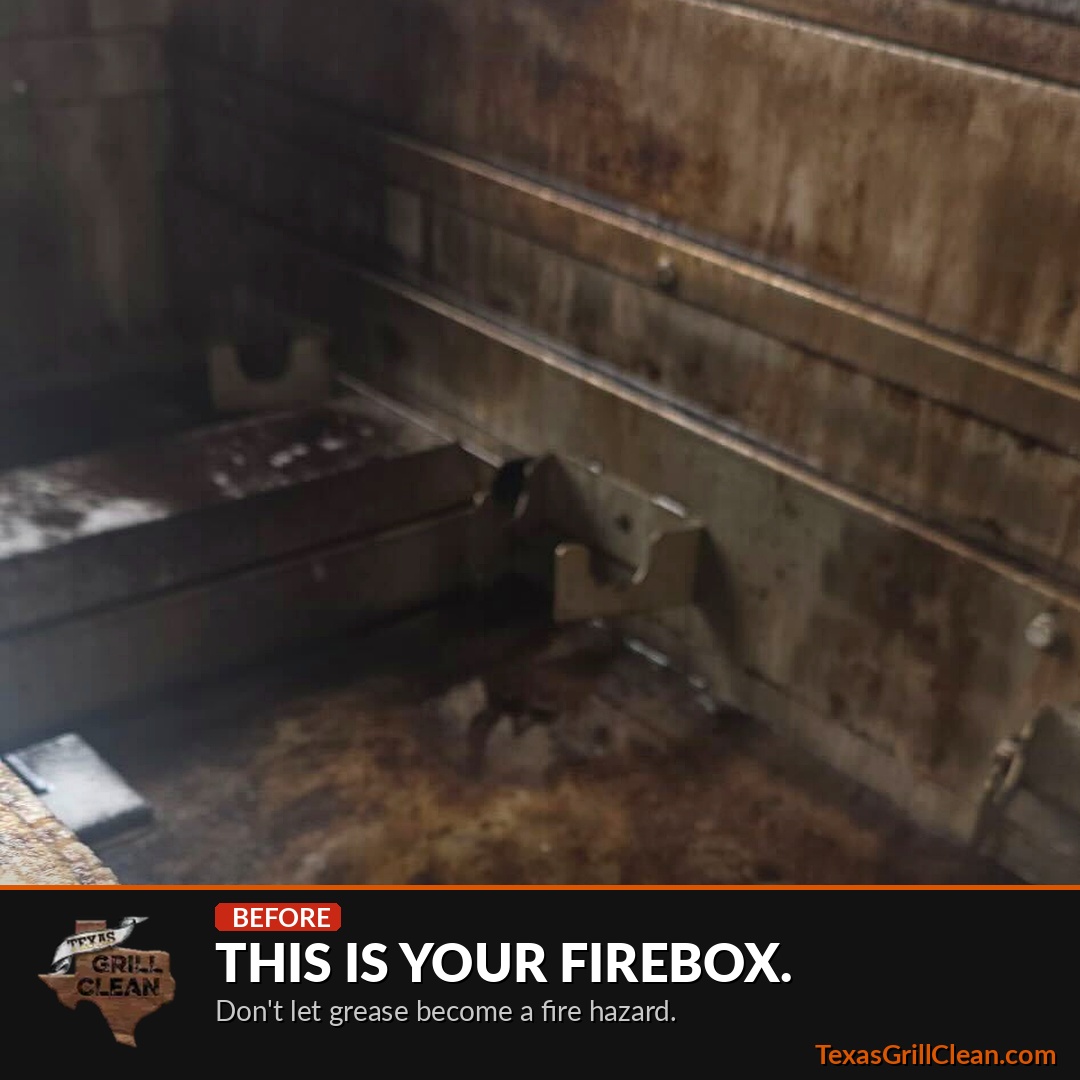
It’s the most common shortcut we get asked about. A homeowner in Grand Prairie opens the lid, sees a firebox coated in black crust, and remembers that a can of Easy-Off fixed the oven last spring. The logic makes sense. The chemistry doesn’t. Here’s what the label actually says, what the metal actually does, and what to use instead.
What is oven cleaner actually made of?
Oven cleaner is a caustic alkali, and the active ingredient is sodium hydroxide, better known as lye. It doesn’t scrub grease off. It chemically converts the fat into soap, which then rinses away. That’s why it works so well on a baked-on oven floor and why it’s so hard on the wrong metals.
According to the Easy-Off Heavy Duty product label, the can is marked “DANGER: CORROSIVE. CONTAINS SODIUM HYDROXIDE (LYE).” The same label says the product is “Recommended for use ONLY on porcelain enamel, iron, stainless steel, ceramic and glass surfaces,” and then adds: “Do not use on exterior oven surfaces, aluminum, chrome, baked enamel.”
Read that list twice. Now go look at your grill. The control panel, the end caps, the side shelves, the knob bezels, and on a lot of portable and kamado-style units the entire body, are cast or extruded aluminum. Lye and aluminum react. The aluminum oxide layer that protects the metal dissolves, hydrogen gas comes off, and you’re left with a chalky gray-white residue and pitting that doesn’t polish out.
Which grill parts can oven cleaner touch, and which can’t?
Only porcelain-enameled surfaces, glass, ceramic, and bare stainless are on the approved list. Everything else on a modern grill is a problem. Use this as a quick sort before you spray anything.
| Grill part | Typical material | Oven cleaner? |
|---|---|---|
| Porcelain-coated lid interior | Porcelain enamel over steel | Allowed by the label |
| Firebox on a built-in (Blaze, Coyote, Lynx) | 304 stainless | Allowed, but follow the label exactly |
| Control panel and knob bezels | Often aluminum or chrome | No |
| Side shelves and end caps | Cast aluminum on many models | No |
| Cast iron cooking grates | Seasoned cast iron | No |
| Painted lid exterior (Weber Spirit, Traeger barrel) | Baked enamel or powder coat | No |
| Igniter module, electrodes, wiring | Electrical | No |
| Pellet grill firepot and auger tube | Coated steel | No |
The Easy-Off label is also blunt about electronics: “Keep off all electrical connections such as heating element, thermostat, bulb receptacles, light switch.” On a grill that means the spark module, the electrodes at each burner, the rotisserie motor, and on a pellet grill the entire controller and induction fan.
Why does oven cleaner ruin cast iron grates?
Lye strips seasoning by design. That’s the whole point of it. Seasoning on cast iron is polymerized oil bonded to the metal. Sodium hydroxide breaks that bond and turns the oil into soap. Cast iron restorers use lye baths on purpose to take a rusted skillet back to raw metal.
So the spray does exactly what it’s built to do. It takes your grates down to bare gray iron. Then North Texas humidity gets to work, and within a week or two you’ve got orange flash rust across a set of grates that were fine before you started. Re-seasoning is possible, but you just traded a 20-minute cleaning for a multi-hour rebuild. Porcelain-coated grates have a different failure mode, and we covered that in our guide to cleaning porcelain grill grates without chipping them.
What do grill manufacturers actually say about it?
Three of the biggest names in grilling either ban oven cleaner outright or tell you to treat it with extreme care. This isn’t a matter of opinion among installers. It’s printed in the support documentation.
- Weber. Weber’s official support article on cleaning products lists oven cleaner under “Products to Avoid,” with the reason given as “Too harsh for grill components.” Power washers and garden hoses are on the same avoid list. (Weber Support)
- Blaze. The Blaze charcoal grill use and care guide says: “If using an oven cleaning agent, be sure to carefully follow the manufacturer’s instructions to avoid damage to the stainless steel.” Blaze’s preferred method is a fine to medium grit non-metallic pad with a stainless cleaner, always worked in the direction of the grain. (Blaze Outdoor Products)
- Traeger. Traeger’s cleaning documentation calls for “an all-natural degreaser free of harsh chemicals,” and lists distilled white vinegar, baking soda, and dish soap as acceptable household substitutes. (Traeger Support)
There’s a warranty angle too. Blaze’s own warranty language states that chlorine, fertilizers, lawn pesticides, and salt “can affect the Stainless Steel components and for these reasons, the limited warranties DO NOT COVER DISCOLORATION OR RUST, unless there is a loss of structural integrity.” Chemical-caused staining is a homeowner problem, not a warranty claim.
You already sprayed it. Now what?
Rinse hard, neutralize the surface, and dry it completely before the grill sees heat again. Lye left sitting on metal keeps working. Move fast.
- Shut the gas off at the tank or the shutoff valve, and unplug anything electric.
- Flood the treated surfaces with clean water and wipe with a cloth. Repeat three or four times. Do not blast it with a pressure washer, for the reasons we laid out in why you should never pressure wash a grill.
- Wipe everything down with a 50/50 mix of white vinegar and water. The acid neutralizes any alkali film left in the seams.
- Rinse once more with plain water, then dry every panel with a towel. Do not let it air dry.
- Check for chalky white haze on aluminum and dull spots on chrome. That damage is permanent, but catching it now stops it spreading.
- Oil any cast iron grates immediately with a high smoke point oil and run the grill at 400 to 450 degrees for 30 minutes to start rebuilding seasoning.
- Before your first real cook, run the grill empty on high for 15 minutes with the lid closed to burn off residue.
What do the pros use instead?
Heat, a scraper, and a degreaser matched to each surface. No single chemical goes on the whole grill. On our DFW routes the sequence is almost always the same: burn the firebox off on high to carbonize soft grease, cool it down, then break the carbon shell mechanically with a plastic or brass scraper. Carbon crust isn’t dirt, it’s polymerized grease, and no spray dissolves it. That black flaking on your lid is the same material, which we explained in what the black flakes inside your grill lid really are.
After the scrape, flame tamers, burner tubes, and the drip pan come out and get cleaned separately. Stainless panels get worked with the grain. That’s the process behind our grill restoration and deep cleaning and stainless steel grill restoration services, and it’s why a real deep clean takes a couple of hours instead of a spray-and-wipe.
If the buildup is heavy enough that you were reaching for oven cleaner in the first place, that’s usually the point where a professional grill cleaning costs less than the parts you’d replace. Deep cleans start at $239. Current numbers are on our pricing page, and we cover Grand Prairie, Colleyville, and the rest of the DFW service area.
Frequently asked questions
Can you use Easy-Off on grill grates?
Only on porcelain-enameled or bare stainless grates, and only following the label directions exactly. Never use it on cast iron grates. The lye dissolves the seasoning and leaves raw iron that rusts within days. It should also never touch chrome-plated grates, which the Easy-Off label specifically excludes.
Does oven cleaner damage stainless steel?
Stainless is on the Easy-Off approved list, so short controlled contact is generally tolerated. The risk is leaving it on too long or letting it run into seams and welds, where residue keeps working and causes staining. Blaze tells owners to follow the cleaner manufacturer’s instructions carefully to avoid damaging stainless. Rinse thoroughly and dry.
Will oven cleaner void my grill warranty?
It can leave you without coverage for the damage it causes. Blaze’s warranty states that chemicals affecting stainless components mean the limited warranty does not cover discoloration or rust unless structural integrity is lost. Weber lists oven cleaner as a product to avoid. Chemical damage is generally treated as improper maintenance, not a defect.
Is it safe to cook on a grill after using oven cleaner?
Only after every treated surface has been rinsed repeatedly, neutralized, dried, and burned off. Sodium hydroxide residue is corrosive and should not contact food. Rinse three or four times with clean water, wipe with a 50/50 vinegar and water mix, dry fully, then run the grill empty on high for 15 minutes before cooking.
What is the best thing to use instead of oven cleaner?
Heat plus mechanical scraping, then a mild degreaser. Burn the firebox off on high for 15 minutes, let it cool, and break the carbon with a plastic or brass scraper. Traeger recommends an all-natural degreaser free of harsh chemicals, and lists white vinegar, baking soda, and dish soap as acceptable household options.
Can you use oven cleaner on a pellet grill or a Blackstone griddle?
No to both. A pellet grill’s barrel is powder coated, and the firepot, auger tube, and controller are all things lye should never reach. A Blackstone griddle top is seasoned carbon steel, chemically the same situation as cast iron. Oven cleaner strips that seasoning to bare metal and the top rusts fast.
Does oven cleaner remove carbon buildup?
Not really. Oven cleaner converts soft grease into soap, but hardened carbon crust is polymerized grease that has already cooked past that stage. It has to come off mechanically with a scraper. That is why heavy buildup keeps coming back after a spray-and-wipe, and why a real deep clean is a physical job.
Ready to skip the chemistry experiment?
If your firebox is crusted over and you’d rather not gamble with your control panel, book us. Schedule a grill cleaning online or call (817) 791-4606. Free estimates, licensed and insured, and we’ll tell you straight if your grill needs a repair instead of a cleaning. More answers are on our FAQ page.
Texas Grill Clean is part of 1st Choice Residential, veteran-owned and locally owned, serving Dallas-Fort Worth since 2009.