
 3302 Westgrove Drive Arlington, TX 76001


No. Do not pressure wash a grill. High-pressure water forces moisture into burner tubes, gas orifices, igniter modules, and control boards. It still won’t remove baked-on carbon, because that layer is polymerized grease, not dirt. Water also starts rust inside the firebox. Every major manufacturer’s own cleaning guide uses scrapers, brushes, and degreaser instead of a hose.
We hear this question every spring in Grand Prairie, Arlington, and Mansfield. Somebody rents a pressure washer for the driveway, looks over at the grill, and figures it’s the same job. It isn’t. Here’s what actually happens, and what works instead.
What happens when you pressure wash a gas grill?
Water goes exactly where gas is supposed to go. A gas grill is a plumbing system with open holes in it by design. The venturi tubes at the front of each burner are open on purpose so air can mix with propane. The burner ports along the top are open so flame can escape. The orifices behind the control panel are drilled openings smaller than a pencil lead.
Aim 1,800 PSI at that and you push water into all of it. Here’s what our crew sees on the callbacks:
- Rust inside the burner tubes. Water sits in the low spots of a stainless or cast tube and corrodes it from the inside where you can’t see it. The tube looks fine. It burns unevenly for the rest of its life.
- Plugged orifices. Water carries loose carbon and scale into the orifice. It dries. Now that burner runs lean and yellow.
- Dead igniters. Spark modules, battery boxes, and electrode wires are not sealed against pressurized water. A soaked module clicks and clicks with no spark.
- Fried control boards. On pellet grills and any grill with a digital panel, this is the expensive one.
- Water in the gas line. Rare, but it happens when someone blasts the manifold area with the hose fitting off.
None of that shows up while you’re washing. It shows up two weeks later when the grill won’t light or only heats on one side. If you’re already there, our guides on uneven heat on one side and an igniter that won’t spark cover the diagnosis.
That maintenance angle isn’t a scare tactic. According to the U.S. Fire Administration, mechanical failure or malfunction is the leading ignition factor in grill fires at 43 percent. That category covers part failure, leaks, breaks, and lack of maintenance. Damaging your own burners and then relighting the grill is not a small thing.
Why doesn’t water remove baked-on grease?
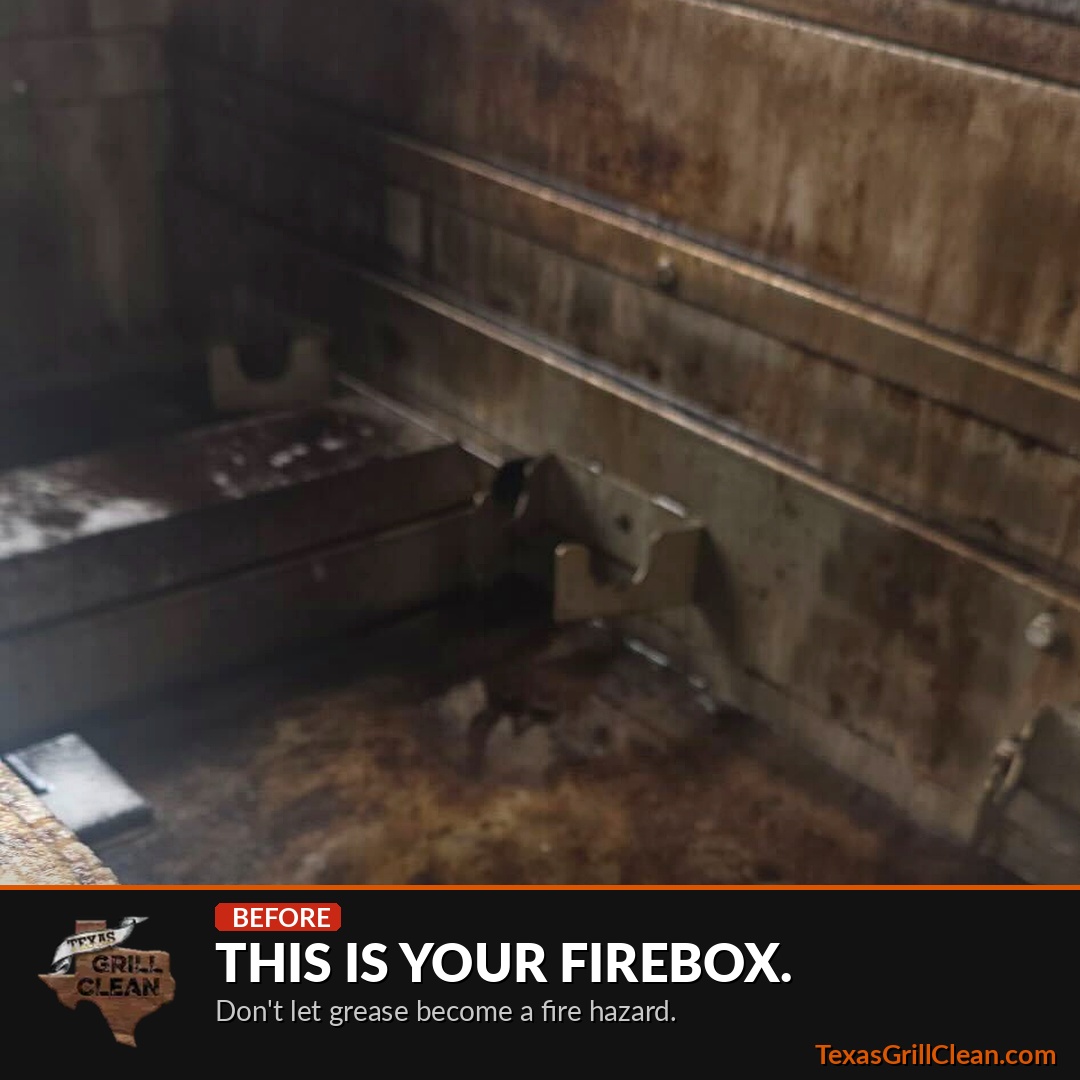
Because that black shell isn’t grease anymore. When fat vaporizes, hits hot metal, and cooks for a few hundred hours, it polymerizes into a hard carbon layer that’s chemically bonded to the surface. It behaves more like paint than like food residue.
Pressure moves loose material. It does almost nothing to a bonded layer. What actually breaks carbon down is heat, an alkaline degreaser with dwell time, and mechanical scraping. That’s why a pressure washer takes off a satisfying sheet of loose flakes and then stops, leaving the hard shell right where it was.
If flakes are already dropping onto your food, that’s a separate problem we cover in what the black flaking inside your lid really is.
Can you pressure wash a pellet grill or smoker?
No, and it’s worse than on a gas grill. A pellet grill has an auger, a hopper full of compressed sawdust, a firepot, an induction fan, an RTD temperature probe, and a controller. Wet pellets swell and jam the auger. A wet firepot rusts. A wet controller is a warranty conversation you don’t want to have.
Traeger’s own cleaning procedure is entirely dry. According to Traeger Support, the interior deep clean should happen every 2 to 3 cooks, or every 20 to 24 hours of cook time, and the method is vacuuming the firepot, scraping the drip tray, and wiping surfaces with degreaser. Traeger also tells owners not to clean the thermocouple or RTD at all unless there’s visible buildup on it. No step in that document involves a hose.
Same logic applies to a Blackstone or Evo flat top. Water on bare carbon steel strips the seasoning and rusts the plate. We walk through the right method in cleaning and seasoning a Blackstone griddle.
What parts of a grill can safely get wet?
Removable parts you can take to a sink or a wash tub, plus the outer cabinet. The rule is simple: if it detaches and has no gas or electrical connection, water is fine. If it’s attached to the grill body, keep water away from it.
| Part | Water OK? | Why |
|---|---|---|
| Cooking grates (stainless, porcelain) | Yes, off the grill | Soak and scrub in soapy water, dry fully before reinstalling |
| Cast iron grates | Minimal | Water strips seasoning and flash-rusts the iron |
| Flame tamers and heat plates | Yes, off the grill | Scrape first, then wash and dry completely |
| Grease tray and catch pan | Yes, off the grill | Degreaser plus hot water works well here |
| Exterior stainless panels | Damp cloth only | Pressure drives water past door seams into the cabinet |
| Burner tubes and venturis | No | Internal rust and clogged ports |
| Manifold, valves, orifices | No | Gas passages, corrosion risk |
| Igniter module, wiring, control board | No | Not sealed against water intrusion |
| Pellet hopper, auger, firepot | No | Swollen pellets jam the auger, firepot rusts |
One more DFW-specific note. Our tap water is hard. Even when you wash a removable part correctly, letting it air dry leaves white mineral spotting on stainless. That’s a cosmetic problem with a real fix, covered in removing hard water spots from stainless steel.
How do you deep clean a grill the right way?
Heat first, scrape second, degrease third, and keep water out of the firebox. This is the sequence that actually removes carbon without wrecking parts.
- Burn it off. Run all burners on high for 15 minutes with the lid closed. Heat carbonizes soft residue so it releases.
- Shut down and disconnect. Close the tank valve, disconnect the regulator, and unplug anything electric. Let it cool completely.
- Pull the removables. Grates, flame tamers, heat plates, grease tray. These go to a wash tub, not back on the grill wet.
- Brush the lid. Scrape the carbon shell off the inside of the hood so it stops flaking onto food.
- Clean the burners dry. Stiff brush along the tubes, then clear blocked ports with a wire or a paperclip. Check the venturi openings for spider webs.
- Scrape the firebox. Push debris down into the grease tray with a scraper. No hose, no bucket poured in.
- Degrease with dwell time. Spray the interior surfaces, let it sit several minutes, wipe with towels. The dwell does the work, not the scrubbing.
- Dry and reassemble. Everything goes back bone dry. Reconnect gas, run a leak check with soapy water on the fittings, and fire it up.
Compare that list to what a pressure washer offers. Weber’s official deep clean guide calls for a grill brush, a scraper, scouring pads, grate cleaner, dish soap, a sponge, and an old toothbrush. According to Weber, a full deep clean should happen at least every three months, and more often if you grill weekly. A pressure washer appears nowhere on their tool list.
When is it worth calling a pro instead?
When the buildup is thick enough that scraping it yourself would take a whole Saturday, or when the grill is built into an island. A built-in doesn’t roll away from the house, which means anything you spray goes into the island cavity, the cabinet, and whatever else lives in there.
Our grill restoration and deep cleaning service pulls the unit down to components, cleans each one with the right method for its material, and reassembles with a gas leak check. Deep cleans start at $239. Full pricing is on our pricing page, and if something is already broken, we also handle gas grill repair and stainless steel restoration.
We work across the Metroplex. See grill cleaning in Grand Prairie or the full service area list to check your city.
Frequently asked questions
Will pressure washing my grill void the warranty?
It can. Manufacturer warranties generally exclude damage from improper cleaning, and no major grill maker lists a pressure washer as an approved method. If a burner rusts through from the inside or a control board fails after water intrusion, that claim is likely to be denied. Check your model’s warranty language before you spray anything.
Can I just use a garden hose instead of a pressure washer?
A garden hose is gentler but carries the same core risk. Water still runs into burner tubes, orifices, and electrical components, and it still won’t dissolve bonded carbon. Rinsing a removable grate or grease tray away from the grill is fine. Rinsing out the firebox while everything is installed is not.
What about pressure washing just the grill grates?
Removable stainless grates handle it better than anything else on the grill, since they have no gas or electrical parts. Take them completely off first and use a wide fan tip at low pressure. Never pressure wash porcelain-coated grates, because the coating chips, or cast iron, because water strips the seasoning and rust follows fast.
My grill already got soaked. What should I do now?
Do not light it yet. Disconnect the gas and unplug any power. Pull the grates, flame tamers, and grease tray, then let everything air out for at least 24 hours in dry conditions. Before relighting, run a soapy-water leak check on every gas fitting and inspect burner tubes for fresh rust or blocked ports.
How do professionals clean grills if not with water pressure?
With heat, chemistry, and mechanical work. A pro deep clean means disassembling the unit, applying commercial degreasers with proper dwell time, hand-scraping the carbon shell, and cleaning each material the way that material requires. Cast iron, porcelain, brass burners, and 304 stainless all need different handling, which is the part a pressure washer cannot do.
Does a dirty grill really cause fires?
Grease buildup is a documented contributor. The U.S. Fire Administration lists mechanical failure and lack of maintenance as the leading ignition factor in grill fires at 43 percent. Grease pooled in the firebox and clogged burner ports both raise flare-up risk, which is why manufacturers publish cleaning schedules rather than treating it as optional.
How often should I deep clean my grill in Texas?
Weber recommends a full deep clean at least every three months, and more often for weekly grillers. In DFW, most homeowners grill nine or ten months a year, so twice a year is a reasonable minimum and quarterly is better. Heavy smokers and high-fat cooks like brisket and pork belly push that interval shorter.
Ready to get it done right?
Put the pressure washer back in the garage. Book an appointment or call (817) 791-4606 for a free estimate, and we’ll bring the right tools to your driveway.
Texas Grill Clean is part of 1st Choice Residential. Veteran-owned, locally owned, licensed and insured, serving Dallas-Fort Worth since 2009. 3302 Westgrove Drive, Arlington, TX 76001. Questions before you book? Our FAQ page covers the rest, and our professional grill cleaning page explains exactly what a service visit includes.