
 3302 Westgrove Drive Arlington, TX 76001


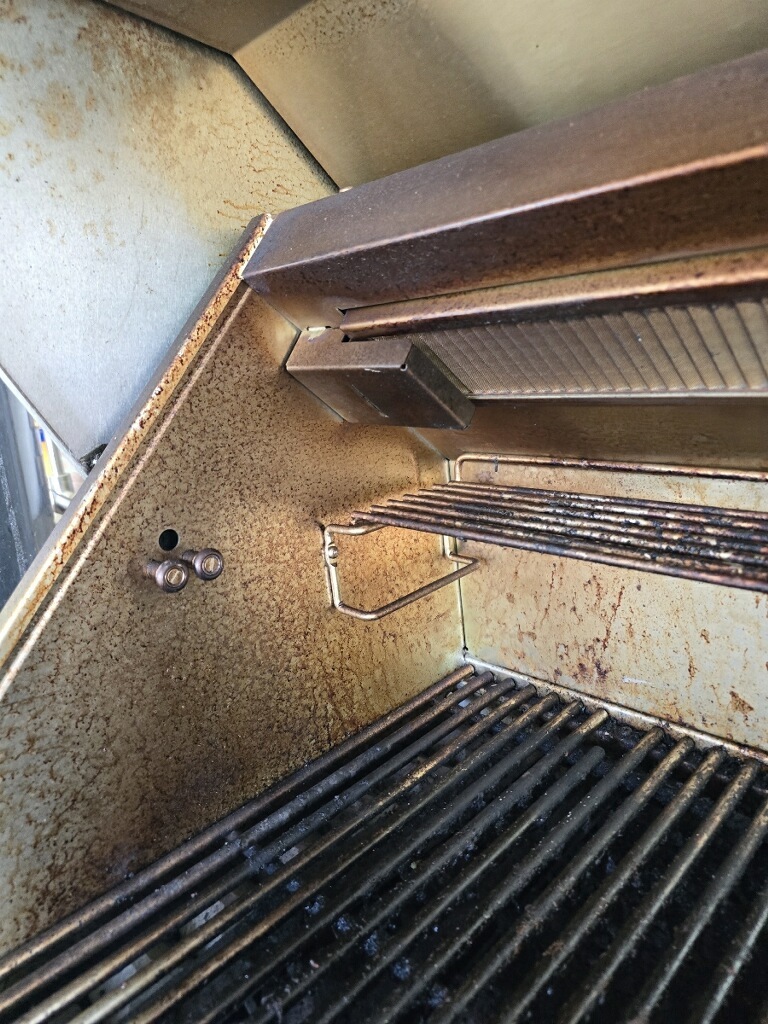
The black flakes peeling off the inside of your grill lid are not paint. Grill manufacturers do not paint the inside of a lid. What you are seeing is carbonized grease: years of cooking vapor that baked onto the metal, hardened into a shell, and started shedding. It is a cleaning problem, not a manufacturing defect, and it is not covered under warranty.
We get this call constantly in Grand Prairie and Colleyville. A homeowner opens the hood, sees black chips raining down onto the grates, and assumes the grill is falling apart. Nine times out of ten the grill is fine. It just hasn’t been cleaned above the cooking surface in a long time.
Is the black stuff inside my grill lid actually paint?
No. There is no paint on the inside of a grill lid to begin with. Porcelain-enameled and stainless lids are finished on the outside only. The interior is bare metal by design, because paint would not survive 500°F cook temps anyway.
According to Weber, the deposits that build up inside a grill lid are grease and smoke residue, not paint, and Weber describes those deposits as nontoxic. The flakes have a tell: paper thin, glossy on one side, matte on the other. Real paint chips do not look like that.
Pellet grill owners see a slightly different version of the same thing. According to Traeger Support, the dark flaking residue on a stainless pellet grill interior is creosote, a tar-like byproduct of burning wood. Traeger warns that creosote is highly flammable and that heavy buildup can increase the risk of grill fires. Same lesson, different fuel: stainless has no paint, so nothing on it can peel.
Is it safe to eat food if flakes fall on it?
The flakes themselves are not poisonous, but you should not eat them, and you should not keep cooking under a lid that is actively shedding. Weber calls the deposits nontoxic. That is not the same as food. Carbon chips carry old rendered fat from every cook that came before, and they land on whatever is on the grates right now.
Two practical rules. First, if flakes drop onto raw food, throw the food out and clean the lid before you cook again. Second, once a lid starts shedding, it keeps shedding until it is scraped. It will not stop on its own.
The bigger issue is what that buildup does to flavor. Old carbon and creosote deposit bitter compounds onto everything you cook. If your steaks have started tasting sharp or ashy, the lid is a likely suspect. We covered that in detail in Why Does My Grilled Food Taste Bitter?
Does lid buildup actually cause fires?
Buildup does not usually start the fire, but it feeds it. Carbonized grease and creosote are fuel sitting directly above an open flame.
According to the National Fire Protection Association, U.S. fire departments responded to an average of 10,600 home grill fires per year between 2014 and 2018, causing roughly $149 million in direct property damage annually. NFPA lists failure to clean as one of the leading factors contributing to those fires, and notes it shows up more often in gas grill fires than in charcoal ones.
That is why our crews scrape the hood, not just the grates. A grate cleaning makes a grill look better. A lid cleaning makes it safer.
How do I remove flaking carbon from a grill lid?
Scrape it dry first, then degrease, then wipe. Do not start with chemicals on a thick shell. Cleaner cannot reach metal through a quarter inch of hardened carbon.
- Cool the grill completely. Warm metal smears the residue instead of releasing it.
- Pull the grates and flame tamers out. Everything you scrape off the lid is going to fall straight down, and you do not want it packed into the burner ports.
- Line the firebox. Foil or a flat piece of cardboard catches the debris and makes cleanup a two-minute job.
- Scrape with a stainless bristle brush or a plastic putty knife. Work back and forth across the lid, not in circles. On porcelain interiors, keep the pressure light so you do not gouge the enamel.
- Degrease what’s left. A grill-specific cleaner or hot soapy water on the remaining film. Let it sit a minute before you wipe.
- Wipe with a damp cloth, then dry. Any moisture left inside a closed lid in North Texas humidity turns into surface rust fast.
- Burn off for 10 minutes on high with the lid closed. This drives out cleaner residue before your next cook.
Skip oven cleaner. Lye-based products attack aluminum lids and can permanently haze porcelain enamel. We see the damage often enough that it is worth saying plainly: the cleaner is the expensive mistake, not the buildup.
Does this look different on gas, pellet, and charcoal grills?
The residue is the same idea on every fuel type, but it builds at different speeds and takes different tools.
| Grill Type | What the flakes are | How fast it builds | What to scrape with |
|---|---|---|---|
| Gas (Weber Genesis, Blaze, Lynx, Coyote) | Carbonized grease from drippings hitting flame tamers | Moderate. Heavy if you cook fatty cuts weekly | Stainless bristle brush |
| Pellet (Traeger, Pit Boss, Camp Chef) | Creosote plus grease, tar-like and sticky | Fast. Wood smoke lays it down every cook | Plastic scraper, then degreaser |
| Charcoal and kamado (Weber Kettle, Big Green Egg) | Soot and carbonized fat | Slower, but bonds hard | Nylon brush on ceramic, stainless on steel |
| Griddle (Blackstone, Evo) | Polymerized oil on the hood, if equipped | Light on the lid, heavy on the surface | Plastic scraper only |
Pellet grills are the ones that surprise people. Traeger owners often go two or three seasons without touching the hood interior because the outside still looks new. Meanwhile the backsplash and the underside of the lid are coated. Our Traeger cleaning guide for Texas heat and humidity walks through that specific grill.
Why does this happen faster in Dallas-Fort Worth?
Heat and a long season. DFW homeowners grill nine or ten months a year, and every one of those cooks adds another layer.
Three things stack up here. Long grilling seasons mean more cycles of vapor condensing on cool metal and baking on. Spring pollen from cedar, oak, and cottonwood settles into grease film and gives it texture to grip. And summer heat over 100°F bakes the deposit harder than it would set in a milder climate, so by fall it has the consistency of enamel.
If your grill lives on an uncovered patio in Grand Prairie or Grapevine, add wind-driven dust to that list. It all ends up in the same place.
When should you call a pro instead of scraping it yourself?
Call when the buildup is thick enough that scraping is not making progress, or when the grill is a built-in you cannot fully break down.
A cart grill with light flaking is a Saturday morning job. A built-in Lynx or Blaze with three seasons of buildup, a rotisserie assembly, and a firebox packed with debris is a different animal. Our grill restoration and deep cleaning service pulls the unit down to components, cleans the hood interior, burners, flame tamers, drip tray, and firebox, and puts it back together tested and working. Deep cleans start at $239. You can see current pricing on our pricing page.
If the interior metal underneath is pitted or discolored once the carbon comes off, that is a separate conversation. Stainless steel restoration handles the finish. And if the grill is not lighting or heating right after the cleaning, our gas grill repair team handles burners, valves, igniters, and regulators.
Frequently Asked Questions
Is peeling inside my grill lid covered by warranty?
No. Manufacturers classify carbonized grease buildup as a maintenance issue, not a defect, because there is no paint or coating on the lid interior to fail. Warranty coverage applies to the metal itself, like a lid that rusts through or warps. Carbon buildup is on the owner to clean, and most manufacturers say so directly in their care documentation.
Can I use oven cleaner on the inside of my grill lid?
Do not. Most oven cleaners are lye-based and will pit aluminum lids, dull porcelain enamel, and leave a residue that smokes into your food on the next cook. Use a dry scrape first, then a grill-specific degreaser or hot soapy water. If the buildup is too thick for that, it needs professional removal, not stronger chemicals.
How often should I clean the inside of my grill hood?
Scrape the lid interior at least twice per grilling season if you cook weekly, and once mid-season if you cook occasionally. Pellet grill owners should check the hood and backsplash more often, since wood smoke lays down creosote every single cook. Waiting until flakes appear means the buildup is already thick enough to be a chore.
Are the black flakes dangerous to breathe or touch?
Weber describes the deposits as nontoxic, and brief handling is not a health concern. Still, wear gloves and avoid breathing the dust while scraping, since you are releasing fine carbon particles from old rendered fat. Work outdoors, which you will be doing anyway, and rinse your hands when you are done.
Will burning the grill on high remove the buildup?
Not from the lid. A high burn-off works on grates because they sit directly over the flame. The hood interior never reaches the temperature needed to fully ash off hardened grease, so a burn-off will loosen surface film at best. Mechanical scraping is the only thing that removes a real carbon shell.
Does a peeling lid mean I need a new grill?
Almost never. Flaking carbon says the grill needs cleaning, not replacing. What actually kills a grill is a firebox rusted through, cracked welds, or a model old enough that replacement burners no longer exist. Clean the lid first, then judge the metal underneath. Most grills that look ruined are one deep clean away from normal.
Do you clean built-in grills in outdoor kitchens?
Yes. Built-in units in DFW outdoor kitchens are a large share of what we service, including Blaze, Lynx, Coyote, DCS, and Alfresco. Built-ins usually need it more than cart grills, since owners rarely break them down. Check our service areas page to confirm coverage in your city, or call and we will tell you straight.
Get the Hood Cleaned, Not Just the Grates
Most grill cleaning stops at the cooking surface. That is why the lid ends up shedding onto your dinner. If yours has started flaking, we can take care of it.
Book an appointment online or call (817) 791-4606. We serve Dallas, Fort Worth, Arlington, Grand Prairie, Colleyville, Grapevine, Southlake, Plano, Frisco, Keller, McKinney, and Allen. See the full service areas list or read our professional grill cleaning page for what a visit includes. More answers on our FAQ page, and if you are wondering whether buildup is a health issue, read Can a Dirty Grill Make You Sick?
Texas Grill Clean is part of 1st Choice Residential. Veteran-owned, locally owned, licensed and insured, serving Dallas-Fort Worth since 2009. Free estimates. 3302 Westgrove Drive, Arlington, TX 76001 · (817) 791-4606 · jeff@texasgrillclean.com