
 3302 Westgrove Drive Arlington, TX 76001


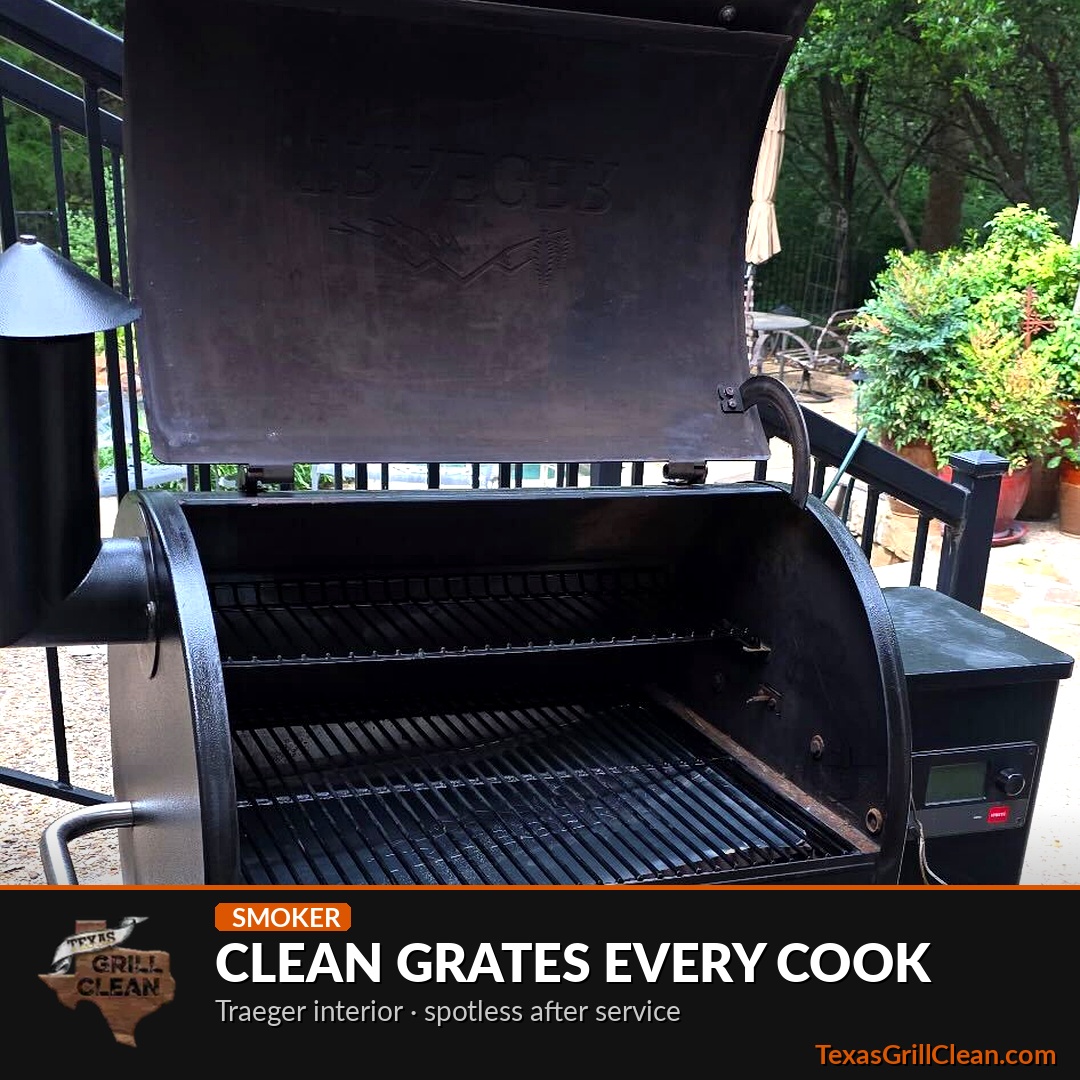
A pellet grill that isn’t producing smoke usually isn’t broken. Pellet grills make the most smoke at low temperatures, roughly 165°F to 225°F. Run one above 275°F and it burns clean, with almost no visible smoke. The other common causes are damp pellets, ash packed around the firepot, and a cook chamber caked in old grease.
We hear this one a lot from homeowners in Frisco, McKinney, and Allen who bought a Traeger or a Pit Boss expecting the same thick smoke they saw at a barbecue joint. The grill is fine. The way it’s being run, fed, and cleaned is what changed.
Why isn’t my pellet grill making smoke?
Four things control smoke output on a pellet grill: the set cook temperature, the moisture content of your pellets, airflow through the firepot, and how much old grease is sitting in the cook chamber.
A pellet grill is a small forced-air furnace. The auger feeds pellets into a steel firepot. A hot rod ignites them. An induction fan pushes air across the fire, and an RTD temperature probe tells the controller when to feed more pellets. Smoke is a byproduct of an incomplete burn. When the fire runs hot and gets plenty of air, the pellets combust fully and you get heat instead of smoke. That’s combustion working correctly, not a defect.
So the question isn’t really “why won’t it smoke.” It’s “what is stopping the fire from smoldering the way I want it to.”
Does cooking temperature control how much smoke you get?
Yes, and it’s the single biggest factor. Smoke production drops off sharply once a pellet grill climbs past about 250°F.
According to Traeger Support, the Super Smoke setting only operates between 165°F and 225°F, because that’s the window where the fan can pulse and let pellets smolder instead of burning clean. Pit Boss controllers work on the same principle with the SMOKE setting and the P-setting, which lengthens the pause between auger feed cycles.
| Set Temperature | What the Fire Is Doing | Smoke Output |
|---|---|---|
| 165°F – 180°F | Pellets smolder, fan pulses on and off | Heaviest |
| 180°F – 225°F | Low, steady burn with restricted airflow | Heavy — the real smoke zone |
| 225°F – 275°F | Cleaner burn, thin blue smoke | Moderate |
| 275°F – 350°F | Efficient combustion | Light |
| 350°F and up | Near-complete combustion | Almost none |
If you’re setting the dial to 275°F and wondering where the smoke went, that’s your answer. Start briskets, pork butts, and ribs in the 180°F to 225°F range for the first few hours, then raise the temperature to finish.
Are damp pellets killing your smoke?
Wet pellets swell, crumble into sawdust, and burn poorly. In North Texas humidity, a bag left open in the garage can be ruined in a few weeks.
According to the Pellet Fuels Institute Standard Specification, PFI Premium grade pellets must have moisture content at or below 8% and ash content at or below 1%. Once pellets pull in humidity past that point they stop behaving like fuel and start behaving like a sponge. They jam the auger, choke the firepot, and produce a dirty, acrid burn instead of clean smoke.
Two field tests you can run in thirty seconds:
- Snap test. A good pellet snaps clean. A damp one bends, crumbles, or turns to powder in your fingers.
- Water test. Drop a few pellets in a glass of water. Fresh pellets sink and hold shape for a minute or two. Waterlogged pellets fall apart almost immediately.
Store pellets in a sealed bin indoors or in a conditioned space. A cracked bag on a garage shelf through a Dallas August is a bag you’ll throw away.
Is ash in the firepot choking your fire?
Ash buildup smothers airflow and starves the hot rod, which produces weak ignition, temperature swings, and thin smoke.
Traeger Support recommends vacuuming ash out of the firepot at least every 20 hours of cook time, and more often for greasy cooks like bacon or pork belly. Twenty hours goes fast. Two briskets and a couple of chicken cooks and you’re there.
Ash that packs around the firepot walls blocks the intake holes the fan feeds through. The fire then runs oxygen-starved in a way you can’t control, which reads as poor temperature holding rather than good smoke. Clear it cold, never warm, and never with a shop vac that has been used for anything flammable.
Does a dirty cook chamber ruin smoke flavor?
Old grease on the heat deflector and drip tray doesn’t add flavor. It adds bitterness and greasy soot that coats the meat.
Rendered fat that sits on a heat deflector for months turns into hardened carbon and creosote. When the chamber comes up to temp, that layer bakes off and lands on whatever you’re cooking. The result tastes sharp and ashy, and homeowners often mistake it for “too much smoke” when it’s actually old residue. We wrote more about that in why grilled food tastes bitter.
The same buildup insulates the chamber and makes temperature recovery sluggish. Our crews see it constantly on pellet grills that have never had the barrel scraped down past the grates. For a full walkthrough of pellet-specific maintenance in this climate, see how to clean a Traeger in Texas heat and humidity.
How do you get more smoke out of a pellet grill?
Work through these seven steps in order. The first three fix most cases.
- Drop your set temperature to 180°F to 225°F for the first three to four hours of any long cook. This is where smoke actually happens.
- Turn on Super Smoke, SMOKE mode, or your controller’s equivalent. On Pit Boss units, raise the P-setting to lengthen the pause between auger feeds.
- Dump the hopper and load fresh pellets. Don’t top off old fuel with new. Empty it, vacuum the hopper, and start clean.
- Vacuum the firepot and the ash around it with the grill completely cold. Check that the hot rod sits clean in its channel.
- Scrape the heat deflector and replace the drip tray liner. Get the hardened carbon off, not just the loose flakes.
- Start with cold meat and a dry surface. Smoke compounds bind best to cool, slightly tacky meat. Meat straight out of the fridge picks up far more smoke than meat that sat on the counter for an hour.
- Add a smoke tube if you still want more. A 12-inch pellet tube burning alongside the cook adds real smoke without changing your grill’s settings.
When is it the grill and not your technique?
Hardware is the problem when the grill can’t hold temperature, throws ignition errors, or produces no fire at all.
Watch for these: an auger that grinds or stalls, a hot rod that won’t glow, an induction fan that rattles or stops, a cracked or grease-fouled RTD probe reading temperatures that don’t match a separate thermometer, or a firepot warped and burned through at the base. Those are repair items, not settings problems. A grill that lights fine and holds 225°F but makes less smoke than you want is a technique and cleanliness issue every time.
What does a professional pellet grill cleaning include?
A full teardown deep clean strips the chamber down to bare metal, clears the firepot and ash channels, degreases the deflector and drip pan, and restores the exterior.
Texas Grill Clean deep cleans start at $239. See current rates on our pricing page, or read what’s covered under grill restoration and deep cleaning and professional grill cleaning. We service pellet grills across the Metroplex, including Frisco and Plano. Full coverage is listed on our service areas page.
Frequently Asked Questions
Does more visible smoke mean more smoke flavor?
No. Thick white smoke usually signals an inefficient, dirty burn and deposits bitter compounds on food. The smoke you want is thin and faintly blue, and it’s easy to miss on a bright day. Judge by the color of the bark and the taste of the meat, not by how much you can see coming out of the chimney.
Why does my pellet grill smoke less than an offset smoker?
Pellet grills use a fan-fed firepot designed for efficient combustion and steady temperature. Offset smokers burn split logs in an open firebox, which is a far dirtier and smokier burn by design. A pellet grill will never match an offset for raw smoke volume. It trades that for temperature control you don’t have to babysit.
Do different pellet brands actually change the flavor?
Yes, though less than most people expect. Hardwood species matters, with hickory, mesquite, and oak producing stronger flavor than apple or cherry. Many blends labeled by flavor use a hardwood base with a smaller percentage of the named wood. Fuel quality and moisture content affect your results more than the flavor name on the bag.
How often should a pellet grill be deep cleaned in North Texas?
Once a year at minimum for occasional use, and twice a year if you cook most weekends. DFW heat bakes grease into hard carbon faster than milder climates, and spring pollen adds a sticky film that traps it. Vacuum the firepot every 20 hours of cook time yourself between professional cleanings.
Will a smoke tube fix a pellet grill that won’t smoke?
A smoke tube adds real smoke, but it treats the symptom. If the underlying problem is damp pellets, a packed firepot, or a greasy chamber, the tube masks a grill that also isn’t holding temperature or burning fuel efficiently. Fix the fuel and the ash first, then add a tube if you still want heavier smoke.
Can old grease inside the barrel make food taste bad?
Yes. Hardened grease and creosote on the heat deflector and barrel walls release acrid, bitter compounds when the chamber heats up, and those land directly on your food. It reads as harsh smoke but it’s residue. Scraping the barrel down to metal usually clears up a bitter taste that no change in pellets fixed.
Is it safe to vacuum ash out of a pellet grill?
Only when the grill is completely cold, and only with a vacuum that has never picked up flammable debris. Warm ash can hold live embers for hours after a cook. Use a dedicated ash vacuum rated for the job, or scoop the firepot by hand into a metal container and let it sit outside overnight.
Get Your Pellet Grill Cleaned Right
If you’ve swapped pellets, dropped the temperature, and cleared the firepot and your grill still isn’t giving you the smoke or the temperature control it used to, the buildup is probably deeper than a shop vac can reach. Book an appointment online or call (817) 791-4606 for a free estimate.
Texas Grill Clean is part of 1st Choice Residential. Veteran-owned, locally owned rather than a franchise, licensed and insured, serving Dallas–Fort Worth since 2009.
Texas Grill Clean
3302 Westgrove Drive, Arlington, TX 76001
(817) 791-4606 · jeff@texasgrillclean.com