
 3302 Westgrove Drive Arlington, TX 76001


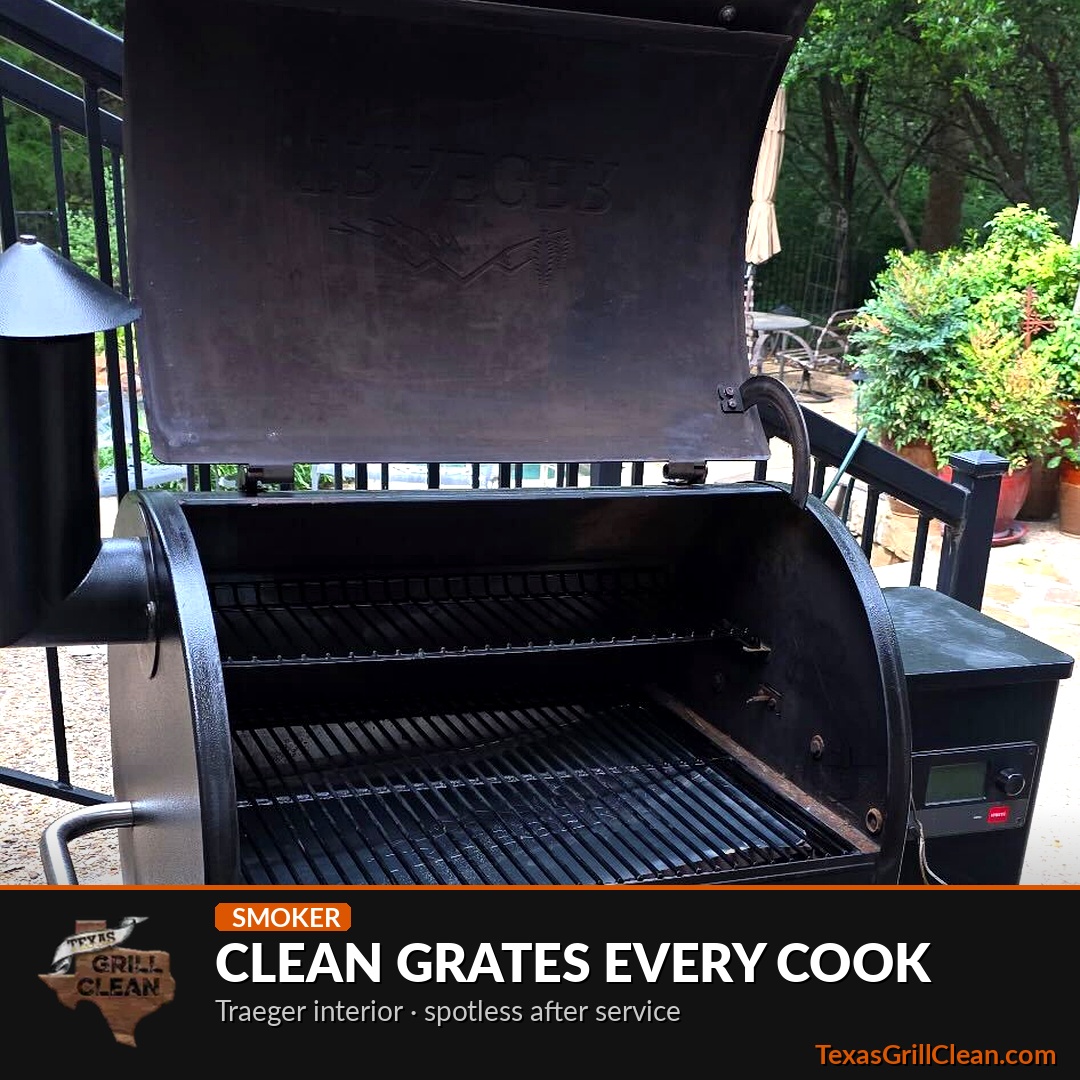
Your Traeger held 225 all last summer. This year it swings forty degrees, takes twenty minutes to come up to temp, and last Saturday it threw an auger error in the middle of a brisket. Nothing is broken. Your grill is dirty, and North Texas humidity is finishing the job.
Pellet grills fail differently than gas grills. A dirty gas grill flares up. A dirty pellet grill lies to you about temperature, burns through pellets, and eventually jams. Here’s the actual maintenance schedule, why our climate accelerates all of it, and what a deep clean fixes that a shop vac can’t.
Why Texas is harder on a pellet grill than on a gas grill
A pellet grill runs on compressed sawdust, and sawdust is hygroscopic. It pulls moisture out of the air.
Traeger puts the ideal moisture content of a wood pellet at around 5%. Above that, pellets don’t burn hot enough. Below it, you get an acidic taste in the food. That’s a narrow window, and a bag of pellets sitting in an open garage through a Dallas August does not stay in it.
What happens next is predictable. Traeger’s own support documentation names swollen pellets from excess moisture as the most common cause of auger jams. The pellets absorb humidity, expand, crumble, and pack together in the hopper and the auger tube. Then the grill either can’t feed fuel or feeds it unevenly, which is exactly what a forty-degree temperature swing looks like from the outside.
Add the grease side of the equation. Our cook season runs from March through Thanksgiving, so a DFW pellet grill puts in roughly twice the hours of one in Chicago. Twice the grease in the drip tray, twice the ash in the firepot, twice the buildup in the chute.
Traeger’s actual cleaning schedule
Most owners clean the grates and call it done. Traeger’s published guidance is considerably more specific, and the number that matters is 20 hours of cook time.
| What | How often | Why it matters |
|---|---|---|
| Firepot ash | Vacuum at least every 20 hours of cook time | Ash smothers ignition and causes temp swings |
| Grease trap / drip tray | Don’t exceed 20 hours between cleanings | Primary fire risk; clean sooner after fatty cooks |
| Interior deep clean | Every 2 to 3 cooks, or every 20 to 24 hours | Carbon buildup on the walls and diffuser |
| Grease chute or downdraft | Every 6 months | Where clogs hide and grease backs up |
| Exterior | Every 3 months, more often without a cover | Pollen, hard water spots, rust prevention |
Twenty hours goes faster than people think. Three briskets is 30 hours. If you cook every other weekend from spring through fall, you’re past due somewhere around June.
The deep clean, step by step
Set aside two hours. Grill completely cold, unplugged.
- Empty the hopper first. Vacuum it out completely. If any pellets look swollen, dusty, or crumble between your fingers, all of them go. Wet pellets are the single most common cause of the problems you’re trying to fix.
- Pull the grates, drip tray, and heat baffle. Everything comes out in layers. Scrape carbon off the baffle with a putty knife.
- Vacuum the firepot. A shop vac is the right tool. Ash packs down hard, and a partly buried igniter is why your grill takes twenty minutes to light.
- Vacuum the whole barrel. Ash migrates everywhere and holds moisture, which is how rust starts on the inside of a barrel that looks fine on the outside.
- Clear the grease chute. Run a bottle brush down it. This is the step everyone skips and the one that causes grease to back up into the barrel.
- Degrease the drip tray and grates. Hot water, dish soap, a nylon brush. Skip oven cleaner on porcelain-coated grates.
- Foil last, if you use it. Fresh foil on the drip tray only. Never line the firepot or the barrel floor.
Pellet storage is the cheapest fix on this list
Traeger recommends storing pellets in a dry, airtight container, and specifically advises indoor storage in humid climates. That’s us for most of the year.
A sealed five-gallon bucket with a gasket lid costs about fifteen dollars and eliminates the majority of auger jams. Not the garage floor, not the original paper bag with the top rolled over, and not the hopper itself between cooks. Pellets left in an open hopper through a humid week are pellets you’ll be vacuuming out later.
The part about fires
Not scare tactics, just the numbers. According to the NFPA’s home grill fires report, U.S. fire departments responded to an average of 12,141 home fires involving grills per year between 2020 and 2024, causing 15 deaths, 171 injuries, and $241 million in property damage.
The leading contributing factor: 20% of those fires involved a grill that had not been cleaned. And July is the peak month, which is where we are right now.
When it’s worth calling somebody
Plenty of this is a Saturday-morning job. Where homeowners hit a wall:
- Built-in pellet grills. No easy access to the back panel, chute, or auger tube without pulling the unit.
- A grill that’s gone two or more seasons. Carbon at that stage doesn’t scrape, and hardened grease in the chute needs to be broken down chemically.
- Auger jams that come back. If it jams again after fresh pellets, the tube needs to come apart.
- You’d rather not spend the weekend on it. Fair enough.
Our deep clean and restoration service starts at $239 and covers the full teardown: hopper, auger area, firepot, barrel, baffle, drip tray, chute, grates, and exterior. Full pricing is on our pricing page, and we cover all of DFW.
Common questions
How often should I clean my Traeger in Texas?
Follow the 20-hour rule for the firepot and grease trap, but tighten the exterior and hopper schedule in summer. Humidity is the variable Traeger’s national guidance doesn’t account for. If you cook most weekends March through November, plan on two thorough cleans a season plus a full deep clean once a year.
Can I use a pressure washer on a pellet grill?
No. Pellet grills have an igniter, a fan, a controller, and wiring in the barrel and hopper. Water in any of those means a repair bill larger than the cleaning you were trying to avoid.
Why does my Traeger keep swinging temperature?
In order of likelihood: ash buildup in the firepot, wet or degraded pellets, a grease-caked heat baffle, or a dirty temperature probe. All four are cleaning problems before they’re repair problems. Work through the deep clean above before assuming a part has failed.
Are wet pellets actually ruined?
Yes. Pellets are held together by the wood’s own lignin, and once moisture breaks that bond they crumble into sawdust. There’s no drying them back out. Throw them away and store the next bag sealed.
Do you clean pellet grills, or only gas?
Both, plus charcoal, kamado, and built-in outdoor kitchens. Pellet grills need a different process than gas, and we treat them that way. See our FAQ for what’s included.
Get it running right before Labor Day
If your Traeger has been fighting you all summer, one thorough clean usually settles it. We’ll do the full teardown, tell you honestly whether anything actually needs replacing, and get it holding temperature again.
Book an appointment online or call (817) 791-4606.
Texas Grill Clean is part of 1st Choice Residential, veteran-owned and serving Dallas-Fort Worth since 2009.