
 3302 Westgrove Drive Arlington, TX 76001


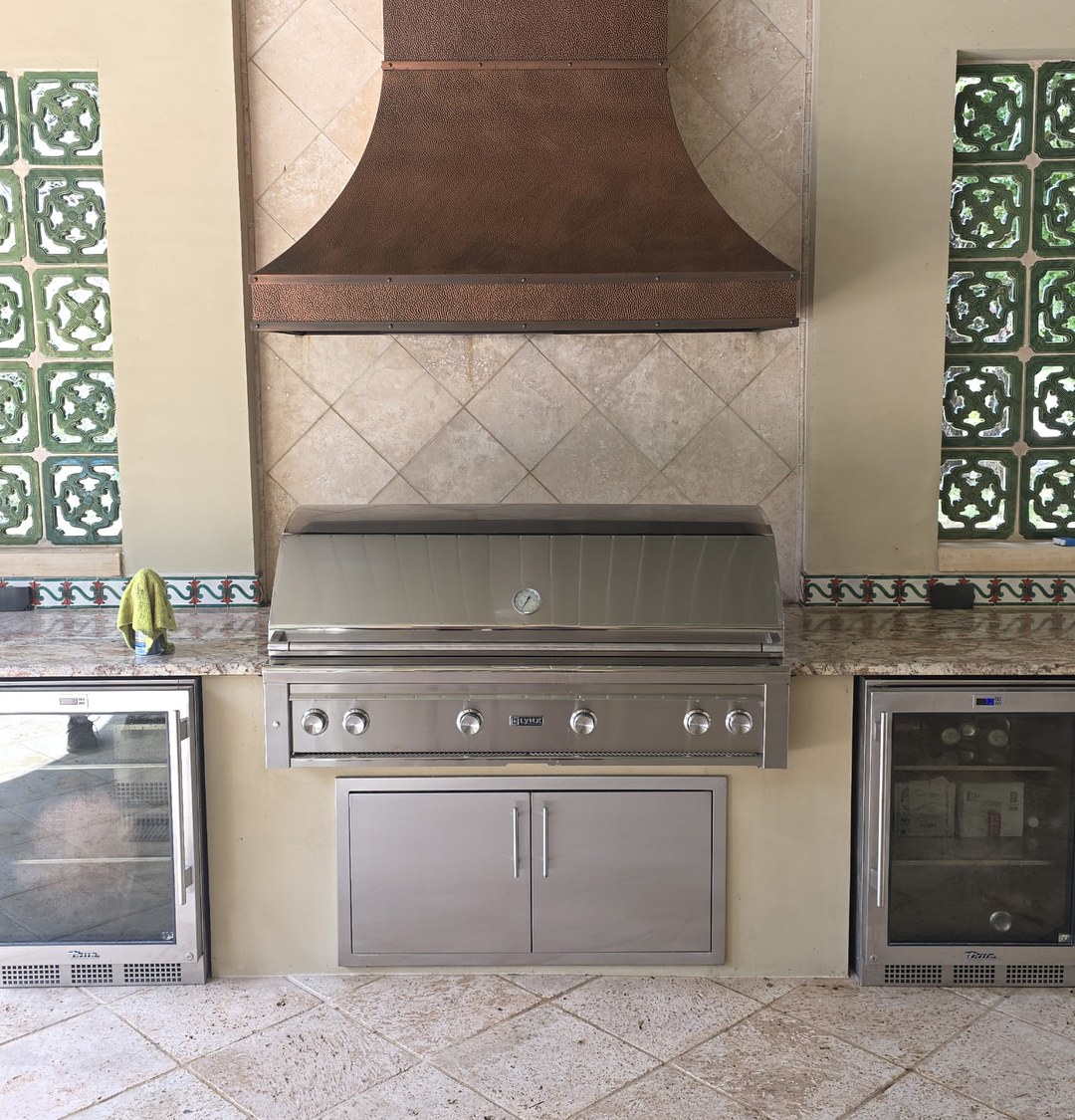
To clean under a built-in grill, shut the gas off at the manual valve, open the access door, and empty the cabinet completely. Vacuum the debris packed against the floor-level vent openings. Degrease the cabinet floor where grease has dripped through. Then inspect the gas hose and fittings for cracks before you close it up. Twice a year is the right interval for most DFW outdoor kitchens.
Almost nobody does this. Homeowners clean the grates, wipe the lid, maybe empty the grease tray. The cabinet underneath gets opened once at installation and then treated like a shed. That’s the part our crew opens on a first visit to a Colleyville or Southlake outdoor kitchen and finds leaves, a bag of charcoal, a nest, and a gas line nobody has looked at in six years.
What’s actually inside the cabinet under a built-in grill?
The cavity under a built-in grill is not storage. It’s a ventilated safety chamber that holds your gas connection.
Open the access door on a typical DFW island and here’s what’s in there: the flexible gas hose running from the manual shutoff valve up to the grill head, the regulator, sometimes a propane cylinder on a tray, electrical for the rotisserie motor and interior lights, and a set of vent openings cut into the masonry at the floor and near the countertop.
Every one of those things has a job. The vents in particular are not decorative. They’re engineered.
The vent openings have a published specification
According to the American Outdoor Grill built-in installation manual, an enclosure must either have one side left completely open to the outside, or it must have four ventilation openings, and each opening must have a minimum of 10 square inches of free area. Two sit at the top (roughly 4 inches below the countertop, or at cylinder valve level on propane installs) and two sit at floor level, no more than 5 inches above the floor, on opposite walls.
The manual states the purpose plainly: those openings exist for drainage, replacement air, and cross-ventilation of a space “exposed to possible leakage from gas connections, the unit, or propane cylinders.” It also says the required ventilation openings must be clear of debris.
That last line is the whole point of this article. Propane is heavier than air. It sinks. The floor-level vents are what let a small leak drain out of the box instead of pooling in it. Pack those vents with oak leaves, a stack of grill covers, and a bag of charcoal, and you’ve disabled the safety feature.
Why does the space under a built-in grill matter for fire safety?
Because gas leaks and grease buildup are the two biggest drivers of grill fires, and both of them live in the cabinet.
According to NFPA research covering 2020 through 2024, gas grills were involved in an average of 9,235 home fires per year, including 4,662 structure fires. The grill had not been cleaned in roughly one-fifth (20%) of grilling fires, which makes it the leading contributing factor. NFPA also reports that 6% of gas grill structure fires and 13% of outside gas grill fires were caused by leaks or breaks.
Leaks and breaks happen at connections. Connections are in the cabinet. A flexible hose that’s been baking at 100-plus degrees through fifteen Texas summers gets stiff and develops surface cracks, and you will never see it if you never open the door.
Grease is the other half. On a built-in, grease that overflows the tray or misses the drip pan doesn’t land on a patio where you’d notice it. It runs down into the cabinet and soaks into whatever is sitting down there. We’ve pulled cardboard boxes out of island cavities that were saturated through.
How do you know something is living under your grill?
Look for droppings, chewed insulation, shredded nesting material, and a musty smell when you first open the door.
An island cabinet is warm, dry, sheltered, and smells like food. In DFW that’s a rodent invitation from October through February. Wasps and mud daubers use the upper corners. Spiders are their own separate problem, and they cause a specific failure we wrote about in the spider in your grill.
If you find droppings, stop and handle it correctly. The CDC’s rodent cleanup guidance says not to sweep or vacuum dry droppings, urine, or nests, because that puts contaminated particles into the air. Ventilate the space for 30 minutes first. Wear gloves. Spray the droppings with a disinfectant or a bleach solution until they’re wet, let it soak about 5 minutes, then wipe up with paper towels.
How do you clean under a built-in grill, step by step?
Six steps, about 45 minutes, and the first one is non-negotiable.
- Shut off the gas. Close the dedicated manual shutoff valve. On natural gas it’s usually inside the cabinet or within about 6 feet of it. On propane, close the cylinder valve. Don’t skip this because you’re “only cleaning.”
- Empty the cabinet completely. Everything comes out. Charcoal bags, covers, tools, the bag of wood chips from 2019. Lay it on the patio so you can see what you actually own.
- Clear the vent openings. Find all four (or confirm one side is open to the outside). Get the leaves, dirt daubers, and spider webbing out of them. Floor-level vents are the ones that matter most, and they’re the ones that clog.
- Vacuum, then degrease the floor. Shop vac the loose debris. Then hit the grease film on the cabinet floor with a degreaser rated for outdoor use and wipe it out. If grease has pooled, find out where it’s dripping from before you refill the cabinet.
- Inspect the gas hose and fittings. Look for cracking, stiffness, abrasion where the hose rubs masonry, and green corrosion on brass fittings. Then leak-test with soapy water at every connection with the gas back on. Bubbles mean shut it down.
- Put back only what belongs. Nothing combustible. No paper, no cardboard, no charcoal bags, no propane cylinder unless the island was built for one with the correct tray and door. Keep the floor and the vents clear.
How often should you clean the cabinet under a built-in grill?
Twice a year for most DFW homes, and more often if the island sits under trees.
| Situation | How often to open and clean the cavity | Why |
|---|---|---|
| Standard DFW island, open patio | Every 6 months | Routine grease drip and dust |
| Island under oaks or pecans | Every 3–4 months | Leaf litter blocks floor vents fast |
| Propane cylinder stored inside | Every 3 months | Heavier-than-air gas needs clear low vents |
| Heavy use (weekly grilling) | Every 4 months | More grease volume past the tray |
| Grill unused 6+ months | Before first use | Nesting season happened while you weren’t looking |
What should you never do when cleaning an island cavity?
Don’t spray water into it, and don’t seal the vents.
Homeowners sometimes decide the vents are how the critters get in and patch them with foam or caulk. That turns a ventilated enclosure into a sealed gas box. If pests are the problem, hardware cloth screen over the opening keeps the free area and keeps the mice out.
Water is the other one. A hose or a pressure washer aimed into the cabinet drives water into the ignition module, the rotisserie motor wiring, and the regulator vent. We covered what that does in our guide to finding a propane leak safely. Degreaser and towels, not a hose.
When should you call a pro instead?
Call someone if you smell gas at all, if the hose looks cracked, or if the grill head has to come out.
Pulling a grill head out of an island is heavier and more awkward than it looks, and on natural gas it means breaking a gas connection. That’s not a Saturday project for most people. Same with a hose or regulator that’s failed inspection.
Our gas grill repair service covers hose, regulator, valve, and manifold work. Our grill restoration and deep cleaning service starts at $239 and includes the cavity, not just the cooking surface. We work built-in islands across the metroplex, including Colleyville and Southlake. You can see the full list on our service areas page.
If the cavity inspection turns up a grill that’s rusted through at the firebox, the next question is whether it’s worth fixing. We walk through that math in repair or replace a built-in grill.
Frequently asked questions
How often should you clean under a built-in grill?
Twice a year works for most DFW outdoor kitchens. Drop to every three or four months if your island sits under oak or pecan trees, if you store a propane cylinder inside, or if you grill weekly. Always clean it before first use after the grill has sat unused for six months or more.
Can you pressure wash the inside of a grill island?
No. Pressurized water drives moisture into the ignition module, rotisserie wiring, regulator vent, and burner ports, and it can push grease deeper into the masonry instead of removing it. Use a shop vac for debris and an outdoor-rated degreaser with towels for the grease film on the cabinet floor.
Is it safe to store a propane tank inside a grill island?
Only if the island was built for it, with the correct cylinder tray, a proper door, and the required ventilation openings at floor level and at cylinder valve height. Propane is heavier than air and sinks, so the low vents are what let a small leak drain out instead of collecting inside the cabinet.
What are the vent openings in a grill island for?
Drainage, replacement air, and cross-ventilation of a space that could be exposed to gas leakage. The American Outdoor Grill built-in manual calls for four openings of at least 10 square inches of free area each, two low and two high on opposite walls, unless one side of the enclosure is fully open to the outside.
Why does my outdoor kitchen smell like gas only sometimes?
An intermittent gas smell usually points to a small leak at a fitting or a cracked hose that opens up under pressure or heat. It can also mean a leak is collecting in the cabinet because the floor vents are blocked. Shut the gas off, leak-test the connections with soapy water, and don’t use the grill until it’s found.
Can mice damage a built-in grill?
Yes. Rodents chew wire insulation on rotisserie motors and igniters, nest inside burner tubes and venturis, and pack debris into vent openings. The nesting material is combustible and sits next to a gas connection. Droppings also carry pathogens, so clean them with disinfectant rather than sweeping or vacuuming them dry.
Do I need to remove the grill head to clean the cavity?
Usually not. The access door gives you enough reach for debris, grease, vents, and a hose inspection on most islands. Pulling the head becomes necessary when grease has run down behind the firebox, when a burner or manifold needs replacing, or when the cutout has to be inspected for rust or damage.
Get the whole grill looked at, not just the top
If you’ve never opened the door under your island, that’s the first place we look. Book online at texasgrillclean.com/book-appointment or call (817) 791-4606. Deep cleans start at $239, and you can see everything on our pricing page.
Texas Grill Clean is part of 1st Choice Residential, veteran-owned and serving Dallas–Fort Worth since 2009. Licensed and insured. Free estimates.