
 3302 Westgrove Drive Arlington, TX 76001


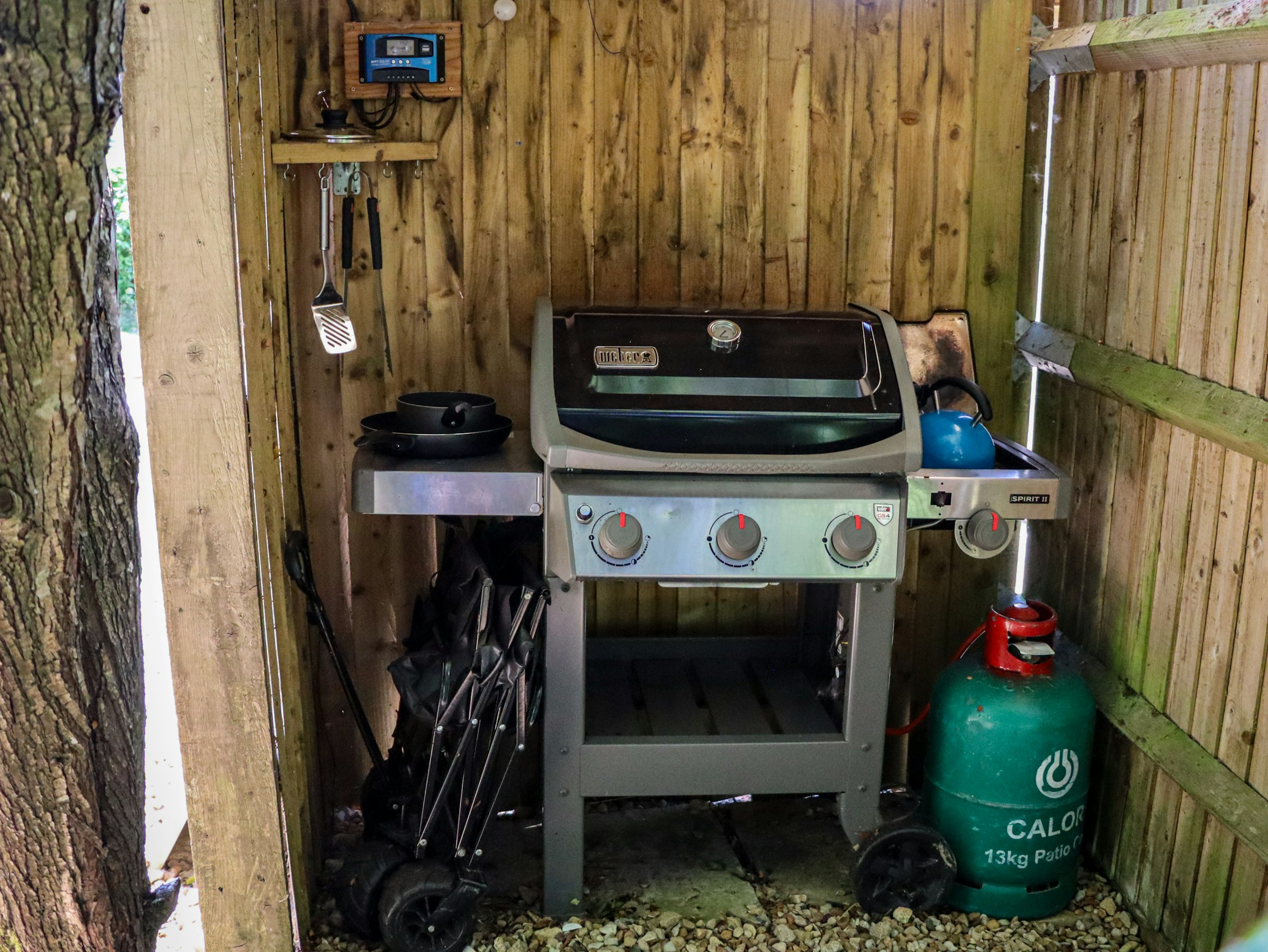
Yes, you can leave a propane tank in the sun, and no, it is not going to explode. A 20-pound grill tank baking on a Texas patio never gets close to the pressure that opens its safety relief valve. What heat really causes is venting, faster corrosion, and a regulator that makes your grill cook badly. Store the tank upright, outdoors, in shade.
This question comes up every August in Grand Prairie, Arlington, and Mansfield, usually right after somebody hears a hiss from the tank while the burgers are on. It is a fair thing to wonder about, and mostly the wrong thing to worry about. Here is what the numbers say, and what our crews actually find on hot-weather service calls.
Will a propane tank explode in the Texas sun?
No. A grill cylinder sitting in direct sunlight does not reach the pressure it would take to rupture. Every DOT-spec propane cylinder sold in the United States has a spring-loaded pressure relief valve built into the valve assembly. According to Propane101, that relief valve is set at 375 psi. If internal pressure ever climbs that high, the spring lifts, the valve vents gas, and pressure drops back down.
A propane cylinder is built to leak before it fails. Venting is not the tank breaking. Venting is the tank working.
How much pressure does heat actually add to a grill tank?
Less than most people assume, and nowhere near the 375 psi relief setting. Propane pressure tracks temperature, so a hot tank does read higher. But the gap between a hot Texas afternoon and a burst cylinder is enormous.
According to the FAA Balloon Flying Handbook vapor pressure table, propane sits at roughly 110 psig at 70°F and about 177 psig at 100°F. According to the National Refrigerants pressure-temperature chart for R-290, which is propane, the number reaches about 259 psig at 130°F.
| Tank temperature | Approximate internal pressure | Relief valve opens at |
|---|---|---|
| 70°F | 110 psig | 375 psi |
| 100°F | 177 psig | 375 psi |
| 130°F | 259 psig | 375 psi |
A steel tank in full sun on a black concrete pad can run hotter than the air around it. It still lands well under the relief setting. That headroom is why the 80 percent fill rule exists: fillers leave 20 percent of the cylinder as vapor space so the liquid has somewhere to go when it warms up and expands.
And this is not a rare situation here. According to the National Weather Service Fort Worth office, DFW averages 18 days a year at 100°F or hotter. Millions of grill tanks sit through every one of them without incident.
So what actually goes wrong when a tank cooks in the sun all summer?
Four things, and none of them are explosions. These are the real reasons to move your tank into the shade.
- Relief venting. An overfilled tank has less vapor space, so it hits the relief setting sooner. You get a hiss and a propane smell. That is a legitimately overfilled cylinder, not a defective one.
- Corrosion at the foot ring. Heat plus DFW humidity plus a tank parked on damp concrete rusts the base first. That is where cylinders usually fail requalification.
- Valve and O-ring wear. The rubber seal at the POL connection dries out and cracks faster under UV and heat cycling. A cracked O-ring is one of the most common slow leaks we find.
- Regulator behavior. A hot regulator combined with a hot tank makes flame output unpredictable. If your burners drop to a trickle, that is usually the regulator in bypass mode, not the heat. We wrote up that two-minute reset in why your gas grill flames are so low.
If you smell propane at any point, shut the tank valve first and diagnose second. Our guide to finding a propane leak safely walks through the soapy water test.
Where should you store a propane grill tank in DFW?
Outdoors, upright, in shade, away from doors and windows. Here is the order to do it in.
- Close the tank valve fully, clockwise, until it stops.
- Keep the cylinder upright. Always. The relief valve is designed to vent vapor, not liquid.
- Move it out of direct afternoon sun. A north wall, a patio corner, or a shade cover all work.
- Get it off bare damp concrete. A paver, a brick, or a scrap of composite decking under the foot ring stops most base rust.
- Keep it clear of building openings. Blue Rhino advises storing tanks in a shaded, cool, ventilated outdoor area at least 5 feet from any doorway or opening.
- Check the O-ring in the tank connection each spring. Replace it if it is cracked, flattened, or missing.
Can you keep a propane tank in the garage or leave it in the car?
No to both, and the car one is the more urgent rule. A garage or a closed trunk is exactly the enclosed space where a small vent or leak becomes a real hazard, because propane is heavier than air and pools at floor level instead of dispersing.
According to the Propane Education and Research Council Safety Guide for Portable Propane Cylinders, you should not leave cylinders inside a vehicle or trunk, because the relief valve may release propane if the parked vehicle gets too hot. PERC says to drive directly to your destination and remove the cylinder immediately. Their transport limits are no more than four 20-pound cylinders, nothing larger than 45 pounds, and no more than 90 pounds of propane total.
Does a hot propane tank change how your grill cooks?
Sometimes, but grease is usually the real culprit. Homeowners blame the tank for weak heat, uneven zones, and long preheats far more often than the tank deserves it. What we pull out of fireboxes on those calls is carbonized grease on the flame tamers, blocked burner ports, and a drip tray nobody has emptied since spring.
Heat and a dirty firebox stack up. A grease-loaded grill already radiates heat where it should not, and summer sun on the cabinet makes it worse. A full deep clean and restoration starts at $239 and puts the burners, tamers, and grates back to bare metal. If the burner tubes or valves are actually failing, that is gas grill repair territory. Current rates for both are on our pricing page.
Not sure whether your cylinder is even legal to refill anymore? That date is stamped in the collar, and we covered how to read it in does a propane tank expire.
Frequently asked questions
Can a propane tank explode from sitting in the sun?
No. A grill cylinder in direct sunlight does not reach rupture pressure. The relief valve is set at 375 psi, and propane at 130°F sits around 259 psig. Long before a tank could burst, the relief valve opens and vents gas to bring pressure back down. Venting is the safety system doing its job.
How hot is too hot for a propane grill tank?
Standard guidance is to keep cylinders below 120°F. That is a storage temperature, not an air temperature. Even on a 105°F DFW afternoon, a shaded tank stays well under it. A tank on black asphalt in full sun can approach that range, which is the practical reason to keep it shaded.
Should I cover my propane tank in the summer?
Shade helps, but do not seal the tank inside anything airtight. A vented tank cover or a shaded corner of the patio is ideal. A sealed plastic bin is not. Cylinders need open air around them so any vented gas disperses instead of collecting. Airflow matters more than the cover itself.
Is it safe to leave the tank connected to the grill year-round?
It is common and generally fine, as long as the valve is closed when you are not cooking and the grill lives outdoors. Close the tank valve after every cook. That single habit protects the regulator and the hose, and it means a failed O-ring cannot leak for weeks unnoticed.
Why does my propane tank hiss on a hot afternoon?
A brief hiss on a hot day usually means the relief valve is venting a small amount of pressure, which most often points to an overfilled cylinder. Move the tank to shade, keep it upright, and stay clear of ignition sources until it stops. A continuous hiss with a strong odor is a leak, not normal venting.
Can I store a propane tank in my garage in Texas?
No. Propane is heavier than air, so any vented or leaked gas settles at floor level in an enclosed garage instead of dispersing. Water heaters, cars, and light switches all live at that level. Store cylinders outdoors in a shaded, ventilated spot, upright, and clear of doorways and windows.
Does heat make my tank gauge read wrong?
Pressure gauges on grill tanks are misleading in any weather, and heat makes them worse. A warm tank shows higher pressure whether it is full or nearly empty. Weigh the tank instead. Subtract the tare weight stamped on the collar from the total, and what remains is your propane in pounds.
Grill running hot, weak, or uneven this summer?
Nine times out of ten it is not the tank. Book online at texasgrillclean.com/book-appointment or call (817) 791-4606. We serve Grand Prairie, Arlington, Fort Worth, and the rest of the DFW Metroplex. Free estimates, licensed and insured.
Texas Grill Clean is part of 1st Choice Residential, veteran-owned and serving Dallas-Fort Worth since 2009.