
 3302 Westgrove Drive Arlington, TX 76001


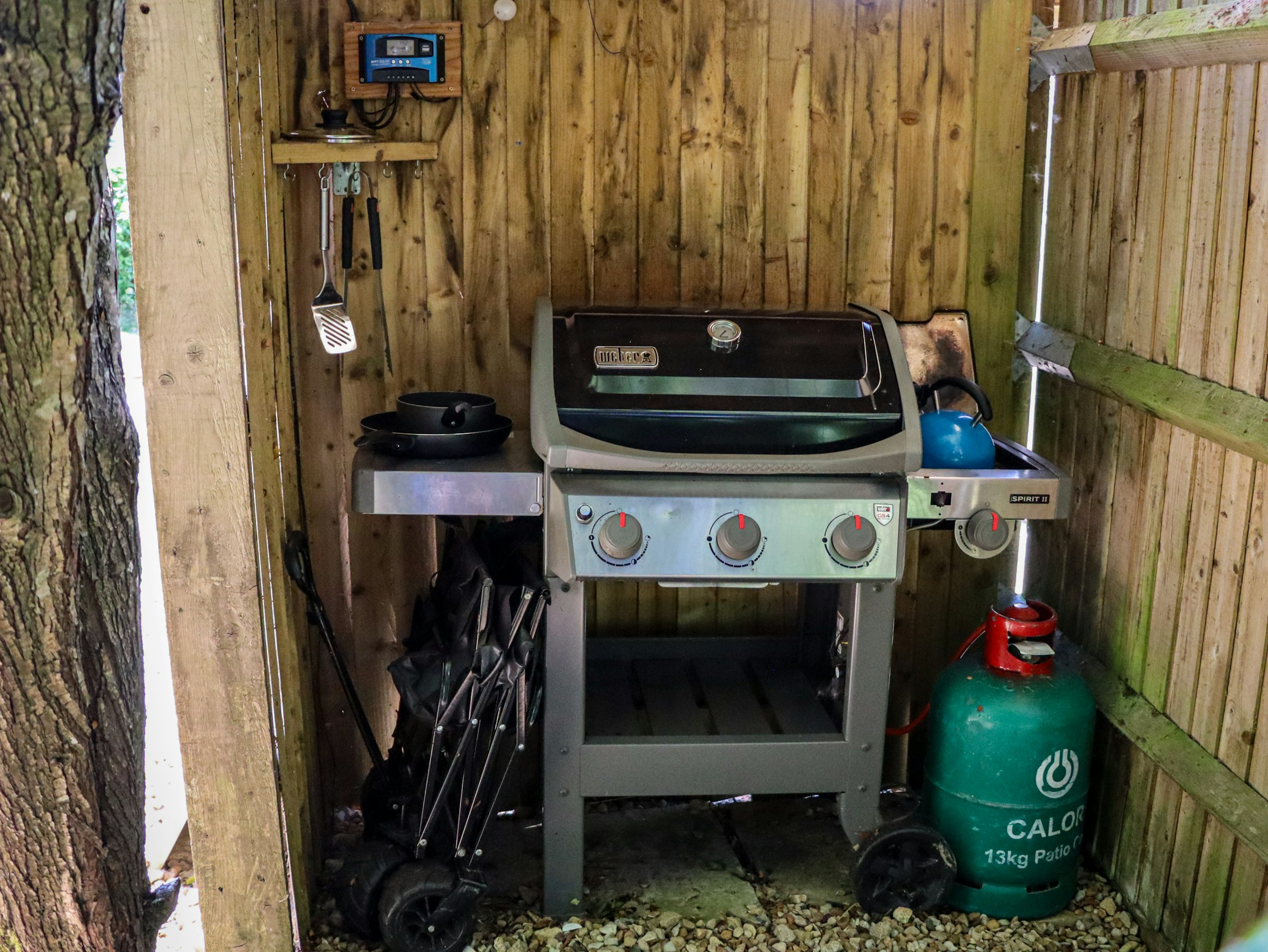
Yes. A propane grill tank has an expiration date, and it is stamped into the metal collar at the top. According to the U.S. Department of Transportation’s PHMSA, cylinders must be requalified within 12 years of manufacture. After that, no licensed filler can legally refill the tank until it has been inspected and re-stamped.
Most people in Grand Prairie, Arlington, and Keller have never looked at that stamp. They swap the tank at the exchange cage and drive home, which works fine. But if you refill instead of exchange, or you inherited a grill with a tank already on it, the date matters. Here is how to read it in 30 seconds.
How long is a propane tank good for?
A standard 20-pound grill cylinder is good for 12 years from its manufacture date, then it needs requalification before anyone can refill it. The tank does not turn dangerous the day it hits 12 years. What changes is whether a filling station will touch it.
Requalification is a real inspection by a DOT-registered requalifier. They look for corrosion, pitting, dents, bulges, and valve problems. Pass, and they stamp a new date on the collar. Fail, and the tank gets condemned. In Texas, cylinder-filling operations are also licensed by the Railroad Commission of Texas.
The clock exists because a grill cylinder lives outside in Texas heat, sits in sprinkler overspray, and gets dragged across concrete. Steel does not stay perfect under that.
Where is the date on a propane tank, and how do I read it?
The manufacture date is stamped into the collar, the metal ring that surrounds and protects the valve. Look on the flat outer face of that collar, usually near the handle. Here is the sequence:
- Turn the tank valve off and disconnect the regulator hose.
- Rotate the tank so you can see the whole collar. The stamps run around it.
- Find a four-digit group that reads like a date, such as 06 16. The first two digits are the month, the second two are the year. That example means June 2016.
- Add 12 years. A June 2016 tank is due for requalification by June 2028.
- If the manufacture date is already more than 12 years old, look for a second, later date stamp. That is the requalification date, and it may have a letter after it.
The collar also carries the DOT specification (usually 4BA240 or 4BW240 on a grill tank), the serial number, and the tare weight, marked TW. Tare weight is the empty weight of the cylinder. It is how a refill station figures out how much propane you actually got.
What do the letters after the requalification date mean?
The letter tells you which inspection method was used, and that determines how long the new certification lasts. This is the part almost nobody knows, and it changes the answer by seven years.
According to PHMSA’s cylinder guidance, the markings break down like this:
| Stamp | Inspection method | Good for | Example: stamped 4-22 |
|---|---|---|---|
| Date with no letter | Volumetric expansion test | 12 years | Due April 2034 |
| Date followed by S | Proof pressure test | 10 years | Due April 2032 |
| Date followed by E | External visual inspection only | 5 years | Due April 2027 |
So a tank stamped 0422E is not good until 2034. It is good until April 2027. The E is the short one, and it is the most common stamp on a requalified grill cylinder because a visual inspection is the fastest method. You will usually see a requalifier ID number next to it, which looks like V123456.
What does OPD mean, and does my tank need one?
OPD stands for overfill prevention device, and yes, your 20-pound grill tank needs one. It is a float-operated shutoff built into the valve that stops the fill before the cylinder gets dangerously full.
According to PHMSA, NFPA 58 requires an OPD on all cylinders with 4 to 40 pound propane capacity that were refilled on or after April 1, 2002. PHMSA notes plainly that for most consumers, this applies to their 20 lb gas grill tank.
Spotting one takes two seconds. An OPD valve has a triangular handwheel instead of the old round or star-shaped one, and the letters OPD are usually stamped on the wheel. A round handwheel means the tank predates the rule and no reputable filler will touch it. Those still show up in DFW garages, usually on a grill nobody has fired since the last owner lived there.
When should you stop messing with it and just replace the tank?
Replace the cylinder when it shows physical damage, because a damaged tank fails inspection anyway. PHMSA’s guidance says a cylinder should not be filled if it has any of the following:
- Excessive rust, corrosion, or pitting, especially near the bottom where the tank sits on concrete
- Dents, bulges, cuts, or cracks in the surface
- A missing or damaged footring, collar, or valve cover
- A leaking or defective valve or pressure relief device
Bottom-edge rust is the one our crew sees most, on the Gulf Coast side of our service area and on any DFW patio where the tank sits straight on a concrete slab. Water wicks under the footring and stays. If you can flake rust off the bottom rim with a fingernail, that tank is done.
Should you refill or exchange your tank in DFW?
Refilling gets you more propane for your money. Exchanging gets you a tank whose date is somebody else’s problem. Both are fine. They solve different things.
A refill station fills to the cylinder’s actual capacity, which on a 20-pound tank is right around 4.7 gallons. Exchange programs fill less. Blue Rhino states its grill tanks contain a net weight of 15 pounds. You are paying for the swap and the convenience, not for a full tank.
The date angle cuts the other way. Exchange takes your out-of-date cylinder and hands you an inspected one. Refill leaves the date for you to track. If your tank is coming up on 12 years, an exchange is the clean exit.
What does a tank’s age have to do with how the grill runs?
The tank’s age does not affect performance, but the valve and regulator on an old setup very often do. This is where tank questions turn into grill questions.
What our crew runs into most on a service call is not a bad tank. It is a regulator stuck in bypass mode, which chokes gas flow to a trickle and leaves lazy flames on every burner and a grill that will not break 300 degrees. That has nothing to do with the date stamp. The two-minute fix is in our guide to low flames and bypass mode.
The second is a slow leak at the connection, usually a dried-out gasket inside the QCC coupling or a hose kinked behind the cart for three summers. If you smell propane, shut the tank valve first and read how to find a propane leak safely before you light anything.
An old cylinder with a corroded valve stem can also weep gas around the handwheel. That is a replace, not a repair. Nobody should put a wrench to a propane cylinder valve in their backyard.
Frequently asked questions
Does a propane tank expire if it is full and never used?
The propane itself does not go bad. Propane has no shelf life and will sit in a sealed cylinder for decades without degrading. What expires is the cylinder’s certification. A full tank that is 14 years old still holds usable fuel, but no licensed filler can top it off until it is requalified and re-stamped.
Can I still use an out-of-date propane tank on my grill?
Using propane already in the tank is not what the rule addresses. The rule governs refilling. A filler cannot legally add propane to a cylinder past its requalification date. That said, an out-of-date tank has gone more than 12 years without anyone checking it for corrosion or valve defects, which is the actual reason to retire it.
How do I tell if my propane tank has an OPD valve?
Look at the handwheel you turn to open the tank. An OPD valve has a triangular wheel, usually with the letters OPD stamped into it. Older non-OPD valves have a round or five-point star wheel. If yours is round, the tank was made before the requirement and cannot be refilled.
Where should I store a spare propane tank?
Outside, upright, away from the house, and never inside a home, a basement, or an attached garage. Propane is heavier than air, so any leak settles at floor level instead of dissipating. Keep the valve closed and the cap or plug in place. The NFPA LP-Gas fact sheet covers the basics.
Do I need a professional for a tank or regulator problem?
For the tank itself, no. Take it to a refill station or swap it. For anything downstream of the tank, including the regulator, hose, manifold, or valves, a professional is the safer call. Texas Grill Clean handles gas grill repair across the Metroplex, and estimates are free.
Get the whole gas system checked, not just the tank
A date stamp is the easiest part of your grill to check. The parts that cause real problems sit behind the control panel where you cannot see them: the regulator, the manifold, the burner orifices, and the venturi tubes that spiders nest in every spring in North Texas.
Our deep clean starts at $239 and includes pulling the grill down to the firebox, degreasing the flame tamers and burners, and checking gas flow on the way back together. See current pricing, browse our Grand Prairie grill cleaning page, or check the full service area list.
Book an appointment online or call (817) 791-4606.
Texas Grill Clean is part of 1st Choice Residential, veteran-owned and serving Dallas–Fort Worth since 2009. Licensed and insured. Free estimates.