
 3302 Westgrove Drive Arlington, TX 76001


If your natural gas grill drops heat the moment the side burner, pizza oven, or fire pit kicks on, the grill isn’t broken. The gas line feeding your outdoor kitchen can’t carry the combined load. Every appliance on that line shares one pipe. Add one more burner and the pressure at the grill falls, so the flames shrink.
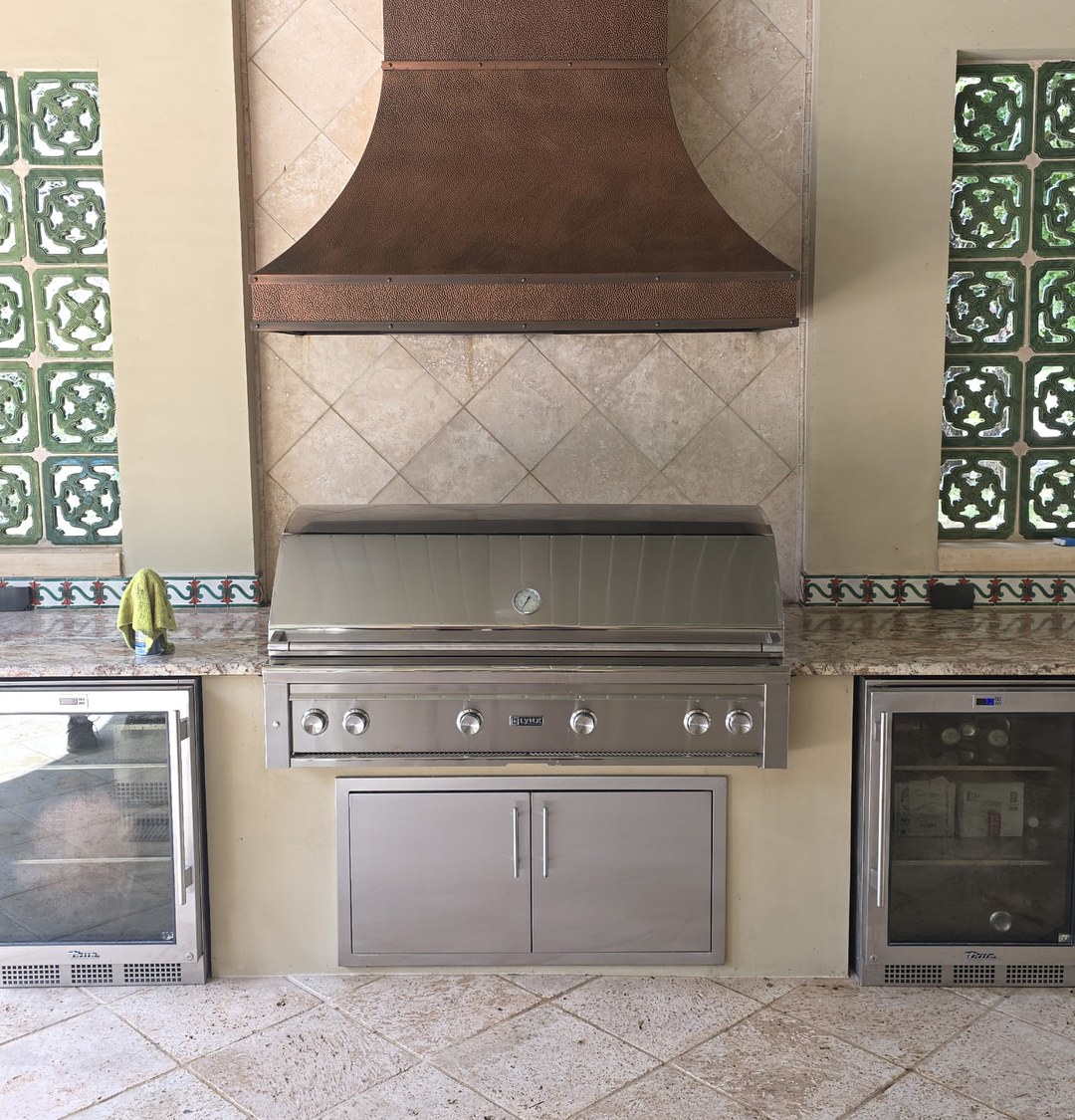
We see it on built-in outdoor kitchens across Frisco, Southlake, Plano, and Colleyville. The grill runs fine alone. Light the side burner and the main grates fall off hard. Homeowners call it a grill problem. It’s a plumbing problem.
Why does my grill lose heat when another burner runs?
Because gas pressure is shared, not reserved. One pipe leaves your meter and feeds everything in the outdoor kitchen, and that pipe has a fixed carrying capacity set by its diameter and length. With only the grill running, pressure at the manifold stays where it should. Turn on a second appliance and demand climbs past what the pipe can deliver. Pressure sags everywhere on the line at once.
You notice the grill first because it’s the one you’re standing over. The side burner is getting starved too. Nothing is malfunctioning. The pipe is too small, too long, or both.
How much gas does a built-in grill actually need?
More than most homeowners guess, and the number is printed on the grill. Gas appliances are rated in BTU per hour. Pipe sizing converts that rating to flow at roughly 1,000 BTU per hour per cubic foot per hour, so a 90,000 BTU grill pulls about 90 CFH.
Real numbers from a real manual: according to the Lynx Professional Grills installation guide, an L36R is rated 89,000 BTU/hr and an L54TR is rated 126,000 BTU/hr. Blaze publishes its own figures: the Premium LTE 32-inch four-burner reaches 66,000 BTU once the rear rotisserie burner is counted.
Then add the rest of the outdoor kitchen. Those loads stack. A 90,000 BTU grill plus a 60,000 BTU power burner is a 150,000 BTU line, and it has to be piped that way from the start.
How far can a 3/4-inch gas line run before it starves your grill?
Not as far as most outdoor kitchens are built. Carrying capacity drops fast as the run gets longer. Lynx publishes a maximum-load table for 3/4-inch pipe in its own installation guide, and it tells the whole story:
| Run length, 3/4-inch pipe | Max BTU for ALL appliances on the line |
|---|---|
| 10 feet | 360,000 BTU |
| 20 feet | 245,000 BTU |
| 30 feet | 198,000 BTU |
| 40 feet | 169,000 BTU |
| 50 feet | 150,000 BTU |
| 60 feet | 135,000 BTU |
| 70 feet | 123,000 BTU |
| 80 feet | 115,000 BTU |
Source: Lynx Professional Grills Care & Use / Installation guide, Maximum Runs For All Appliances On Supply Line.
Read that 80-foot row again. At 80 feet a 3/4-inch line tops out near 115,000 BTU for everything combined. A 126,000 BTU grill by itself already exceeds it, with nothing else connected. The same manual says it plainly: in no case should an inlet pipe less than 3/4-inch inside diameter ever be used, and failure to meet the run requirements may reduce performance of the grill and any other appliances on that supply line.
What pressure should a natural gas grill actually see?
Around 4 inches of water column at the manifold, and it has to hold there with every burner lit. That last part separates a good install from a bad one. The Lynx guide specifies natural gas inlet pressure of at least 5 inches W.C. and manifold pressure of not less than 4 inches W.C. under full load, with all burners on. The Blaze Professional grill manual states the regulator must be set for 4 inches water column on natural gas. Propane is different, regulated near 11 inches W.C.
A line that’s too small still reads fine at idle. It only fails under load. That’s why the problem shows up the instant a second appliance lights, and why a pressure check with one burner running proves nothing.
All of it traces back to NFPA 54, the National Fuel Gas Code, the standard the Lynx manual names directly. It sizes piping off the longest run from the meter to the farthest appliance and the total connected BTU load.
How do you tell a gas-supply problem from a dirty grill?
Run one test: light everything at once and watch what happens. A supply problem gets worse as you add burners. A cleaning problem doesn’t care how many burners are on.
- Light the grill alone, all main burners on high, lid closed. Give it 15 minutes and note the temperature.
- Look at the flames. Even blue cones across every port is a healthy burner. Ragged or yellow flames point at dirt, not supply.
- Now light the side burner, power burner, or anything else on that line. Watch the main burners.
- If the grill flames visibly shrink within seconds and the temperature falls, that’s a shared-supply problem.
- If the flames hold steady and the grill is just running cool, the issue is inside the grill. Think clogged burner ports, a spider web in a venturi tube, or grease-caked flame tamers.
- If one burner is weak while the others are strong, that’s a blocked port or orifice. A whole-grill drop is supply.
Two field notes. A grill converted from propane to natural gas with the wrong orifices behaves a lot like a starved grill, so rule that out first. And on a propane tank, weak flames everywhere usually mean a regulator stuck in bypass, which has a two-minute reset.
What actually fixes it?
Either the pipe gets upsized or the load gets reduced, and the pipe work goes to a licensed gas professional. There’s no homeowner fix for an undersized gas line, and we won’t pretend otherwise. Repiping an outdoor kitchen supply line is licensed, permitted work in Texas.
What our crew can do is tell you which problem you actually have before you pay a plumber to solve the wrong one. A grill choked with carbon and a grill choked for gas look identical from the patio. They aren’t.
If it’s supply, we document the total connected BTU load, the run length, and how pressure behaves under full load, and you hand that to your gas plumber. If it’s the grill, we fix it. A full grill restoration and deep clean starts at $239 and clears the burner ports, flame tamers, and firebox that steal heat. Gas grill repair starts at $239 plus parts with a 30-day labor warranty. Current numbers are on our pricing page.
Why does this happen so often in newer DFW outdoor kitchens?
Because the meter is at the front of the house and the outdoor kitchen is at the back corner of the lot. In newer Frisco and Southlake construction that’s easily a 60 to 90 foot developed run once you count elbows and tees. Then the kitchen gets built out over several years. Grill first. Side burner next season. Fire pit the year after. Nobody resizes the pipe, because nobody planned for the third appliance when the first one went in.
We see the same pattern on Frisco outdoor kitchens and Southlake built-ins constantly. The grill gets blamed for years. The pipe was the problem all along.
Frequently asked questions
Can a dirty grill cause the same low-heat symptom?
Yes, and it is more common than an undersized line. Carbon-caked flame tamers, blocked burner ports, and a grease-packed firebox all rob heat. The difference is behavior. A dirty grill runs cool no matter what else is on. A starved grill drops noticeably the second another appliance lights on the same supply line.
What size gas line does a built-in grill need?
The Lynx Professional installation guide says never use an inlet pipe smaller than 3/4-inch inside diameter for its grills, and it sizes the run off total connected BTU load. Correct size depends on how many appliances share the line and how far the pipe travels from the meter. A licensed gas professional sizes it under NFPA 54.
Why does my grill work fine alone but not with the side burner?
Both appliances draw from one pipe with a fixed capacity. Alone, the grill stays under that ceiling. Together, combined demand passes it and pressure falls at both appliances at once. The grill is simply the one you notice, because you are standing at it watching the flames shrink.
Can I just turn up the regulator to get more heat?
No. The regulator is set to the pressure your grill was designed and certified for, generally 4 inches water column on natural gas. Raising it does not add capacity to an undersized pipe, and over-pressuring a gas appliance is dangerous. Regulator adjustment is work for a licensed gas professional, not a patio fix.
Does this happen with propane grills too?
It can, but it looks different. Propane tank grills more often suffer from a regulator stuck in bypass mode, which chokes flow on every burner at once. That one has a two-minute reset. Hard-piped propane outdoor kitchens can have true sizing problems, and propane regulates at roughly 11 inches water column instead of 4.
Will cleaning my grill fix a gas line problem?
No, but it will tell you whether you have one. A deep clean removes every heat-robbing variable inside the grill. If full heat comes back, it was never the pipe. If the grill still sags the moment a second burner lights, you have your answer and a clean grill to go with it.
Get a straight answer before you repipe
If your grill sags every time something else lights, rule the grill in or out first. It’s the cheaper half of the question and the half we can settle in one visit.
Book a service visit or call (817) 791-4606. We cover Dallas-Fort Worth, including Frisco, Southlake, Plano, Colleyville, Grapevine, Keller, Arlington, and Fort Worth. See the full service area list or our grill and chimney FAQ.
Texas Grill Clean is part of 1st Choice Residential, veteran-owned, locally owned rather than a franchise, licensed and insured, and serving Dallas-Fort Worth since 2009. 3302 Westgrove Drive, Arlington, TX 76001.