
 3302 Westgrove Drive Arlington, TX 76001


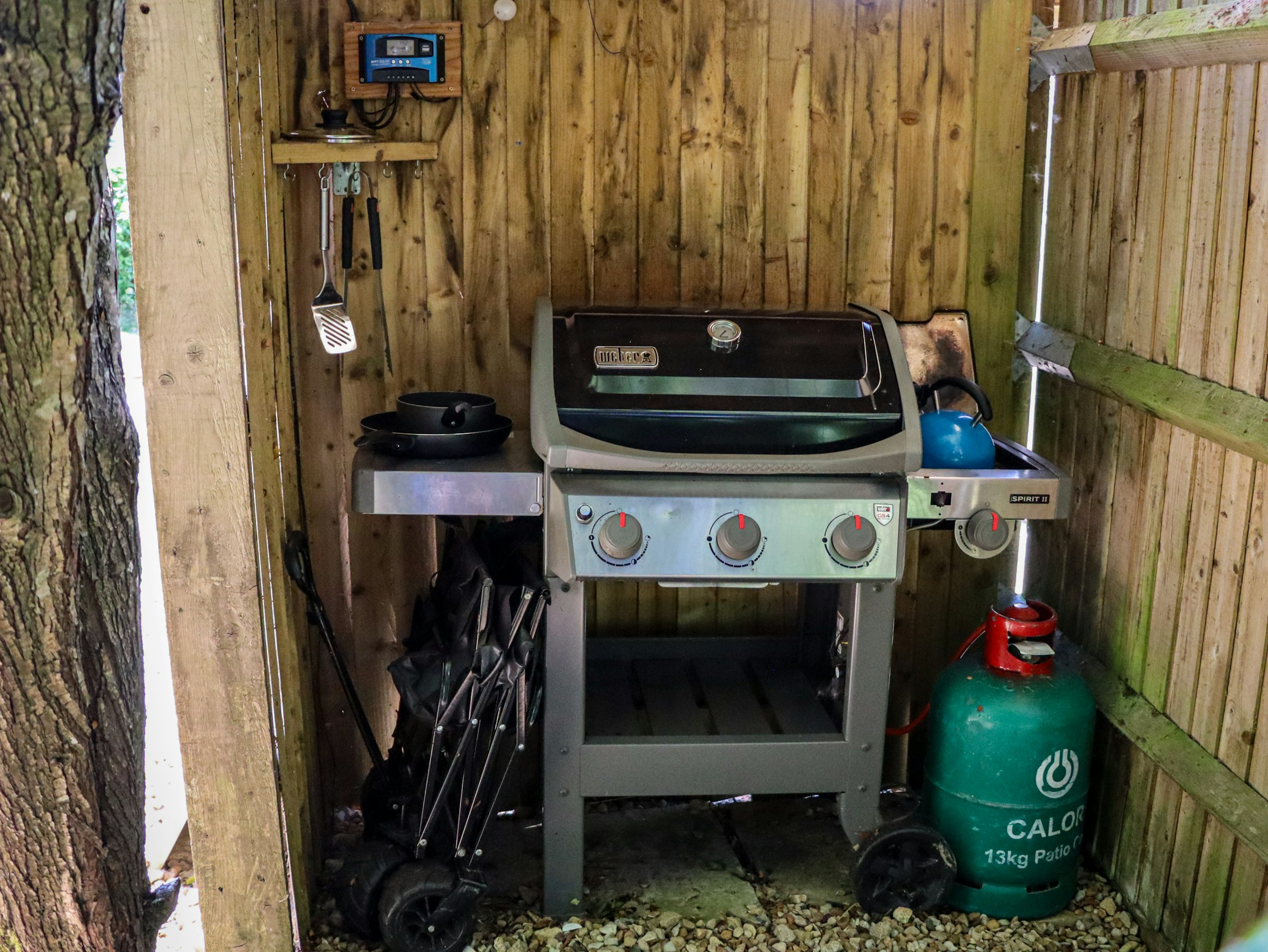
Yes, you can put a grill under a covered patio, but only if two things are true. The ceiling has to be high enough to meet the grill maker’s published clearance, and the overhead structure has to be non-combustible or covered by a vent hood. A wood or vinyl ceiling with no hood is the setup that starts fires.
Almost every backyard built in Dallas, Fort Worth, Frisco and Southlake in the last fifteen years came with a covered patio. Homeowners roll a grill under it, and nobody ever checks the manual. Here is what the manuals actually say, and what our crew sees on those patios after a few seasons.
Can you grill under a covered patio at all?
You can, as long as the roof is high enough and either non-combustible or served by a vent hood. Manufacturers do not ban covered patios outright. They ban unprotected combustible material directly above the cooking surface. Stucco soffit, cement board, stone, and metal are non-combustible. Cedar tongue-and-groove, exposed rafters, painted plywood, and vinyl soffit are not.
That distinction is the whole answer. A grill under a stucco-and-stone patio ceiling twelve feet up is fine. The same grill under a stained cedar ceiling eight feet up is a problem, and it will keep being a problem until you add a hood or move the grill.
How much overhead clearance does a grill need?
Five to six feet above the cooking surface is the common manufacturer minimum, and each brand publishes its own number. Nominal ceiling height is not the measurement. Measure from the cooking grate up, not from the patio slab.
| Brand | Overhead requirement | Combustible ceiling |
|---|---|---|
| Blaze | Minimum 6 feet between the countertop and overhead construction | Requires a vent hood larger than the cooking area, minimum 1,200 CFM |
| Lynx | Minimum 60 inches between the grilling surface and overhead construction | Requires an exhaust hood, no less than 1,200 CFM |
| Weber (freestanding gas) | 24 inches minimum from combustible material on top, bottom, back and sides | Not for use beneath overhead combustible construction |
According to the Blaze Professional use and care guide, a minimum of 6 feet of clearance is required between the countertop and the overhead construction. Lynx’s care, use and installation instructions call for a minimum 60-inch clearance between the grilling surface and overhead construction. According to Weber’s gas grill owner’s manuals, the grill must not be used within 24 inches of combustible material on the top, bottom, back or sides, and must not be used beneath overhead combustible construction.
Check your own model before you trust a general number. A built-in Blaze in an island and a cart-model Weber Genesis are held to different rules, and the warranty follows the manual, not the internet.
Why is a covered patio riskier than an open one?
A roof traps heat and grease vapor against a surface that cannot shed it. On an open patio, hot cooking vapor rises and disappears. Under a roof, it hits the ceiling, cools, and leaves a film. Season after season that film thickens into the same polymerized grease layer that coats the inside of a firebox. Add a flare-up underneath it and you have fuel directly over an open flame.
The fire data lines up with that. According to the National Fire Protection Association, U.S. fire departments respond to an annual average of 12,141 home fires involving grills, hibachis or barbecues, and roughly 25% of the home structure fires involving grills started on an exterior balcony or open porch. In 8% of those structure fires an outside wall ignited first, and in 3% the structural framing or wood members went first. NFPA also reports that 20% of grilling fires trace back to a grill that had not been cleaned.
Read those two facts together. Covered outdoor space is where grill fires turn into house fires, and a dirty grill is the leading contributing factor. Put a dirty grill under a wood ceiling and you have stacked both.
Do you need a vent hood over a grill on a covered patio?
You need a hood any time combustible material sits above the cooking surface, and most premium brands spell out the CFM. Blaze and Lynx both call for a minimum of 1,200 CFM for outdoor use. That is far more than a typical indoor range hood moves, because an outdoor grill puts out several times the BTUs of an indoor cooktop.
A hood also has to be wider than what it covers. Lynx asks for 3 to 6 inches of overhang on all exposed sides. A 42-inch hood over a 36-inch grill is the usual pairing, not a 36 over a 36.
A hood only works if the filters are clean. Grease-loaded baffle filters choke airflow and become their own fire load. We cover the routine in our guide to cleaning an outdoor kitchen vent hood.
How do you set up a covered patio grill safely?
- Find your model’s number. Pull the manual or search the model number plus “installation.” Do not guess.
- Measure from the grate, not the floor. Tape measure from the cooking surface straight up to the lowest point of the ceiling, including beams and light fixtures.
- Identify the ceiling material. Stucco, cement board, stone and metal are non-combustible. Wood, vinyl and painted plywood are not.
- Add a hood or move the grill. If the ceiling is combustible and you are short on height, a rated hood is the fix. Rolling the cart out from under the roof to cook is the free fix.
- Keep the sides honest. Weber’s 24-inch rule applies to walls and posts too, not just the ceiling. Screened porches and pergola posts get crowded fast.
- Verify the gas side. A propane cylinder never goes in an enclosed cabinet or a sealed island. If you smell gas, stop and read how to find a propane leak safely.
- Clean on a schedule. Under a roof, grease has somewhere to go and it goes there. Deep clean before it builds.
What about pergolas, screened porches and built-in islands?
A pergola with open slats is not a solution, and a screened porch is worse than a covered patio. Open slats still put combustible wood directly over the flame path, and the gaps do not vent much. Screened porches trap smoke and carbon monoxide, which is a health problem before it is a fire problem.
Built-in islands under a roof have a second issue. The island itself has to breathe. Sealed masonry islands need vent openings so a slow leak has somewhere to go, which we walk through in our post on built-in grill island vents. A covered patio does not change that requirement. It adds to it.
Frequently asked questions
Can you put a grill under a covered patio?
Yes, if the ceiling clears the manufacturer’s published minimum and the overhead material is non-combustible or covered by a rated vent hood. Blaze calls for 6 feet above the countertop. Lynx calls for 60 inches above the grilling surface. Weber’s freestanding gas grills are not approved for use beneath overhead combustible construction at all. Check your own model’s manual first.
How high does a patio roof need to be above a grill?
Most premium grill makers publish 5 to 6 feet of clearance measured from the cooking surface up to the lowest point of the overhead structure. Blaze specifies a minimum of 6 feet from the countertop. Lynx specifies a minimum of 60 inches from the grilling surface. Measure to the lowest obstruction, including beams, fans and light fixtures, not to the highest part of the ceiling.
Do you need a vent hood over a grill on a covered patio?
You need one whenever combustible material sits above the cooking surface. Blaze and Lynx both require an exhaust hood of no less than 1,200 CFM for outdoor use, sized larger than the cooking area. Lynx asks for 3 to 6 inches of overhang on all exposed sides. A hood with clogged grease filters does not count, because blocked baffles kill airflow.
Can you grill under a wood pergola?
Not safely without a hood or a real height buffer. Open slats still place combustible wood in the direct path of heat and grease vapor, and the gaps between slats vent far less than people assume. Over a few seasons the underside of the slats picks up a grease film. If the pergola is your only cover, roll a cart grill out from under it while you cook.
Why does my covered patio ceiling look yellow or greasy?
That film is cooking vapor that rose, cooled against the ceiling, and stuck. It is the same polymerized grease that hardens inside a firebox, just spread thin over a wide surface. It is not paint failure and it will not wash off with plain water. It also means the vapor has nowhere to escape, which is the exact condition a vent hood exists to fix.
Is it safe to use a propane grill under a covered patio?
It can be, with the same clearance and ceiling rules that apply to natural gas. The added rule is the cylinder. A propane tank must stay outside any enclosed cabinet or sealed island, upright, and away from the burner. Leaks pool low in still air, and a covered patio has less air movement than an open yard. Soap-test the connections at the start of every season.
Grill under a roof? Clean it more often, not less
Every hour of cooking under a covered patio puts grease somewhere. Some lands in the firebox, some ends up on the ceiling above you. The firebox is the part you can control, and it is the part NFPA identifies as the leading contributing factor in grilling fires.
Texas Grill Clean handles full grill restoration and deep cleaning across DFW, including built-ins under covered patios in Southlake, Colleyville, Frisco and Grand Prairie. Deep cleans start at $239. Full pricing is on our pricing page, and coverage is listed on our service areas page.
Ready to get it done? Book an appointment online or call (817) 791-4606. Free estimates.
Texas Grill Clean is part of 1st Choice Residential. Veteran-owned, locally owned, licensed and insured, serving Dallas-Fort Worth since 2009. 3302 Westgrove Drive, Arlington, TX 76001.