
 3302 Westgrove Drive Arlington, TX 76001


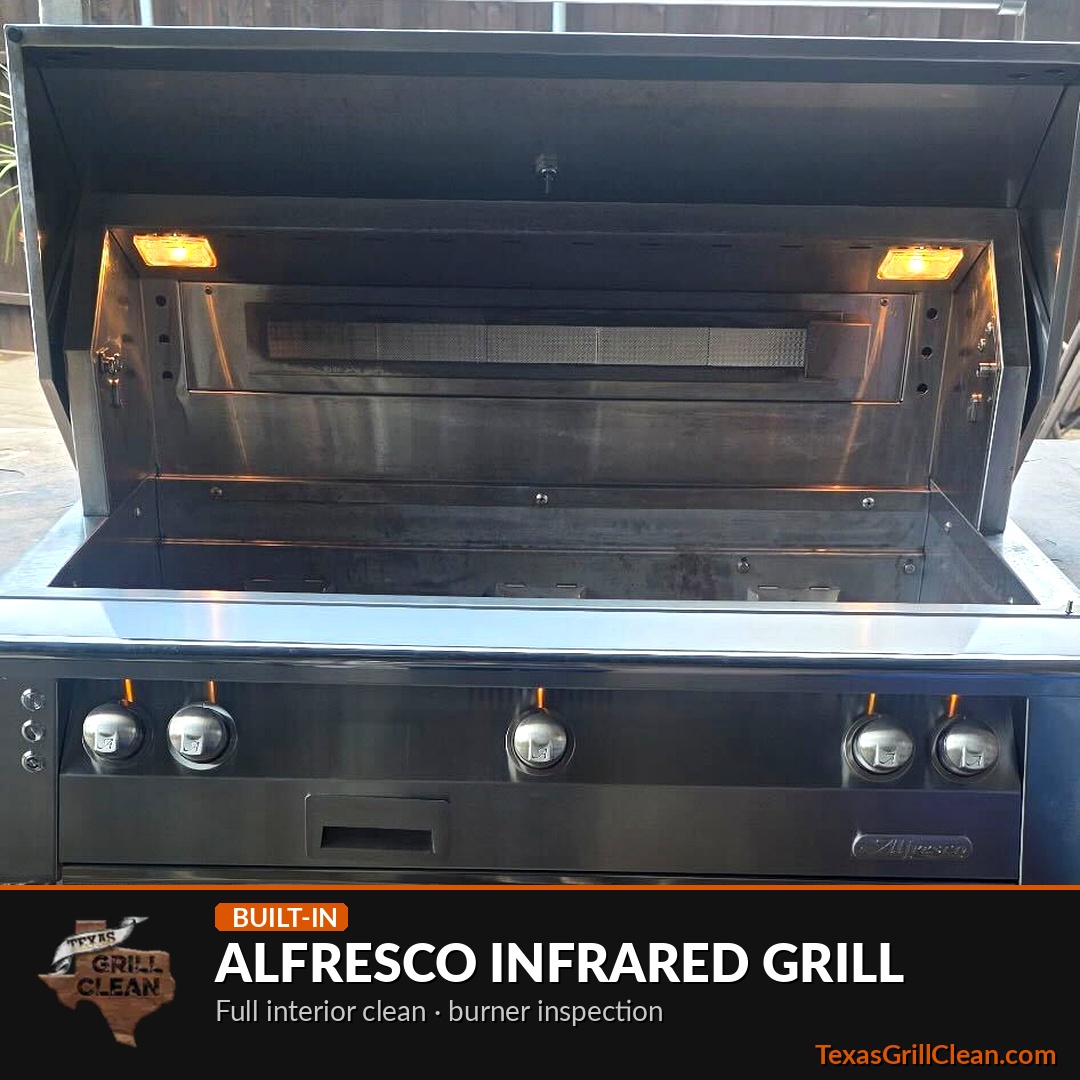
A grill rotisserie that won’t work fails in one of three places: the motor, the rear infrared burner, or the balance of the spit itself. Motors quit because of grease and moisture. Rear burners clog with drippings. An unbalanced spit stalls a motor that’s otherwise fine. Check power first, then the burner ports, then the counterweight.
Rotisseries are the most ignored part of an outdoor kitchen. Most homeowners in Colleyville, Grapevine, and Southlake use the main burners every weekend and fire the rotisserie twice a year. That’s exactly why it fails. Parts that sit unused in a North Texas backyard collect pollen, grease vapor, and moisture, and then get asked to work perfectly on Thanksgiving morning.
Here’s how to figure out what actually broke.
Why won’t my rotisserie motor turn?
A motor that hums but doesn’t turn is overloaded or gummed up. A motor that does nothing at all has lost power.
Start with the outlet. Almost every built-in outdoor kitchen in DFW runs off a GFCI receptacle, and those trip after storms and sprinkler overspray. The reset button is usually inside the island cabinet, sometimes behind the access door near the gas manifold. Press it and try again before you assume the motor is dead.
If the motor has power and still won’t spin, it’s usually one of three things. The spit rod isn’t seated all the way into the drive socket. The load is too heavy or off-center. Or the internal gear train has seized because grease vapor got past the housing seal and hardened inside.
That last one is common on grills we service after a long gap. Rotisserie motors live directly in the path of rising smoke. Even a sealed stainless housing lets vapor in over the years, and once that residue cools and hardens on the gears, the motor draws current, heats up, and hums without moving.
Worth knowing before you call the manufacturer: motors are electrical parts, and electrical parts carry much shorter coverage than the grill body. According to Blaze Grills, their gas grills carry a lifetime warranty on main burners, cooking grids, body, flame tamers, and control valves, while ignition, electronic, and lighting systems are covered for one year from purchase. Most premium brands split coverage the same way.
Why won’t the rear infrared burner light?
A rear infrared burner that won’t light is almost always blocked, not broken.
The rear burner sits at the back wall of the firebox, behind the grates, aimed forward at the spit. Every drip of fat that runs off a chicken lands on or near it. Over a season those drippings bake onto the perforated screen or ceramic panel and plug the gas ports.
The other frequent culprit is a spider web in the venturi tube. Rear burners have their own venturi running back from the valve, and because the burner sits idle most of the year, it’s prime real estate for mud daubers. We wrote about that specific failure in our guide to the spider in your grill, and it applies to rear burners even more than main burners.
Rear burners also run lower gas volume than main burners, which means a partial blockage kills them faster. According to Blaze Grills, the Premium LTE+ 32-inch grill pairs 14,000 BTU main burners with a 10,000 BTU infrared rear rotisserie burner. That’s less gas moving through a smaller opening, so it takes less debris to choke it out.
If the rear burner lights but the flame dies once you close the hood, the problem is airflow or gas supply rather than the burner itself. That’s the same family of causes we cover in why grill flames go out when the lid is closed.
Motor or burner: which one is actually failing?
Match your symptom to the column below before you buy a single part.
| What you see | Likely cause | Where to look | DIY or pro |
|---|---|---|---|
| No sound at all from the motor | No power | GFCI reset inside the island, cord, plug | DIY |
| Motor hums, spit doesn’t move | Seized gear train or overloaded spit | Motor housing, counterweight, meat position | DIY first, then pro |
| Spit turns in jerks or stalls at one point | Unbalanced load | Counterweight, fork placement | DIY |
| Rear burner clicks but won’t light | Blocked ports or fouled electrode | Perforated screen, ceramic panel, electrode tip | DIY or pro |
| Rear burner lights, then goes out | Venturi obstruction or gas supply | Venturi tube, valve, regulator | Pro |
| Yellow, lazy flame across the rear burner | Incomplete combustion | Air shutter, port blockage, debris | Pro |
| Spit rod spins but wobbles badly | Bent rod or loose forks | Spit rod, fork thumbscrews | DIY |
How do you balance a rotisserie spit so the motor doesn’t burn out?
Balance the spit before the motor ever runs. An off-center load is the single most common reason a rotisserie motor dies early.
- Run the spit rod through the center of the meat, not off to one side. On a whole chicken, that means through the cavity and out between the legs.
- Slide a fork onto each end with the tines facing the meat, then push both forks in firmly.
- Tighten the fork thumbscrews against the rod. Hand tight is enough. Overtightening strips the threads on the fork collar.
- Rest the rod across your open palms and let it roll. If it rolls to a stop in the same position every time, the heavy side is down.
- Slide the counterweight arm to the opposite side of the heavy spot and tighten it. Repeat the palm roll until the rod holds wherever you set it.
- Seat the pointed end into the motor drive socket and drop the other end into the support bracket on the far wall.
- Let the motor turn one full revolution before you light the burner. If it hesitates anywhere, stop and rebalance.
Truss the bird with butcher’s twine too. Loose wings and legs flop out, catch the grate, and give the motor something to fight.
How much weight can a grill rotisserie hold?
Most residential rotisserie kits are rated for about 15 pounds, and that number includes the forks and counterweight, not just the meat.
According to Napoleon, its heavy-duty stainless steel spit rod and motor hold and turn up to 15 lbs (6.8 kg) of food. That’s the ceiling for most residential kits, and people blow past it every holiday season trying to spin a 20-pound turkey.
A whole chicken is four to six pounds. A pork loin is three to five. Two chickens side by side is fine. A large turkey is not, and forcing it is how you end up buying a new motor in January.
Cook temperature matters as much as weight. According to the USDA Food Safety and Inspection Service, all poultry should be cooked to a safe minimum internal temperature of 165°F, measured with a food thermometer. Rotisserie chicken browns fast on the outside under an infrared burner, so check the thickest part of the breast and the innermost part of the thigh rather than trusting the color.
Does North Texas weather really kill rotisserie parts?
Yes, and it does it while the grill is sitting idle rather than while you’re cooking.
Three things stack up on DFW patios. Spring cedar and oak pollen settles into every opening on the grill, including rear burner ports and the motor’s ventilation slots. Hard water from sprinkler overspray leaves mineral deposits that hold moisture against stainless. And the humidity swing between a 100-degree afternoon and a cool morning pulls condensation into anything with an enclosed cavity.
A rotisserie motor mounted on the outside of the firebox catches all three. So does the rear burner, which sits at the coldest, wettest part of the grill when it isn’t running.
The crews see the same pattern on service calls across Grapevine, Colleyville, and Keller: main burners in decent shape, rear burner completely blocked, motor stiff. The parts nobody uses are the parts that fail.
If your stainless is showing white chalky spots too, that’s mineral deposit rather than rust, and we cover the fix in how to remove hard water spots from a stainless steel grill.
When is it worth calling a pro?
Call a pro when the problem is on the gas side. Handle the electrical and mechanical side yourself.
Resetting a GFCI, rebalancing a spit, tightening forks, and brushing loose debris off a rear burner screen are all reasonable weekend jobs. Pulling a rear burner to clear its venturi, checking a valve, or diagnosing a regulator is not, because you’re working on a live gas circuit inside a sealed island.
A full grill restoration and deep cleaning starts at $239 and includes the rear burner and rotisserie hardware, not just the grates. If the rear burner or valve needs replacing, that falls under gas grill repair. Current rates for both are on our pricing page, and estimates are free.
We work across the Metroplex, including Colleyville, Grapevine, and Southlake. The full list is on our service areas page.
Frequently asked questions
Can I run a rotisserie without the rear infrared burner?
Yes. Turn on the outer main burners and leave the burners directly under the spit off. This creates an indirect heat zone, which is how rotisserie cooking worked before rear burners existed. It takes longer and browns less aggressively, but it works fine and it’s a good workaround while you wait on a repair.
Why does my rotisserie motor hum but not turn?
A humming motor is getting power but can’t overcome resistance. The two causes are an overloaded or unbalanced spit and a seized internal gear train from hardened grease. Remove the spit and run the motor empty. If it turns freely with nothing on it, the problem is your load balance, not the motor.
How often should a rear rotisserie burner be cleaned?
Clean the rear burner every time you use it, and inspect it before the first use of the season even if you didn’t cook with it. Because it sits idle for months and lives directly in the drip path, it accumulates blockage faster than main burners. A quick brush after cooking prevents most port clogs.
Can a rotisserie motor be repaired, or does it need replacing?
Most residential rotisserie motors are sealed units and get replaced rather than rebuilt. Replacement motors are widely available for major brands and usually mount to the same bracket. Before ordering, confirm the drive socket shape matches your spit rod, since square and hex rods are not interchangeable between brands.
Is it safe to leave the rotisserie motor mounted year-round?
It’s better to take it off. The motor is the most weather-sensitive part of the whole assembly, and leaving it bolted to the firebox exposes it to rain, sprinkler spray, and pollen all year. Pull it after each use and store it indoors. That single habit adds years to its life.
What size food fits a residential rotisserie?
Stay under the manufacturer’s weight rating, which is commonly around 15 pounds. Just as important is clearance. The spit has to turn a full circle without touching the grates below or the warming rack above. Measure the widest point of your roast before you truss it, not after.
Does grease buildup elsewhere in the grill affect the rotisserie?
It does. Heavy buildup on flame tamers and in the firebox produces more smoke and vapor, and that vapor is what works its way into the motor housing and coats the rear burner. Keeping the firebox clean protects the rotisserie hardware indirectly, which is why deep cleans and rotisserie problems tend to show up on the same service call.
Get it looked at
If the rear burner won’t light or the motor is stiff, we can handle both on one visit. Book an appointment online or call (817) 791-4606. Estimates are free, and grill deep cleans start at $239.
Texas Grill Clean is part of 1st Choice Residential, veteran-owned and serving Dallas–Fort Worth since 2009. We’re licensed and insured, and we’re locally owned rather than a franchise.
3302 Westgrove Drive, Arlington, TX 76001 · (817) 791-4606 · jeff@texasgrillclean.com