
 3302 Westgrove Drive Arlington, TX 76001


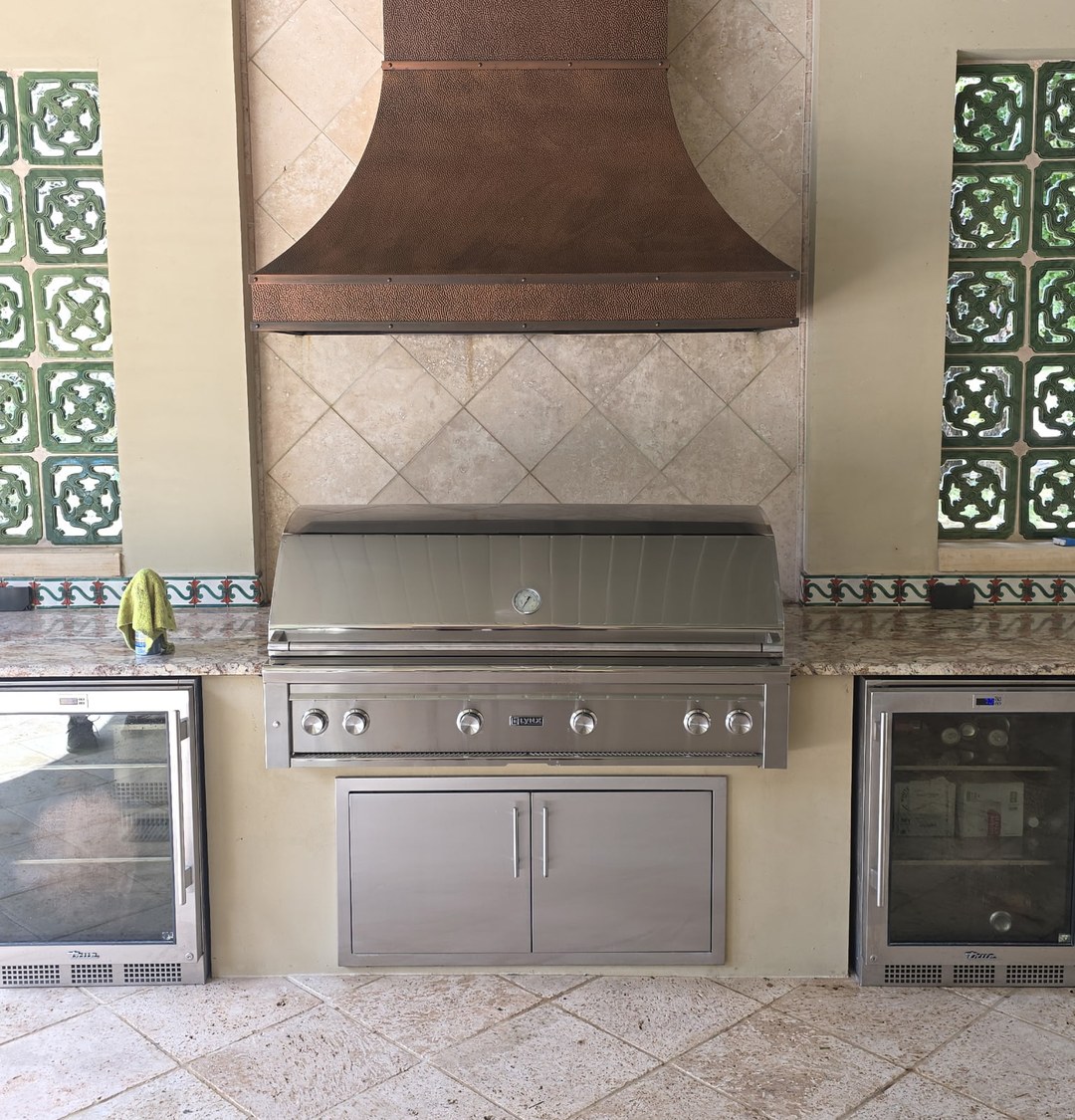
White chalky spots on a stainless steel grill are mineral deposits left behind when hard water or sprinkler overspray dries on the metal. They are not rust. Wipe the panel with a 50/50 mix of white vinegar and warm water, let it sit two minutes, rinse with clean water, and dry immediately with a microfiber towel moving with the grain. Most spotting lifts on the first pass.
We see this constantly on service calls in Frisco, Plano, and McKinney. A homeowner buys a $6,000 Lynx or Blaze built-in, keeps it covered, cleans it after every cook, and by August the hood and the control panel look like somebody splattered them with white paint. Nothing is wrong with the grill. The sprinkler system is hitting it three mornings a week, and North Texas water is doing exactly what North Texas water does.
Here’s how to tell what you’re actually looking at, how to get it off without wrecking the finish, and how to keep it from coming back.
Why does my stainless steel grill have white spots?
Water evaporates. The calcium and magnesium dissolved in it do not. When a droplet dries on your grill, it leaves the minerals behind as a chalky white ring. Do that a few hundred times over a summer and the rings stack into a haze that looks baked on, because on a hot hood it partly is.
Three things make it worse in a DFW backyard:
- Lawn sprinklers. Overspray from an irrigation head is the number one cause we find. It hits the same spot on the same panel every cycle.
- Heat. Water that lands on a warm lid or a hot side burner flashes off fast and concentrates the minerals instead of running off.
- Rinsing and walking away. Hosing down grates and letting them air dry guarantees spots. The rinse is not the problem. The air drying is.
Is it hard water spotting, heat tint, or actual rust?
Run a fingernail over the mark. If it feels like a film on top of the steel, it’s mineral. If the steel itself is rough or dimpled, you’re past spotting. Use this table before you pick a cleaner, because the wrong product on the wrong problem makes it worse.
| What you see | What it is | What fixes it |
|---|---|---|
| White or gray chalky film, wipes partly off with a wet rag | Hard water mineral deposit | Diluted white vinegar, then rinse and dry |
| Gold, blue, or purple sheen near burners and the firebox | Heat tint (oxide layer, normal on hot panels) | Non-abrasive stainless cleaner with the grain; it may not fully clear |
| Orange-brown freckles sitting on the surface | Surface rust from airborne iron, usually not the grill itself | Bar Keepers Friend or a stainless cleaner, worked with the grain |
| Tiny craters or rough pinholes you can feel | Pitting corrosion; the passive layer is broken | Not a cleaning problem. Get it assessed before it goes through the panel |
That last row is the one worth taking seriously. According to the Specialty Steel Industry of North America, once pitting starts, “the growth rate of the pit can be relatively rapid resulting in deep cavities and even through-wall attack.” If you’re not sure which category you’re in, our cosmetic vs. structural rust guide walks through the same check in more detail.
How do you remove hard water spots from a stainless steel grill?
Work on a cool grill, use diluted white vinegar, and dry the panel before the vinegar dries on it. The whole job takes about fifteen minutes on a standard hood and control panel.
- Let the grill cool completely. Vinegar on hot stainless flash-dries and leaves its own streaks. Give it an hour after a cook.
- Find the grain. Look closely at the hood. The brushed lines usually run side to side. Every wipe from here on follows those lines.
- Mix 50/50 white vinegar and warm water in a spray bottle. Distilled vinegar, not cleaning vinegar at industrial strength, and never mixed with anything containing bleach.
- Spray one panel at a time and let it dwell about two minutes. The acid loosens the mineral bond. The U.S. Geological Survey describes the same mechanism people use on a scaled coffee maker: “The acidity of vinegar helps to dissolve mineral particles by making them charged.”
- Wipe with a soft microfiber cloth going with the grain. No circles, no scrubbing pads, no back-and-forth against the lines.
- Rinse with clean water and wipe again. Leftover vinegar left to sit will dull the finish.
- Dry immediately with a second dry microfiber. This step is the one people skip, and it’s the one that decides whether the spots come back next week.
- Finish with a stainless polish if you want the shine back. A light coat also sheds the next round of overspray.
For stubborn buildup that laughs at vinegar, a Bar Keepers Friend paste worked gently with the grain will usually take it. Test on the back of the hood or a cart panel first.
Why is sprinkler overspray worse than tap water?
Sprinkler water carries the same minerals as your tap plus whatever it picks up on the way, and it hits your grill on a timer whether you’re home or not. A single rinse dries and leaves a ring. An irrigation zone running three mornings a week leaves 150 rings a season on the exact same square foot of steel.
If your grill sits in the spray pattern, no cleaning schedule wins. Fix it at the source:
- Adjust or swap the offending head so the arc stops short of the grill island.
- Move a cart-style Weber Genesis or Traeger out of the zone.
- Keep a cover on a built-in during the watering window, then pull it once the sun’s up so moisture doesn’t sit trapped underneath.
Gulf Coast readers in Mobile and Baldwin County have a related but nastier version of this problem, since salt air adds chlorides on top of the minerals. SSINA notes that the conditions favoring localized attack on stainless are “higher chloride content, higher temperatures, lower pH.” That’s a fair description of a Gulf Coast summer.
How hard is Dallas-Fort Worth tap water?
Hard enough to spot stainless, and you can look up your exact number in ten seconds. According to the U.S. Geological Survey, water measuring 0 to 60 mg/L as calcium carbonate is classified as soft, 61 to 120 mg/L as moderately hard, 121 to 180 mg/L as hard, and anything above 180 mg/L as very hard.
Every public water system in Texas publishes an annual Consumer Confidence Report with its total hardness listed. Dallas residents can pull the City of Dallas water quality report directly. Grand Prairie, Arlington, Keller, Colleyville, and Grapevine all publish their own. Find your number, drop it on the USGS scale, and you’ll know whether you’re fighting a nuisance or a standing appointment.
What should you never use on a stainless steel grill?
Anything abrasive, anything chlorinated, and anything meant for an oven. These are the finish-killers we see most often on grills that arrive at a job already scratched.
- Steel wool and steel-bristle pads. They embed carbon steel particles in the stainless. Those particles rust, and then people think the grill is rusting.
- Bleach and bleach-based cleaners. SSINA lists bleach among the chloride compounds that trigger pitting. It’s the fastest way to turn a cosmetic problem into a structural one.
- Oven cleaner. Caustic, and on most premium brands it voids the finish warranty outright.
- Scrubbing across the grain. It leaves permanent cross-hatching that catches light forever.
- Letting cleaner dry on the panel. Rinse and dry, every time.
Weber’s own guidance on stainless grates boils down to three habits: preheat the grill, use the correct brush, and oil your food, not your grates. That last one keeps carbonized oil off the steel in the first place. Our full stainless steel grill cleaning guide covers the technique side in depth.
When is spotting past the point of DIY?
Call somebody when the marks won’t lift with vinegar, when you can feel texture in the steel, or when the spotting is only the outside of a much bigger problem. On a lot of the built-ins we service, the hood spotting is what got the homeowner’s attention, and the grease-caked flame tamers and clogged burner ports underneath are the actual reason the grill isn’t cooking right.
Our stainless steel grill restoration service handles heavy mineral scale, heat tint, and surface rust without abrasives that damage the grain. A full professional grill deep clean starts at $239 and covers grates, burners, flame tamers, firebox, and exterior. See the full breakdown on our pricing page.
We work across the Metroplex, including Frisco, Plano, McKinney, and Colleyville. Check the full service areas list to confirm your city.
Frequently asked questions
Can I use vinegar on my stainless steel grill?
Yes, diluted. Mix white vinegar 50/50 with warm water, apply to a cool grill, let it dwell about two minutes, then rinse with clean water and dry with a microfiber cloth going with the grain. Never leave vinegar to dry on the panel, and never mix it with bleach or any chlorinated cleaner.
Will hard water spots turn into rust?
Not directly. Mineral deposits sit on top of the steel and do not corrode it by themselves. The risk is indirect: a mineral film traps moisture against the surface and holds airborne contaminants in place. That combination can break down the passive layer over time, especially on lower-grade 430 stainless. Removing spots promptly avoids the whole chain.
Why does my grill spot worse in summer?
Two reasons. Irrigation systems run more often in a North Texas summer, so the grill gets hit with more water. And higher ambient temperatures make each droplet evaporate faster, which concentrates the minerals into a tighter, denser ring instead of letting the water run off. Same water, worse result.
Does a grill cover stop hard water spots?
It stops sprinkler overspray, which is the main source. But a cover left on a damp grill traps moisture underneath and can cause worse problems than spotting. Best practice: cover the grill once it’s fully cool and dry, and pull the cover off during the day so the unit can breathe.
Should I use filtered or distilled water to rinse my grill?
For the final rinse on visible stainless, yes, it helps. Distilled water has essentially no dissolved minerals, so it cannot leave a deposit. It is not worth doing for the whole grill. Use it for the last wipe on the hood and control panel, then dry immediately, and you get the same result for a couple of dollars.
Can baked-on mineral scale still be removed?
Usually. Repeated heat cycles bond the deposit tighter, but the mineral is still sitting on the steel rather than in it. Longer vinegar dwell time or a Bar Keepers Friend paste worked gently with the grain will take most of it. If the surface feels rough after cleaning, that is pitting, not scale, and cleaning will not fix it.
How often should a DFW grill get a professional clean?
Once or twice a year for most households, and twice for anyone grilling weekly or running a built-in in an outdoor kitchen. Grills in a sprinkler zone or near a pool benefit from the higher end of that range, since the exterior takes constant mineral and chemical exposure on top of normal cooking buildup.
Get it handled
If the spotting won’t budge, or you’d rather not spend a Saturday finding out, book us. Schedule an appointment online or call (817) 791-4606 for a free estimate.
Texas Grill Clean is part of 1st Choice Residential. Veteran-owned, locally owned, and serving Dallas-Fort Worth since 2009. 3302 Westgrove Drive, Arlington, TX 76001 | (817) 791-4606 | jeff@texasgrillclean.com