
 3302 Westgrove Drive Arlington, TX 76001


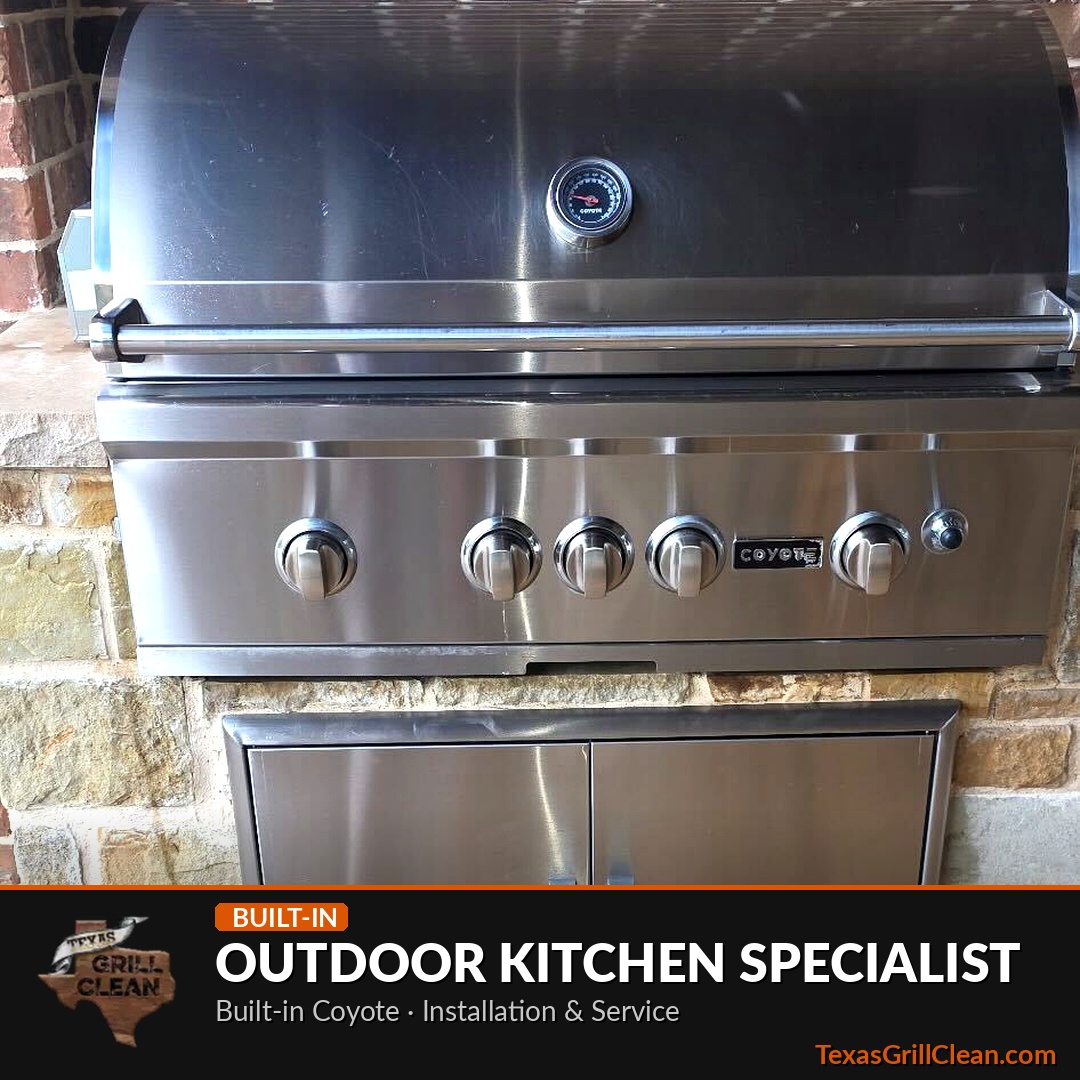
Yes. A built-in grill set into a sealed masonry or framed island needs ventilation openings, and the grill manufacturer sets the size and placement. Blaze calls for at least two vents of 20 square inches each. Without them, a slow gas leak has nowhere to go. It pools inside the island cavity, directly under the burners you are about to light.
We see this on outdoor kitchens all over Southlake, Plano, and Colleyville. Beautiful stone islands. Expensive grill heads. Zero vent panels. The builder finished the stone and nobody checked the grill manual.
Why does a built-in grill island need vents at all?
Vents exist for one reason: to give leaking gas an exit before it collects. A grill head drops into a cavity. Behind the control panel sit the manifold, the valves, and the flex connector. Every one of those is a potential leak point. In a freestanding cart grill, a leak drifts off into the yard. In a sealed island, it has nowhere to go.
The risk is not theoretical. According to the NFPA home grill fires report, U.S. fire departments responded to an annual average of 12,141 home fires involving grills between 2020 and 2024, and leaks or breaks caused 6% of gas grill structure fires and 13% of outside gas grill fires. Leaks are a real category, not an edge case.
There is a second reason, and it costs money rather than causing fires. A sealed cavity traps heat and moisture. Cabinet interiors that cannot breathe rust faster, and the underside of a firebox is the first place we find corrosion on unvented islands.
How many vents does a built-in grill island need, and how big?
Two vents minimum, on opposite or adjacent walls, sized by your grill manual and your fuel type. There is no single universal number, which is exactly why people skip it. Here is what the published guidance actually says.
| Source | Requirement |
|---|---|
| Blaze Professional grill manual | At least two vents inside the island, each at least 20 square inches, allowing air to move from the grill cabinet to the outside. Islands longer than 8 feet should use multiple vents. |
| ANSI Z21.58, referenced in Lynx grill installation instructions | For an enclosure holding a 20 lb propane cylinder: at least 10 square inches of free area per tank at floor level, split across at least two openings on adjacent sides. Bottom of the opening 1 inch or less off the floor, top edge no more than 5 inches above it. |
| Blaze installation guidance | Your local contractor or local code authority determines adequate ventilation for the specific installation. |
That last line matters. The manufacturer sets a floor, not a ceiling. Pull your own model’s manual before you cut anything, and if the island houses a propane tank, the tank enclosure has its own separate requirement on top of the grill cabinet vents.
Should the vents go high or low in the island?
It depends entirely on your fuel, and getting it backwards makes the vents nearly useless. Propane is heavier than air. It sinks and puddles at the bottom of the cavity. Natural gas is lighter than air and rises toward the top.
Blaze spells this out in its install guidance: for a propane setup, vents go lower in the island so the heavy vapor can drain out. For a natural gas setup, vents go higher, because that is where the gas collects.
The mistake we run into most often on Fort Worth and Arlington islands is a single decorative vent panel placed at eye level on a propane island. It looks like ventilation. It does nothing for propane sitting six inches off the slab.
What does an unvented island actually look like from the inside?
Grease, rust on the firebox underside, and rodent nesting. When our crew pulls a grill head to service the burners and manifold, the sealed islands look different from the vented ones. Trapped humidity leaves a film on the inside of the cabinet walls. Firebox bottoms corrode from below where nobody ever looks. Enclosed, warm, dark cavities are also where we find mice and wasps, and a nest packed against a burner venturi is its own fire problem.
None of that shows up from the outside. The grill still lights. It just quietly ages twice as fast, which is one reason we open the cabinet on every grill restoration and deep cleaning job rather than only working the cook box.
How do I check my own outdoor kitchen island in five minutes?
Look for openings, confirm they are not blocked, then confirm they are on the right end of the island for your fuel. Run these steps with the gas off.
- Shut off the gas. Close the propane tank valve or the natural gas shutoff before you put your hands anywhere near the cabinet.
- Open the access doors and look at the side walls. You are looking for cut openings with a louvered or slotted stainless panel in them. Solid stone or stucco with no openings means no ventilation.
- Measure what you find. A 6 by 14 inch vent panel typically covers a cutout around 5 by 12.75 inches, which is roughly 64 square inches of opening. Two of those clear the Blaze 20 square inch threshold with room to spare. One small 4-inch round hole does not.
- Check for blockage. Vents get packed with leaves, cedar pollen, spider webs, and stored charcoal bags. A blocked vent is the same as no vent.
- Match placement to fuel. Propane means low vents. Natural gas means high vents. Both means both.
- Do a soap test on the connections while you are in there. Brush soapy water on the flex connector and manifold fittings with the gas back on. Growing bubbles mean a leak. Shut the gas and call a licensed pro.
If step 6 turns up bubbles, stop grilling and read our walkthrough on finding a propane leak safely before you use the grill again.
Can vents be added to an island that is already built?
Usually yes, and it is far cheaper than people expect. Stainless vent panels are stock items. The work is cutting a clean opening in stone, stucco, or framed veneer and setting the panel so water sheds out rather than in. On a framed island with a veneer, it is straightforward. On solid poured masonry, it is a masonry job and you want someone who cuts stone for a living.
What we can do is tell you what is missing and what your specific grill manual calls for. When we service a built-in in Frisco or Grapevine and the cabinet is sealed, that goes in the report along with everything else we find behind the panel. Gas grill repair and cabinet inspection are part of the same visit.
Frequently asked questions
Does a natural gas grill island need vents too?
Yes. Natural gas is lighter than air, so it collects at the top of an enclosed cavity instead of the bottom. Blaze guidance places vents higher in the island for natural gas installations. The opening size requirement stays the same. The only thing that changes is where the openings go.
How big should a grill island vent be?
Follow your grill manual first. The Blaze Professional manual calls for at least two vents of 20 square inches each. A common 6 by 14 inch stainless vent panel covers a cutout near 5 by 12.75 inches, which comfortably exceeds that. Islands longer than 8 feet should add more vents rather than making two larger.
Can I just leave the access doors open instead of adding vents?
No. Doors get closed. Ventilation has to work when nobody is thinking about it, including the day a fitting starts weeping while the island sits unused. Permanent openings are the point. Propping a door is a habit, and habits fail.
Does a propane tank stored inside the island need its own ventilation?
Yes, and it is separate from the grill cabinet requirement. ANSI Z21.58, referenced in Lynx installation instructions, calls for at least 10 square inches of free area per 20 lb cylinder at floor level, split across at least two unobstructed openings on adjacent sides, with the bottom of each opening within 1 inch of the floor.
Will adding vents make my grill cook worse in the wind?
No. Vents ventilate the cabinet below the cook box, not the cooking chamber itself. Airflow under the firebox does not reach your food. If your grill struggles with heat, the cause is usually clogged burner ports, grease-loaded flame tamers, or a regulator issue rather than cabinet airflow.
How do I find the ventilation spec for my exact grill?
Search the manufacturer name plus your model number and the word manual. Blaze, Lynx, Coyote, Alfresco, Bull, and Summerset all publish installation PDFs free. The ventilation section usually sits in the built-in installation chapter, not the cooking or cleaning chapter, which is why owners miss it.
Is this something a grill cleaning service checks?
It should be. Any service that pulls the grill head or opens the cabinet is already looking at the walls. On our jobs across the DFW Metroplex we note sealed cabinets, blocked vents, corrosion under the firebox, and nesting during the service. See our service areas for coverage.
Get eyes inside your island
A grill deep clean starts at $239. See current pricing for built-in and outdoor kitchen work, or read how we handle Blaze built-in grills specifically. Homeowners in Southlake can start at our Southlake grill cleaning page.
Ready to book? Schedule an appointment or call (817) 791-4606. Free estimates, licensed and insured.
Texas Grill Clean is part of 1st Choice Residential, veteran-owned and serving Dallas-Fort Worth since 2009. 3302 Westgrove Drive, Arlington, TX 76001 · (817) 791-4606 · jeff@texasgrillclean.com