
 3302 Westgrove Drive Arlington, TX 76001


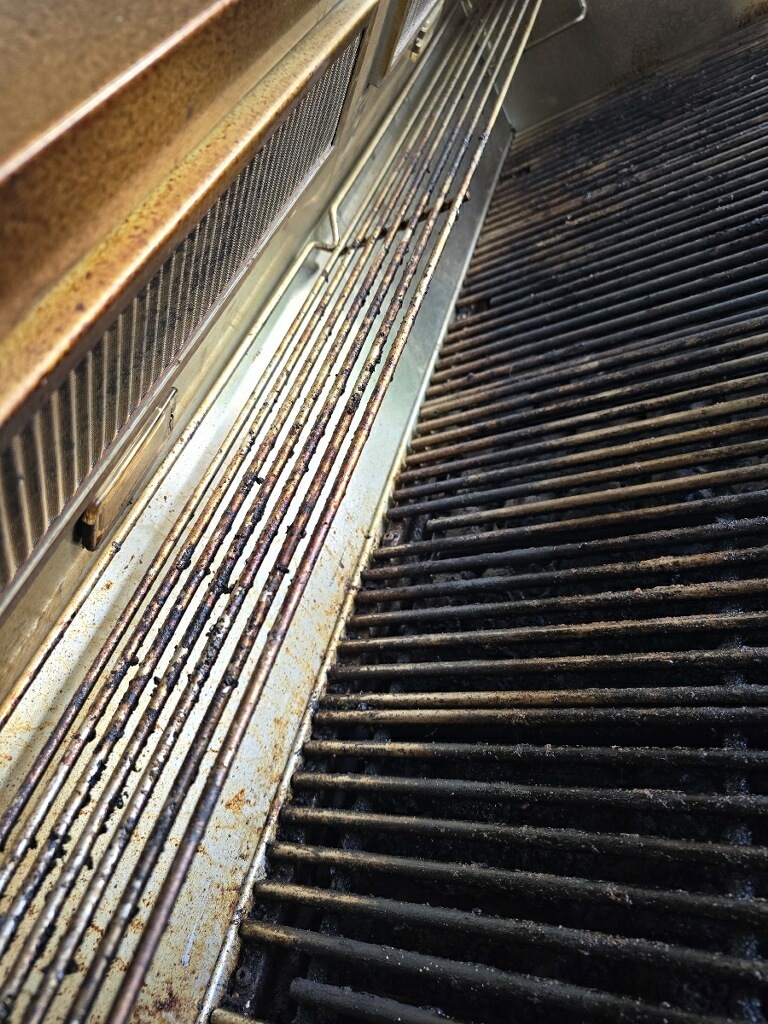
Yes, a dirty grill can make you sick, but not for the reason most people assume. Old baked-on grease is rarely the culprit. The real hazards are raw-meat juices left on cold grates, loose carbon flakes that drop onto your food, and wire bristles that break off a worn brush and end up in what you eat. Heat kills bacteria. Heat does not remove metal or carbon.
That distinction matters, because most homeowners in Dallas, Grand Prairie, and McKinney solve the wrong problem. They scrub hard with a wire brush right before cooking, which is the single riskiest thing you can do, and then leave the flame tamers and grease tray untouched for two years. Here’s what actually threatens your food, and what to do about it.
Does bacteria survive on a dirty grill grate?
Most foodborne bacteria do not survive a proper preheat, so a hot grill is largely self-sanitizing on the cooking surface. According to the University of Wyoming Extension, preheating the grill for at least 15 minutes after reinstalling parts burns off residual dirt and grease and kills germs on cooking surfaces.
The problem is what happens between cooks. When you pull chicken off the grate and shut the lid, raw juice is still sitting on that metal. It cools down. It sits in a Texas backyard at 95 degrees for a week. Then you throw vegetables on a grate you never reheated, and there’s your cross-contamination.
The fix is simple and free: preheat before you cook, every single time, not just when the grate looks bad.
So what actually makes people sick from a dirty grill?
Three things, in order of how often we see them: broken wire brush bristles, loose carbon flakes falling off the lid and flame tamers, and raw juice transferred by tongs or an unheated grate.
- Wire bristles. They break off cheap or worn brushes, stick to the grate in the grease film, and transfer to food. They’re thin, silver, and nearly invisible against a browned burger.
- Carbon flakes. The black crust on the underside of your lid is polymerized grease and smoke residue. When it gets thick enough, it lets go in sheets. Our crew sees this constantly on grills that have gone three or four seasons without a deep clean. It’s not toxic in a dramatic way, but it tastes terrible and nobody wants to eat it. We wrote more about that in our guide to why grilled food tastes bitter.
- Raw juice. Same plate for raw and cooked. Same tongs. Cold grate. This is the classic one, and it has nothing to do with how shiny your grill looks.
Notice that heavy grease buildup shows up on that list mostly as a delivery vehicle, not a poison. Grease is still a genuine problem, but the danger it creates is fire, not food poisoning. That’s covered in our grease fire prevention guide.
How dangerous is a wire grill brush, really?
Wire bristle ingestion sends thousands of Americans to the emergency room, and the numbers are climbing, not falling. According to a study published in Otolaryngology–Head and Neck Surgery, there were an estimated 1,698 emergency department visits for wire-bristle grill brush injuries in the United States between 2002 and 2014. Most of those injuries were to the mouth and throat, and case counts peaked in June, July, and August.
A follow-up analysis of the same national injury database found an estimated 3,739 cases between 2015 and 2023, roughly a 220% increase over the earlier period. The researchers noted that a decade of public warnings has not brought the numbers down.
If you own a wire brush, look at the head. If bristles are splayed, missing, or come loose when you tug them, throw it out today. Replace it with a bristle-free coil scraper, a wooden grate scraper, or a wadded ball of aluminum foil held in tongs. All three work. None of them shed metal into your dinner.
What’s the safest way to clean grates before you cook?
Heat first, scrape second, wipe third, oil last. Doing it in that order removes residue without leaving anything behind on the cooking surface.
- Preheat on high for 15 minutes with the lid closed. This carbonizes food residue and kills surface bacteria before you touch anything.
- Scrape with a bristle-free tool. A coil scraper or wood scraper pushes the burnt residue off without shedding wire.
- Wipe the grate with a folded paper towel held in long tongs. This is the step almost everyone skips, and it’s the one that catches loose debris a scraper leaves behind.
- Oil lightly. Use a high smoke point oil on the towel. It keeps food from sticking and slows rust between cooks, which matters in North Texas humidity.
- Check the drip tray before you start cooking. A full tray is a flare-up waiting to happen, and flare-ups are what drive carbon up onto the lid in the first place.
That routine takes about five minutes and covers the food-contact surfaces. It does not touch the firebox, the burner tubes, the venturi, or the flame tamers, which is where the real buildup lives.
Does cooking to temperature solve the problem anyway?
Cooking to a safe internal temperature protects you from bacteria inside the meat, but it does nothing about bristles, carbon, or cross-contamination after the food comes off. The USDA Food Safety and Inspection Service publishes these minimums:
| Food | Safe minimum internal temperature | Rest time |
|---|---|---|
| Beef, pork, veal, lamb — steaks, chops, roasts | 145°F | 3 minutes |
| Ground beef, pork, veal, lamb | 160°F | None |
| All poultry, including ground | 165°F | None |
| Cooked food held before serving | 140°F or warmer | N/A |
USDA also advises washing grill surfaces with soap and water and scraping off old residue, and never partially grilling meat to finish later. Use a thermometer. Color is not a doneness test.
When is the buildup past the point of DIY?
When you can’t see bare metal on the flame tamers, when carbon flakes off the lid onto your food, or when the grease tray has hardened into a solid layer, a scraper won’t fix it. At that point the buildup is inside the firebox, packed around the burner tubes and diffusers where a brush can’t reach.
| What you’re seeing | Handle it yourself | Call a pro |
|---|---|---|
| Food residue on grates | Yes — preheat and scrape | No |
| Light grease film in the firebox | Yes — degreaser and towel | No |
| Black flakes dropping from the lid | No | Yes |
| Flame tamers fully coated in carbon | No | Yes |
| Hardened grease tray, uneven heat, yellow flames | No | Yes |
A professional grill cleaning pulls the grill down to components, degreases the firebox, clears the burner ports, and puts it back together. Our deep clean and restoration service starts at $239. You can see the full breakdown on our pricing page.
We service backyards across the Metroplex, including Dallas, Plano, Grand Prairie, McKinney, Arlington, and Southlake. The full list is on our service areas page.
Frequently asked questions
Can you get food poisoning from a dirty grill?
It’s possible but uncommon from the grease itself. Food poisoning from grilling almost always traces back to cross-contamination, meaning raw meat juice reaching cooked food through shared plates, tongs, or an unheated grate. Preheating the grate for 15 minutes before cooking and using separate utensils for raw and cooked food eliminates most of that risk.
Does burning off the grill kill all the bacteria?
A 15-minute preheat on high kills bacteria on the cooking grates, which is where food makes contact. It does not sterilize the whole grill, and it does nothing to remove carbon buildup, grease in the firebox, or wire bristles stuck in the grate. Burn-off is a sanitizing step, not a cleaning step.
Are wire grill brushes actually banned anywhere?
No, wire bristle brushes remain legal and widely sold in the United States. Published injury research shows the estimated case count rose from about 1,698 between 2002 and 2014 to about 3,739 between 2015 and 2023. Many grillers now use bristle-free coil scrapers, wooden scrapers, or foil instead.
How can I tell if a bristle got in my food?
You usually can’t see one, which is the danger. A bristle is thin, silver, and about a half inch long, and it disappears against a seared surface. Inspect the grate under good light after scraping, and run a paper towel across it. If the towel snags, something is stuck there.
How often should a grill be professionally cleaned in Texas?
Once a year for most DFW households, and twice a year if you grill weekly or entertain often. North Texas heat bakes grease into hard carbon faster than cooler climates, and pollen season adds a layer on top of it. Heavy users on the Gulf Coast often need service twice a year because of salt air.
Is it safe to grill on rusty grates?
Light surface rust that wipes off is not a health hazard, but flaking rust means the grate is losing structure and should be replaced. Rust flakes behave like carbon flakes: they end up on your food. If a grate has pitted through or sheds when you scrape it, replace it rather than restoring it.
Does a clean grill actually cook better?
Yes. Clear burner ports produce even heat, clean flame tamers vaporize drippings instead of smoldering them, and bare metal grates transfer heat directly for a better sear. Buildup insulates the cooking surface and creates cold spots, which is why a neglected grill takes longer to reach temperature.
Ready to get it handled?
If your grates look like the photo at the top of this page, five minutes with a scraper isn’t going to do it. Book an appointment online or call (817) 791-4606 and we’ll come take it apart, degrease it, and put it back together right.
Texas Grill Clean is part of 1st Choice Residential. Veteran-owned, locally owned rather than a franchise, and serving Dallas–Fort Worth since 2009. Licensed and insured. Free estimates. 3302 Westgrove Drive, Arlington, TX 76001 · (817) 791-4606 · jeff@texasgrillclean.com