
 3302 Westgrove Drive Arlington, TX 76001


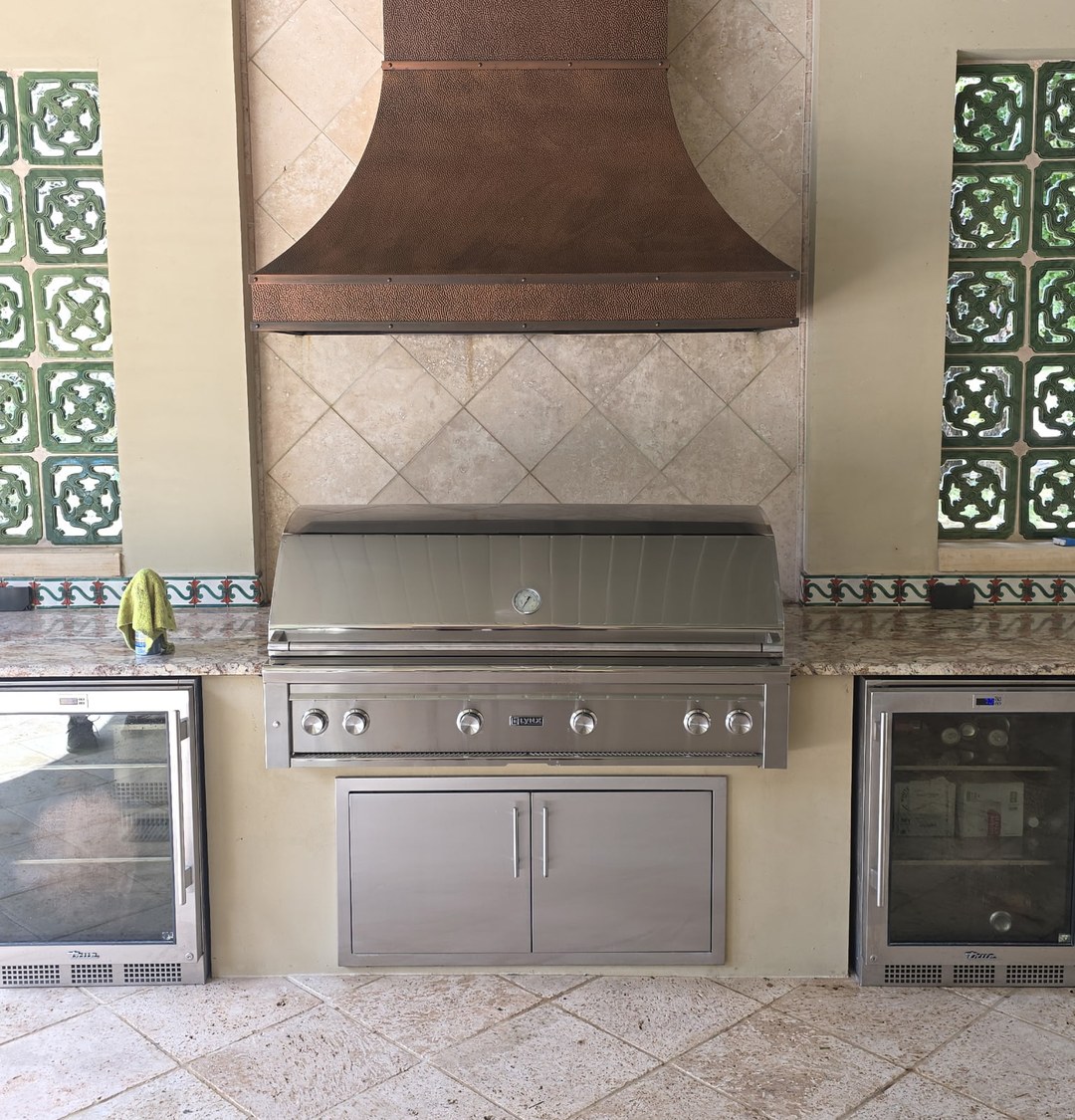
Clean your outdoor kitchen vent hood filters about once a month during grilling season. Pull the filters, soak or spray them with a degreaser, empty the grease cups, and wipe the inside of the hood before the filters go back in. Never run the hood with the filters out. That is the whole job for a homeowner. Ductwork and blower housings need a pro.
How often should you clean an outdoor vent hood?
Once a month while you are actively grilling, and more often if you fry, smoke, or cook fatty cuts. That is not our number. According to Wolf’s own service documentation, ventilation filters and grease cups should be cleaned approximately every month, and more frequently when your cooking style generates large amounts of grease.
Most homeowners in Colleyville and Grapevine we talk to have never cleaned the hood at all. They clean the grill. The hood sits four feet above it collecting everything the grill throws off, and nobody thinks about it until grease starts dripping back down onto the cooking grates.
What actually happens when the hood never gets cleaned?
Grease stops draining, starts pooling, and eventually drips back onto your grill and countertop. The filters are the first thing to load up. Once they are saturated, grease pushes past them into the hood cavity, then into the duct, then into the blower housing.
The fire angle is worth stating plainly. Commercial kitchens are governed by NFPA 96, which requires the exhaust system to be cleaned when grease deposits reach 0.002 inches, roughly 50 micrometers. That standard does not apply to a backyard. But the physics do not care whether the hood is over a restaurant range or over your Lynx. Grease burns.
And the grill underneath it matters too. According to the NFPA, U.S. fire departments respond to an annual average of roughly 12,100 home fires involving grills, and failure to clean is the leading contributing factor in about one in five of them.
Which parts of the hood hold grease?
Four parts, and only two of them are homeowner territory. Here is the breakdown we walk customers through on site.
| Component | What it does | Who cleans it |
|---|---|---|
| Baffle or mesh filters | Catch airborne grease before it enters the duct | You, monthly |
| Grease cups or trays | Collect what drains off the filters | You, monthly |
| Hood interior and ledges | Catches what the cups miss | You, wipe at every filter cleaning |
| Ductwork and blower housing | Moves air out of the space | Pro only |
Wolf is direct about that last row: do not remove or disassemble an internal blower motor to clean grease out of it. Wipe the exterior of the motor with degreaser sprayed onto a cloth, and call someone for the rest.
How do you clean outdoor vent hood filters step by step?
Six steps, about thirty minutes, mostly soaking time. Do this when the grill is cold and the hood has been off for at least an hour.
- Kill the power. Shut off the hood at the switch. If your outdoor kitchen has a dedicated breaker for the blower, flip it. You will be reaching into a metal box.
- Pull the filters. On most hoods you press up, then rotate the bottom edge out and down. Take the center filter first if there are three, since the outers usually have more play. Wear gloves.
- Lift out the grease cups. They sit in the bottom rail or hang from a rear flange. Go slow so you do not slosh. Dump them into a can, not down a drain.
- Soak or spray. Hot water, a few drops of degreasing dish soap, fifteen minutes in a utility sink. For baked-on buildup, hit them with a spray degreaser first, then soak. Scrub with a soft brush along the channels, not across them.
- Wipe the hood interior. This is the step everybody skips. Grease collects on the interior ledge and around the light housings. Degreaser on a rag, not sprayed directly into the fixtures.
- Dry completely, then reinstall. Wet filters going back into a warm hood is how you get corrosion streaks on the outside of the stainless. Air dry them fully.
Baffle filters or mesh filters, and does it change anything?
Yes. Baffles are metal channels that fling grease out by inertia. Mesh filters are woven aluminum that traps it. Most quality outdoor hoods use stainless baffles. Cheaper inserts and older units often use mesh.
| Stainless baffle | Aluminum mesh | |
|---|---|---|
| Cleaning method | Degreaser soak or dishwasher | Hand wash preferred |
| Dishwasher safe | Usually yes | Often discolors and oxidizes |
| Lifespan | Years, replace if warped | Replace when the mesh mats down |
| Grease capacity | Higher | Loads up faster |
Wolf notes that its filters and grease cups are dishwasher safe, but that over time harsh detergents can cause pitting if you wash them in the dishwasher regularly. Alternating between dishwasher and hand wash is the sane middle ground.
Why do DFW outdoor kitchens load up faster than the manual expects?
Pollen, dust, and heat. North Texas throws cedar, oak, and cottonwood at your patio for months, and every bit of it lands in a hood that is already tacky with grease. That combination sets up into something closer to varnish than grease, and it does not rinse off. Add 100-degree summers that keep the grease liquid and mobile, and you get drips that a Midwest hood would never produce.
Covered patios make it worse, not better. A roofed structure is exactly where a hood is most necessary, and also where smoke lingers longest. According to BBQGuys, outdoor applications should provide at least 1,200 CFM regardless of grill size, following a rule of 1 CFM per 100 BTUs, and the hood should extend at least 3 inches past each side of the grill. Undersized hoods push more smoke into the ceiling than into the duct, which is why some patios stain even with a hood running.
When should you stop and call somebody?
When grease is coming from somewhere other than the filters. A few specific signs mean the buildup is past the filters and into the system:
- Grease dripping from the light fixtures or running down the hood face
- Brown staining on the ceiling above the hood
- The blower running louder or slower than it used to
- Smoke hanging under the hood instead of getting pulled up
- Filters that look clean but the hood still smells rancid
That last one usually means the duct. Our crews see it most in outdoor kitchens that are five or more years old and have never had anything beyond a filter rinse. It is the same pattern we describe in our complete outdoor kitchen grill cleaning guide for DFW homeowners, and it often shows up alongside a side burner that stopped lighting, because both problems trace back to the same neglected island.
Texas Grill Clean handles the hood as part of a full outdoor kitchen service. Our grill restoration and deep cleaning starts at $239 for the grill itself. Hood and island work is quoted on site because no two outdoor kitchens are built the same. If the stainless is streaked or pitted, that falls under stainless steel restoration, and if the blower or a burner has actually failed, it moves over to gas grill repair. Full numbers live on our pricing page.
We service Colleyville, Grapevine, Southlake, Keller, and the rest of the Metroplex. The full list is on our service areas page.
Frequently asked questions
How often should I clean my outdoor vent hood filters?
About once a month during grilling season. Wolf’s service documentation recommends cleaning ventilation filters and grease cups approximately every month, and more often if you fry or cook fatty foods. If you only grill a few times a year, quarterly is reasonable. If you smoke briskets most weekends, pull the filters every two or three cooks.
Can I put outdoor vent hood filters in the dishwasher?
Usually yes for stainless baffle filters. Wolf states its filters and grease cups are dishwasher safe, but warns that harsh detergents can cause pitting over time with regular dishwasher use. Aluminum mesh filters often discolor and oxidize in a dishwasher, so hand wash those. Scrape heavy grease off before loading either type.
Can I run my vent hood without the filters installed?
No. Wolf explicitly cautions against operating a ventilation hood without filters installed, because doing so can damage the blower or other internal components. The filters are the only thing standing between airborne grease and the fan motor. If you pull them to clean, leave the hood switched off until they are dry and back in place.
Do I really need a vent hood if my grill is already outside?
Only if you grill under a roof, pergola with a solid cover, or any enclosed structure. In fully open air, smoke disperses on its own. Under cover, smoke carries grease that stains ceilings, peels paint, and corrodes stainless. BBQGuys recommends a hood any time you are grilling under a roofed structure.
Why is grease dripping out of my hood onto the grill?
The filters are saturated, the grease cups are full, or grease has worked its way back out of the ductwork. Start by pulling and cleaning the filters and emptying the cups. If drips continue after that, the buildup is in the duct or hood cavity, and that needs a professional cleaning rather than another filter rinse.
Does a dirty vent hood change how my food tastes?
Indirectly, yes. A loaded hood stops pulling smoke, so stale smoke recirculates around the cooking area and settles back onto food. Old rancid grease overhead can also drip onto the cooking surface. The bitter flavor most people notice traces back to the grill grates and diffusers first, but a saturated hood makes it worse.
How much does professional outdoor kitchen hood cleaning cost?
Our grill deep clean starts at $239. Hood, duct, and island work is quoted on site, because outdoor kitchen layouts vary too much for a flat rate to be honest. Estimates are free. We look at the hood size, duct run, and how long it has been since the last service before giving you a number.
Get the whole island looked at
If the hood is dirty, the grill under it usually is too. Book online at texasgrillclean.com/book-appointment or call (817) 791-4606. More answers on our FAQ page, and service details on our professional grill cleaning page.
Texas Grill Clean is part of 1st Choice Residential, veteran-owned and serving Dallas-Fort Worth since 2009. Licensed and insured. Free estimates. 3302 Westgrove Drive, Arlington, TX 76001 | (817) 791-4606 | jeff@texasgrillclean.com