
 3302 Westgrove Drive Arlington, TX 76001


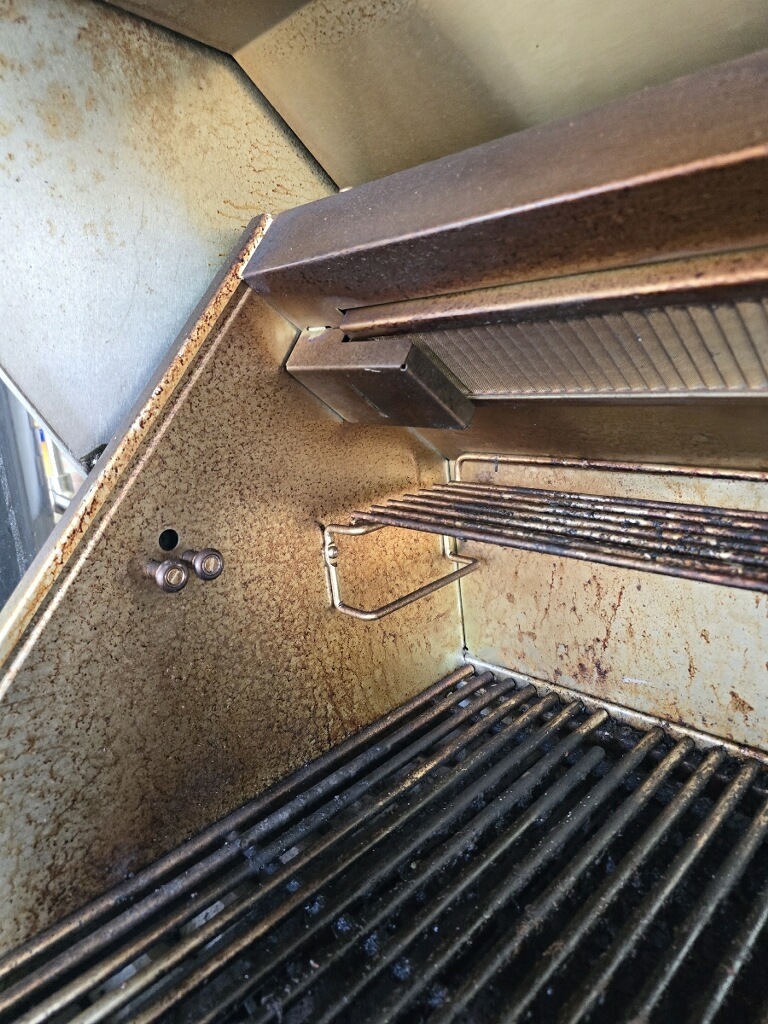
A grill that has been sitting for years needs a full cold teardown clean and a gas-system safety check before you ever light it. Old grease hardens into carbon. Spiders and mud daubers block the burner tubes. Rubber hoses dry out and crack. Clean it cold and dry first, then leak-test every gas connection. Do not light it and try to burn it off.
We get this call constantly in Frisco, Southlake, McKinney, and Colleyville. Somebody buys a house with an outdoor kitchen the previous owner stopped using. Or a grill sat under a cover behind the garage for four summers. The grill usually isn’t dead. But the order you do things in matters a lot.
What happens to a grill that sits unused for years?
Three things fail at the same time: grease hardens, pests move in, and rubber parts age out.
The grease is the part people expect. What they don’t expect is that it stops being grease. Left alone through a few Texas summers, it polymerizes into a hard black carbon shell on the flame tamers, the firebox floor, and the underside of the lid. A wire brush won’t touch it. That layer also flakes into food once you start cooking again.
The pests are the part people never expect. Spiders and mud daubers love the smell of propane mercaptan, and they build nests inside the venturi tubes where the burner draws its air. A blocked venturi starves the burner of oxygen and pushes the flame back toward the valve. We wrote about that specific failure in the spider in your grill, and it’s the single most common thing we find on a dormant gas grill. On built-ins, we also pull rodent nests out from under the firebox and behind the drawer bank.
The rubber is the quiet one. A hose that looks fine can be brittle underneath. According to Weber’s own support documentation, the hose and regulator on a gas grill should be replaced every five years, because UV exposure and weather shorten their life. A grill that sat outside in Denton County sun for four years is already at that line.
Why does this matter more on a dormant grill than a used one?
Because nobody has been there to notice the small failures. A grill you use every weekend tells you when a burner runs uneven or a knob gets stiff. A grill that sat gives you no warning at all. Every problem it accumulated shows up on the first light, all at once.
According to the National Fire Protection Association, U.S. fire departments responded to an average of 12,141 home fires involving grills per year between 2020 and 2024, and gas grills accounted for 9,235 of those. Leaks or breaks caused 6 percent of gas grill structure fires and 13 percent of outdoor gas grill fires. Leaks and breaks are exactly what dry rubber and corroded fittings produce.
Is it safe to just light an old grill and see what happens?
No. Lighting an unknown grill without a leak test is how people get hurt.
The “burn it off on high for 20 minutes” advice works on a grill you used last month. On a grill that sat for years it does three bad things. It ignites a heavy grease load you can’t see. It pushes gas through a hose you haven’t inspected. And it doesn’t remove polymerized carbon anyway, because that layer isn’t food residue, it’s plastic.
Before any gas reaches a burner, do a soap test. Mix dish soap and water, brush it on every connection from the tank or gas line to the manifold, turn the gas on with the burners off, and watch for bubbles. Bubbles mean stop. If you smell gas at any point, shut the supply off and walk away. Our guide on finding a propane leak safely covers what to do next.
How do you clean a grill that has been sitting for years?
Work cold, work dry, and go from the outside in. Never start with water.
- Disconnect the fuel. Close the tank valve and remove the tank, or shut off the natural gas line at the valve. Nothing else happens until this is done.
- Pull everything out. Grates, flame tamers or heat plates, warming rack, grease tray, and the catch pan underneath. Lay it out on cardboard so you can see what you actually have.
- Scrape the firebox dry. A plastic or wood scraper on the walls and floor. You are moving loose carbon and old debris to the bottom so you can lift it out, not scrubbing.
- Clear the burner tubes and venturis. Remove each burner. Look down the venturi opening for webbing or a mud nest. Run a burner brush or a bent wire through it. Then check that every port on the burner tube is open.
- Inspect the burners for burn-through. Hold each one up to light. Holes that have merged into slots, or thin flaky metal, mean the burner is done. Cleaning won’t fix a burned-through tube.
- Degrease the removable parts. Grates and flame tamers get soaked and worked over separately, matched to the material. Porcelain, cast iron, and stainless each want different handling.
- Inspect the gas train. Hose, regulator, manifold, orifices, and valves. Look for cracking, green corrosion, and stiff knobs. Replace the hose and regulator if you can’t confirm their age.
- Reassemble, leak-test, then light one burner at a time. You want a steady blue flame across the whole tube. Yellow, lazy, or lifting flames mean you still have an air or gas problem.
That’s the honest version. On a freestanding Weber or a Char-Broil it’s a long Saturday. On a built-in Lynx, Alfresco, DCS, or Coyote in a stone island, it’s more involved, because the burners, radiants, and drip pans come out in a specific order and the firebox has to be pulled and degreased in place.
Which parts usually need replacing, and which just need cleaning?
Anything rubber or thin-walled steel gets replaced. Anything cast or heavy-gauge usually cleans up.
| Part | What goes wrong while it sits | Clean or replace |
|---|---|---|
| Gas hose and regulator | Dries out, cracks, loses pressure regulation | Replace if over five years or unknown age |
| Burner tubes (thin stainless) | Rust-through, ports merge into slots | Replace once holed |
| Burner tubes (cast stainless or brass) | Clogged ports, blocked venturi | Clean, usually salvageable |
| Flame tamers and heat plates | Polymerized carbon, warping | Clean, replace if warped or perforated |
| Cast iron grates | Surface rust, lost seasoning | Clean and re-season |
| Porcelain-coated grates | Chipping, exposed steel rusting | Replace once the coating is gone |
| Igniter module and electrode | Corroded electrode, dead battery, cracked ceramic | Clean, then replace the electrode if no spark |
| Grease tray and catch pan | Rotted through, rusted out | Replace, cheap and fire-relevant |
Rust is the judgment call. Surface rust on a firebox wall is cosmetic. Rust you can push a screwdriver through is structural. We break that down in cosmetic versus structural grill rust.
Should you restore an old grill or replace it?
Restore a built-in. Think hard about a cheap freestanding one.
A built-in grill sits in a masonry island cut to its exact dimensions. Replacing it usually means matching a discontinued cutout size or rebuilding stonework, which costs far more than a restoration and a set of burners. Premium built-ins from Lynx, Alfresco, DCS, Blaze, Coyote, and Wolf are built to be rebuilt, and we regularly bring back grills that sat unused for five or six years.
A $400 big-box freestanding grill with a rusted-through firebox is a different math problem. We’ll tell you when it isn’t worth it. Our full breakdown is in repair or replace a built-in grill.
What does it cost to bring a dormant grill back in DFW?
Our grill deep clean starts at $239, and restoration work is quoted after we see the grill.
A grill that sat for years usually isn’t a straight deep clean. It’s a deep clean plus some combination of burner replacement, a new hose and regulator, an igniter repair, or grease tray replacement. We give free estimates, and we tell you up front when a grill isn’t worth the money. Current service pricing is on our pricing page.
Related services: grill restoration and deep cleaning, gas grill repair, and stainless steel restoration. We cover the whole Metroplex, including Frisco and Southlake. Full coverage map is on our service areas page.
Frequently asked questions
Can I just burn off an old grill instead of cleaning it?
No. Burning off works on a grill you used recently. On a grill that sat for years it ignites a heavy grease load, pushes gas through a hose you have not inspected, and still does not remove the hardened carbon layer. That layer is polymerized grease, closer to plastic than food residue, and heat alone will not lift it.
How long can a gas grill sit before it becomes unsafe to use?
There is no fixed number, but one full season outdoors is enough for spiders to nest in the venturi tubes. Past about two years, assume the hose, regulator, and igniter all need inspection. Weber recommends replacing the hose and regulator every five years regardless of use, because UV and weather age the rubber whether you grill or not.
Do I need a new propane tank if the grill sat for years?
Probably. Propane itself does not spoil, but the cylinder has a requalification date stamped on the collar, and the valve and O-ring can degrade. If the tank is out of date or the valve feels stiff, exchange it. A fresh tank is cheap insurance on a grill you are already unsure about.
Is a rusty grill still safe to cook on?
It depends on where the rust is. Surface rust on the firebox walls or the outside of a burner is cosmetic and cleans up. Rust you can push a screwdriver through, or a burner tube whose ports have merged into open slots, is structural. Structural rust in the firebox or burners means those parts get replaced before the grill is used.
We bought a house with a built-in grill. Who services it?
A grill service company, not a general handyman. Built-in grills from Lynx, Alfresco, DCS, Blaze, Coyote, and Wolf use brand-specific burners, radiants, and orifices, and the gas connection is usually plumbed natural gas. We service built-ins across Dallas-Fort Worth and can identify the brand and model from photos before we come out.
How much does it cost to restore a grill that has been sitting?
Our grill deep clean starts at $239. A dormant grill often needs parts on top of that, commonly burners, a hose and regulator, or an igniter electrode. We quote restoration work after we see the grill, and estimates are free. If the grill is not worth restoring, we say so instead of selling you the service.
Can I pressure wash a grill that has been sitting outside?
No. High-pressure water forces moisture into burner tubes, orifices, igniter modules, and control boards, and it starts rust inside the firebox. It also will not remove the hardened carbon, because that layer is not dirt. Cold scraping and the right degreaser are what actually work on a grill that has sat.
Ready to bring it back?
If you have a grill that has not been lit in years, we will look at it and tell you honestly whether it is worth restoring. Book an appointment online or call (817) 791-4606.
Texas Grill Clean is part of 1st Choice Residential, veteran-owned and serving Dallas-Fort Worth since 2009. Licensed and insured. Free estimates. 3302 Westgrove Drive, Arlington, TX 76001.