
 3302 Westgrove Drive Arlington, TX 76001


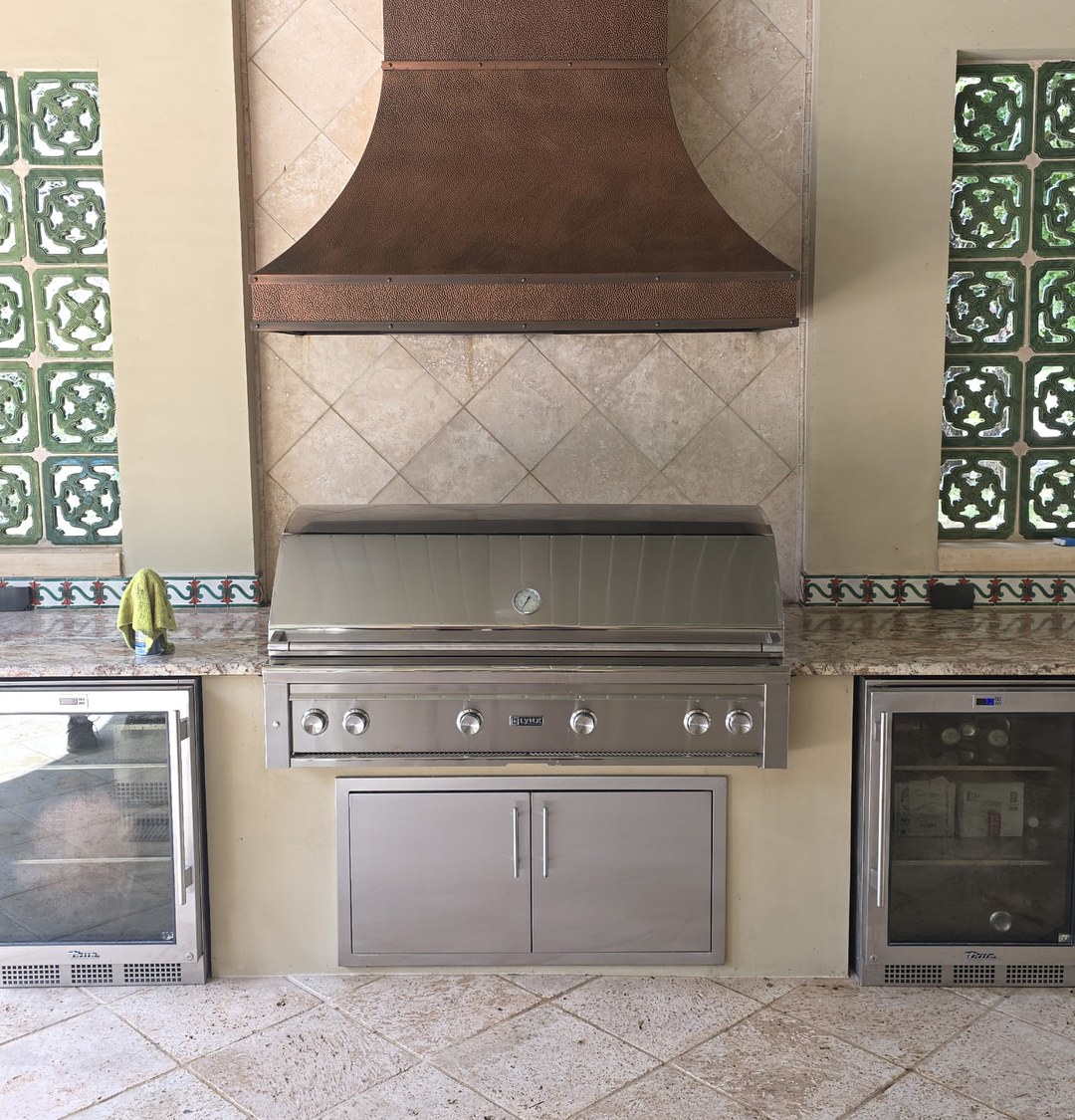
A new built-in grill fits your existing island only if the manufacturer’s published cutout dimensions match the opening you already have. Cutout size is not the same as the grill’s nominal size. A 36-inch grill does not need a 36-inch hole. Measure the width, depth, and height of your opening first, then shop grills that match those three numbers.
We service built-in grills in outdoor kitchens all over DFW, and this is the question that comes up right before somebody spends four thousand dollars on the wrong grill head. Colleyville, Southlake, Grapevine, Frisco. Same island, same problem. The old grill died, the homeowner ordered a replacement based on the number in the model name, and the new unit showed up an inch and a half too wide.
Here’s how to get it right before you order.
What exactly do you measure on a built-in grill island?
You measure three things: the width of the opening, the depth from front edge to back wall, and the height from the support ledge to the top of the counter. All three have to clear. Miss one and the grill either won’t drop in or won’t sit flush.
- Pull the old grill if it lifts out. Most built-in heads sit on a ledge and are held by gravity, not fasteners. Shut off the gas first. Disconnect the flex line. Get a second person on the other end. These are heavy.
- Measure the width at the narrowest point. Tile or stone returns often eat a half inch you can’t see from the front.
- Measure the depth from the inside of the front face to the back wall of the cavity. Not to the countertop edge.
- Measure the height from the ledge the grill rests on to the underside of the counter overhang. This is the number people skip, and it’s the one that stops a grill cold.
- Photograph the cavity. Note where the gas line enters, whether there’s an outlet, and what the island is built from.
Why doesn’t a 36-inch grill need a 36-inch cutout?
Because the number in the model name is the grill’s overall width, including the flange that rests on the counter. The body that drops into the hole is always narrower. How much narrower varies by brand, which is exactly why you can’t guess.
According to Blaze Grills, the 32-inch Premium LTE+ (BLZ-4LTE3) is 32.5 inches wide overall but requires a cutout of only 30.625 inches wide by 21.25 inches deep by 8.5 inches high. According to Coyote, the S-Series 36-inch (C2SL36) is 35.5 inches wide overall and needs a cutout of 32.5 inches wide by 20.5 inches deep by 10.25 inches high.
Look at what that means in practice.
| Model | Nominal size | Overall width | Cutout W x D x H |
|---|---|---|---|
| Blaze Premium LTE+ BLZ-4LTE3 | 32-inch | 32.5 in | 30.625 x 21.25 x 8.5 in |
| Coyote S-Series C2SL36 | 36-inch | 35.5 in | 32.5 x 20.5 x 10.25 in |
The 36-inch Coyote needs a cutout under 33 inches. The 32-inch Blaze needs one under 31. And the Blaze is actually deeper in its cutout requirement than the bigger Coyote, by three quarters of an inch. Brand names and inch labels won’t tell you any of that. Lynx, DCS, Alfresco, and Napoleon all publish their own numbers, and you need the sheet for your exact model, not the series.
How much clearance does a built-in grill need from wood?
More than most people assume, and the manufacturer’s manual sets the number, not a general rule of thumb. This is the part that turns a simple swap into a real project.
According to Sub-Zero and Wolf, combustible material should not be within 12 inches of the side or rear of a Wolf outdoor grill, regardless of how high that material sits relative to the grill. If the entire enclosure is combustible, Wolf requires a grill liner. Wolf also states its outdoor grills cannot be installed in any enclosed or covered area with a roof or overhang, including a roof eave.
That last line catches people in DFW every year, because covered patios are everywhere here. If your island sits under a roof, the grill you want may not be legal to install there, no matter how well it fits.
For combustible islands, most premium brands sell an insulated jacket. Coyote lists one for its 36-inch grills specifically for installation next to combustible surfaces. Masonry and block islands usually don’t need a jacket, but your local code has the final say on what counts as combustible.
What actually kills a drop-in grill replacement?
Fit is only the first gate. The gas supply, the fuel type, and the power are what stop jobs on install day. These are the ones we see in the field.
- Wrong fuel. A propane grill and a natural gas version of the same model use different orifices and different regulators. You can convert some grills. You cannot convert all of them.
- Undersized gas line. An old two-burner used a fraction of the BTUs a modern four-burner with a rear infrared burner demands. The line that fed the old grill may not feed the new one at full pressure.
- No electrical. Interior lights, illuminated knobs, and rotisserie motors need a standard outlet inside or near the island. Older islands often have nothing.
- Ledge height. The new grill’s body is taller than the old cavity between the ledge and the counter.
- Countertop overhang. Granite or tile that laps over the opening by a half inch will block the flange from seating.
- No island vents. If your island is enclosed and unvented, that’s a separate safety issue worth solving before you spend on a grill. We covered it in does a built-in grill island need vents.
Should you replace the grill head or clean the one you have?
Clean it first, then decide. A lot of grills that look dead are just buried. Grease-packed burner ports, a warped flame tamer, and a drip tray rusted through all read as failure from the outside.
Our crews open fireboxes every week where the burner tubes are structurally fine under a quarter inch of carbon. Once that’s off, you can actually see whether the burners are pitted through, whether the manifold is corroded, and whether the firebox welds have let go. That’s the information you need to make a five-thousand-dollar decision, and you can’t get it through the grime.
A grill deep clean and restoration starts at $239. Compare that to a new built-in head plus a mason to modify the opening. If you already know the grill is done, our guide on whether to repair or replace a built-in grill walks through the math. Full pricing is on our pricing page.
Frequently asked questions
Will a 36-inch grill fit a 36-inch cutout?
Not always. Nominal size is the grill’s overall width, not the hole it drops into. Coyote lists the S-Series 36 as needing a cutout of 32.5 inches wide. Blaze lists its 32-inch Premium LTE Plus as needing 30.625 inches. Measure your opening and match it to the new grill’s published cutout, not its model name.
Can I just swap a grill head into my existing island?
Often yes, if three things line up: the cutout width, the cutout depth, and the cutout height. You also need the right fuel. A propane grill and a natural gas grill of the same model use different orifices and regulators. If the new grill has lights or a rotisserie motor, you may need a nearby outlet too.
How much clearance does a built-in grill need from wood?
It depends on the manufacturer, and you have to read the manual. Wolf states that combustible material should not be within 12 inches of the side or rear of its outdoor grills, no matter how high that material sits. If the whole enclosure is combustible, Wolf requires a grill liner. Many brands sell an insulated jacket for the same reason.
What is an insulated jacket and do I need one?
An insulated jacket is a metal sleeve that lets a built-in grill sit next to combustible framing safely. Coyote sells one for its 36-inch grills specifically for installation next to combustible surfaces. If your island is wood framing with a combustible finish, plan on a jacket. Masonry and block islands usually do not need one.
Do I need to widen the cutout if the new grill is bigger?
Yes, and that is real construction, not a swap. Widening a masonry or block island means cutting the opening, resetting the ledge the grill rests on, and often replacing the countertop piece around it. Get a mason or outdoor kitchen builder to quote it before you buy the grill, not after.
Should I clean the old grill before deciding to replace it?
Often, yes. Plenty of grills that seem dead are just buried. Grease-clogged burner ports, a warped flame tamer, and a rusted-through drip tray all look like failure and are not. A deep clean starts at 239 dollars and gives you a clear look at the firebox and burners before you spend thousands on a new head.
Who should measure the cutout, me or a pro?
Measure it yourself first. It takes ten minutes and tells you whether the grill you want is even in the running. Bring a tape, pull the old grill if it lifts out, and record width, depth, and height at the ledge. Then have a pro confirm gas supply and clearances before anything gets ordered.
Get eyes on your island before you order
We clean, restore, and repair built-in grills across the Metroplex, including Colleyville, Southlake, Grapevine, and Frisco. See the full list on our service areas page. If the grill is salvageable, our professional grill cleaning and gas grill repair services will tell you fast. If the stainless is dull but sound, stainless steel restoration is usually the cheaper path.
Book an appointment or call (817) 791-4606. Free estimates. Licensed and insured. More answers on our FAQ page.
Texas Grill Clean is part of 1st Choice Residential, veteran-owned and serving Dallas-Fort Worth since 2009. 3302 Westgrove Drive, Arlington, TX 76001.